
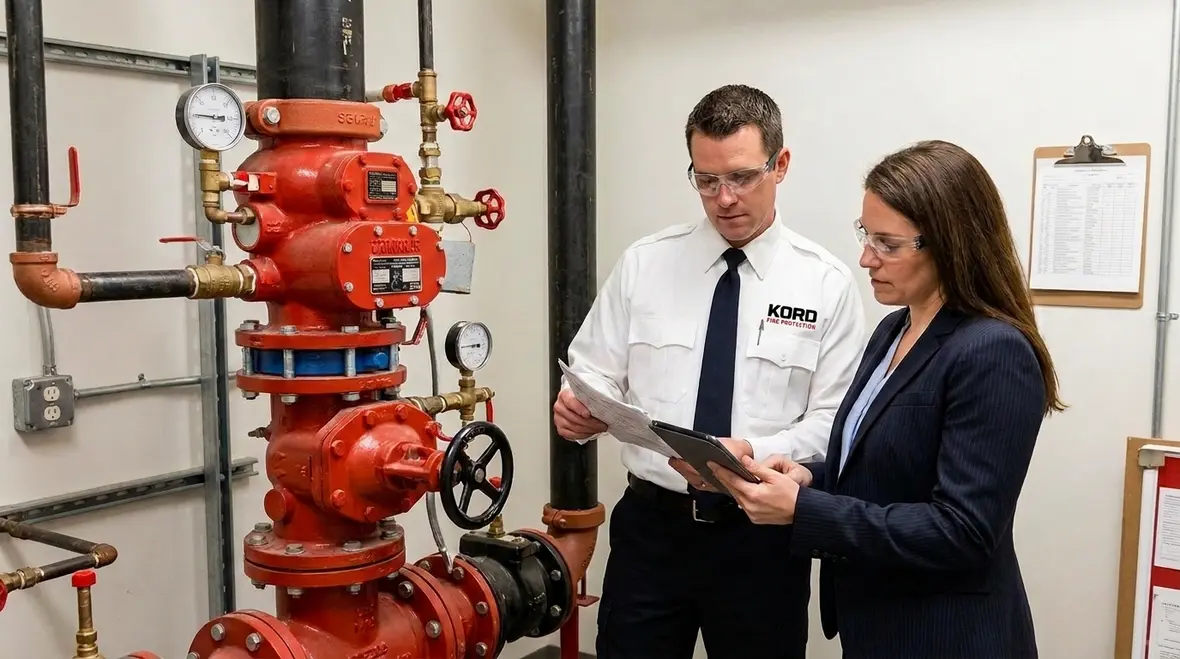
NFPA 25C Chapter 1 Administration: AHJ Authority Having Jurisdiction Explained
Quick Answer: NFPA 25C Chapter 1 establishes how the Authority Having Jurisdiction (AHJ) interprets, applies, and enforces inspection, testing, and maintenance requirements for commercial water based fire protection systems. The AHJ also coordinates approvals, clarifications, and enforcement actions that directly affect ongoing compliance.
What “AHJ authority having jurisdiction fire code” means in NFPA 25C Chapter 1
In NFPA 25C, the Authority Having Jurisdiction (AHJ) is the entity responsible for interpreting and enforcing the applicable fire code and referenced standards within a specific jurisdiction. When facilities use the NFPA 25C inspection, testing, and maintenance framework, the AHJ authority having jurisdiction fire code expectation drives how requirements are verified in the field, how documentation is reviewed, and when corrective actions become mandatory.
For commercial, industrial, and retail sites, this matters because the “letter” of the standard always meets “local practice.” Building departments, fire prevention bureaus, state inspectors, and private fire consultants authorized by insurers can apply NFPA 25C requirements with additional local constraints, schedules, or documentation formats. A facility that only follows minimum reading of the text can still fail during an AHJ review if it cannot demonstrate consistent, maintainable inspection and testing routines.
How NFPA 25C Chapter 1 assigns enforcement authority and decision making
NFPA 25C Chapter 1 Administration defines the administrative mechanics of the standard. It clarifies that the AHJ has authority to interpret provisions and to determine what constitutes acceptable compliance for the conditions found at the site. This includes decisions related to system readiness, test evidence, operational parameters, and whether specific deviations are permitted.
In practice, AHJ interpretation becomes visible in these recurring compliance touchpoints:
- Inspection and test acceptance criteria: The AHJ often verifies that results match the system design and installation intent. If testing reveals abnormal conditions, the AHJ expects documented corrective action and retesting.
- Documentation and record retention: The AHJ evaluates whether test reports and maintenance logs are complete, consistent, and traceable to the affected system component.
- Approval workflow: If changes, impairments, or alternative methods are proposed, the AHJ may require prior approval or additional justification.
- Scheduling and special circumstances: Jurisdictions may require sequencing that reduces risk during tenant operations, after-hours testing, or coordination with facility management.
Where AHJ review most often affects commercial sprinkler and fire protection operations
Water based fire protection systems in commercial facilities run on dependable mechanical performance plus disciplined inspection and maintenance. NFPA 25C helps facilities build that discipline, but AHJ authority influences how it is proven. The most common operational pain points appear where testing changes the state of equipment or where evidence must support safe operation.
1) Impairment control and readiness verification
When valves are closed, systems are taken out of service, or parts are replaced, the AHJ focuses on impairment risk management. Facility teams must maintain a clear impairment narrative: what was impaired, why it was necessary, what compensating measures were used, and how the system returned to normal service.
Common failure points include incomplete impairment permits, missing pre and post repair system verification, and documentation that does not tie the work to the affected system zone.
2) Test outcomes and corrective action thresholds
NFPA 25C includes inspection and testing activities that reveal real world degradation. Air or water delivery issues, abnormal pressure readings, and unexpected flow conditions can indicate clogged strainers, undersized or partially obstructed piping, sticking alarm devices, or leaking check components.
AHJ enforcement tends to escalate when test results show conditions that could prevent timely fire response. Commercial operators often slow down at the moment of corrective action: they repair, but do not complete full retesting, do not update as built data, or do not document the causal fix. The AHJ expects a closed loop between test evidence and the verified resolution.
3) Documentation integrity and audit readiness
During inspections, the AHJ authority having jurisdiction fire code expectation commonly includes a paper trail that can be audited quickly. Facilities that use multiple vendors, inconsistent reporting templates, or fragmented logbooks frequently struggle to produce a clean compliance story.
A best practice is to ensure every scheduled test maps to a component and a date, uses consistent terminology, and provides photos or measurement values when practical. This is especially relevant for commercial water based systems where evidence is tied to equipment mechanisms such as water supply flow, valve positions, alarm signaling, and control logic.
Practical compliance strategy for facilities: aligning NFPA 25C with AHJ expectations
Facility leadership can reduce enforcement risk by building a compliance program that anticipates AHJ questions before the inspection starts. This approach also improves operational stability, because it turns testing into a controlled maintenance cycle rather than a reactive event.
Set a written AHJ aligned inspection and testing plan
Even when the standard provides frequency guidance, sites differ by occupancy, hydraulics, water supply reliability, and tenant turnover. A strong plan defines scope per system and per zone, identifies responsible parties, and includes a documented process for reviewing test results.
For facilities building stronger service routines, Kord Fire Protection’s commercial fire sprinkler services page is a useful reference for how inspections, repairs, maintenance, and installation support long term compliance readiness.
For background on system installation scope and the maintenance implications of correct installation, Kord Fire Protection provides additional context here: NFPA 13 overview and automatic fire sprinkler system installation.
Use maintenance breakdown thinking to prevent recurring failures
Maintenance that prevents rather than replaces lowers test failures and reduces AHJ follow up. Operators benefit from organizing work by failure modes: water supply issues, valve hardware degradation, alarm device malfunction, pipe obstruction potential, and corrosion related impacts.
To support this failure mode approach for ongoing compliance, review: NFPA 25 overview: complete water based fire protection systems maintenance breakdown.
Account for regional code interactions and local enforcement differences
Local code requirements can change the practical implementation of inspections and testing. For example, state and local amendments can affect how requirements are interpreted, especially around retrofit expectations and documentation standards. When sites operate across multiple jurisdictions, uniform compliance becomes harder unless reporting and evidence standards are standardized.
For California specific enforcement context and how sprinkler and fire code expectations interact, see: Fire sprinkler code California explained.
Choose a service partner that can sustain audit ready evidence
Kord Fire Protection supports commercial customers by managing the inspection and maintenance process in a way that supports AHJ review: consistent test documentation, component level traceability, and maintenance actions that close the loop after abnormal readings. A reliable program also improves tenant confidence, reduces business interruption, and helps prevent system impairments from becoming prolonged events.
For additional technical industry resources, stakeholders also reference NFPA 25 fire pump testing requirements guidance to support understanding of water delivery equipment fundamentals that often appear in AHJ review outcomes.
What to expect during an AHJ encounter: process and evidence
When the AHJ conducts a review, the focus usually shifts from “what the standard says” to “what the facility can prove.” The most effective sites treat the AHJ visit as a verification meeting and have system evidence prepared in advance.
A practical expectation checklist includes:
- System inventory clarity: Identify which water based systems are present, their coverage areas, and any special control valves or equipment.
- Last inspection and testing records: Provide recent test reports by system component and date, including any abnormal findings and the corrective actions taken.
- Impairment history: Show how impairments were handled and how systems were restored to normal service with verification evidence.
- As built relevance: Confirm that the current system arrangement matches documentation used during testing and maintenance.
- Communication readiness: Provide a contact who understands the maintenance program and can answer questions about test results and maintenance history.
Facilities that prepare this evidence often reduce time on site and avoid the escalation that comes when documentation gaps force the AHJ to require additional testing or corrective action.
Frequently Asked Questions
Conclusion and Call to Action
Facilities that treat NFPA 25C Chapter 1 AHJ authority as an operational requirement, not a paperwork step, reduce risk during inspections and prevent recurring system failures. Kord Fire Protection helps commercial owners and managers build audit ready inspection, testing, and maintenance documentation tied to real equipment outcomes. Contact Kord Fire Protection to assess current compliance evidence, identify likely AHJ friction points, and build a sustainable maintenance and testing plan.

Join Our Newsletter!
Get the latest fire safety tips delivered straight to your inbox From our Newsletter.


