
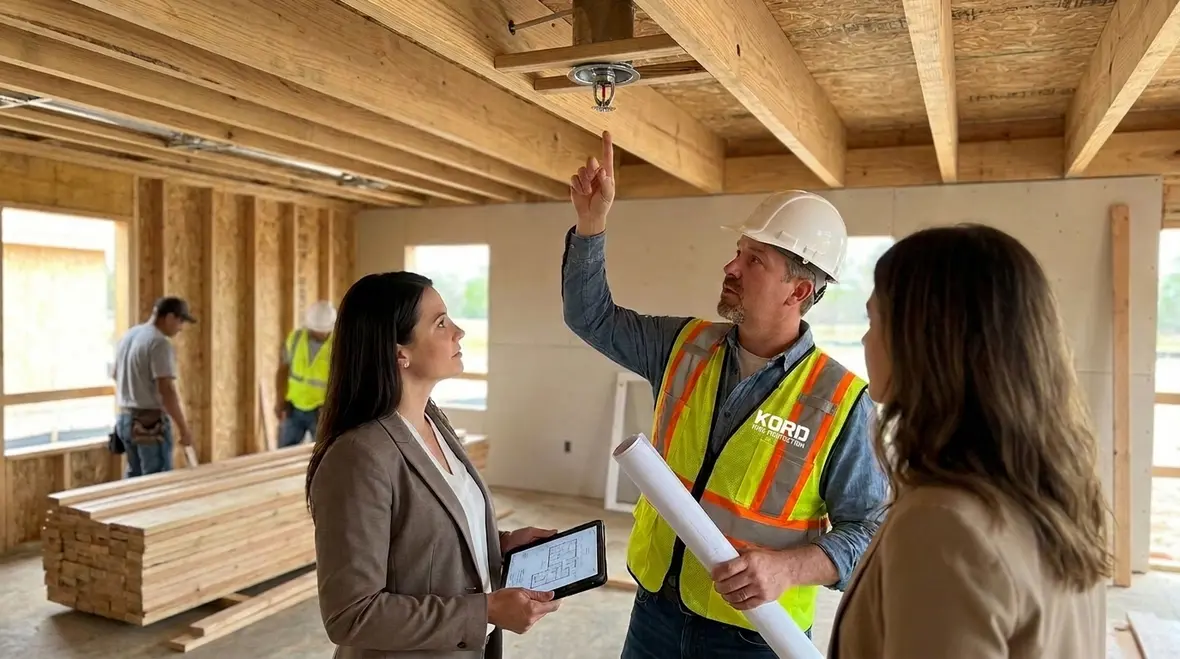
NFPA 13D Annex B: Builder and Developer Benefits of Residential Fire Sprinkler Adoption
Quick Answer
NFPA 13D Annex B explains why builders and developers adopt residential fire sprinklers using practical, project-level incentives. The annex supports risk reduction, smoother permitting conversations, and long-term cost control through improved fire outcomes. These builder and developer benefits residential fire sprinkler adoption incentives strengthen defensible code compliance strategies.
For teams planning installation scope and long-term upkeep, Kord Fire’s fire sprinkler system service page gives a practical look at design, installation, inspection, repairs, and maintenance working together as one managed program.
Why NFPA 13D Annex B matters to builders and developers
Residential fire sprinkler systems under NFPA 13D are engineered to control or suppress fire, limiting fire growth and reducing the likelihood of flashover and rapid untenable conditions. Annex B reinforces adoption by framing incentives from a stakeholder perspective, including builders, developers, and those managing multi year maintenance and service expectations.
In practical terms, NFPA 13D Annex B builder developer benefits residential fire sprinkler adoption incentives typically show up as improved development risk posture, fewer catastrophic loss events, and clearer expectations for inspectors, service technicians, and property owners. The annex also supports a more predictable life cycle cost narrative when jurisdictions or underwriting stakeholders ask for evidence of fire risk management.
What Annex B incentives look like on real projects
Annex B is structured around the rationale for adoption rather than system design changes. That distinction matters for builders and developers because it allows project teams to treat sprinklers as a managed scope decision with measurable outcomes.
1) Reduced loss potential and fewer severe fire outcomes
Residential sprinklers are designed to activate early when exposed to sufficient heat. The operational mechanism is straightforward: the heat responsive element triggers discharge over a localized area. That localized control reduces heat release rate, limits spread to adjacent spaces, and can shorten the time to survivable conditions.
From a developer lens, this translates into a stronger risk management story for lenders, owners, insurers, and asset managers who need defensible evidence of fire protection performance, not just intent.
2) Improved permitting and stakeholder alignment
Adoption often reduces friction during plan review because the development team has already standardized system components, installation practices, and documentation. When the building plan set consistently reflects NFPA 13D system features, inspectors focus on code compliance details instead of repeating baseline education each project.
For organizations managing commercial, industrial, and retail facilities alongside residential work, the same operational discipline pays off. Safety standards are easiest to maintain when documentation, inspection schedules, and corrective action processes are built once and reused across portfolios.
3) Predictable service and maintenance pathways
Even when a development is primarily residential, operational maintenance matters. Sprinkler systems require inspection, testing, and upkeep practices that avoid hidden deterioration, clogged components, or impaired discharge conditions. Annex B supports the idea that standardized adoption makes long-term service more reliable.
Maintenance planning also helps when properties transition from builder turnover to HOA control, property management, or commercial tenancy management. A controlled service approach reduces downtime and avoids emergency repair work.
Installation quality is the real determinant of performance
NFPA 13D adoption incentives are meaningful only when the system performs as intended. Quality starts before rough in and continues through close out documentation and acceptance testing.
Operational procedures that prevent common failure points
- Correct pipe sizing and pressure verification: Hydraulic performance relies on accurate routing, fittings selection, and system pressure characteristics. Deviations can cause delayed activation or insufficient coverage.
- Proper sprinkler placement and deflector clearance: Sprinklers must be installed at specified orientations and maintained clearance from obstructions to preserve spray pattern behavior.
- System cleanliness during construction: Debris and construction residues can enter piping and affect valves, water delivery paths, and discharge performance. Flushing procedures and caps protect the system during build.
- Reliable water supply interfaces: The water supply connection and any associated controls must be installed to function as designed, including ensuring accessibility and correct valve operation.
Acceptance testing and inspection realities
Builders and developers typically benefit most when acceptance testing is treated as a process, not a one time event. Operational checks include verifying system integrity, checking key components for damage, and documenting as built conditions. Close out packages should include manufacturer information, schematic drawings, and service instructions.
For teams scaling across many units, repeatable inspection checklists reduce rework, shorten correction cycles, and support consistent performance outcomes.
How builders can handle inspection and compliance challenges
Residential sprinkler adoption increases coordination demands during construction. Those challenges become manageable when teams standardize how they respond to plan review and field verification.
Coordination challenges common in multi trade construction
- Coordination with HVAC, ductwork, and recessed lighting: Obstructions can interfere with spray patterns and create coverage compromises if not managed early.
- Schedule compression: Compressed timelines increase the risk of missed rough in steps, inadequate flushing, or incomplete labeling.
- Documentation gaps: Missing as built details and incomplete component records complicate future service and inspections.
Commercial facility standards that reinforce residential consistency
Commercial, industrial, and retail facilities often operate under stricter inspection and maintenance expectations. When builders align sprinkler adoption practices with the same discipline used in commercial facility standards, they reduce life cycle surprises after turnover.
For a broader sprinkler installation approach, including system overview considerations and installation planning, review this resource: NFPA 13 overview and automatic fire sprinkler system installation. While the design references differ between NFPA 13 and NFPA 13D, the project workflow logic and documentation discipline remain highly transferable.
For builder and developer teams seeking portfolio wide reliability, Kord Fire Protection supports installation quality controls, documentation readiness, and ongoing compliance support through structured inspection and maintenance pathways.
Turnkey compliance support: where Kord Fire Protection fits
Adoption incentives in Annex B drive business value only when systems remain compliant and functional over time. Kord Fire Protection positions as a service partner that helps organizations keep sprinkler systems in reliable operating condition through inspection, testing, and maintenance execution.
Maintenance and inspection mechanisms that protect performance
- Component verification: Service confirms that sprinkler components, fittings, and associated controls remain intact and unobstructed.
- Operational checks of key assemblies: Service verifies functional operation paths so water delivery remains reliable.
- Documentation and traceability: Ongoing record keeping supports inspections and reduces repair ambiguity when tenants or owners change.
Why this matters during portfolio turnover
One of the most frequent operational gaps occurs after build completion, when property management transitions responsibility without a structured handoff. Kord Fire Protection helps close that gap by aligning service plans with the inspection cadence expected by stakeholders in facilities where compliance is audited.
Frequently Asked Questions
Call to action
If your next development targets smoother permitting, stronger risk management, and predictable life cycle compliance, treat NFPA 13D adoption as a managed program. Engage Kord Fire Protection early for documentation readiness, installation quality verification, and ongoing inspection and maintenance planning. Build the sprinkler scope once, maintain it consistently, and protect property value through reliable compliance performance.

Join Our Newsletter!
Get the latest fire safety tips delivered straight to your inbox From our Newsletter.



