NFPA 52 Section 21.11: Pressure Gauging and Control for LNG Containers
Quick Answer: NFPA 52 Section 21.11 establishes how LNG container pressure must be measured, displayed, and controlled to support safe operation. It focuses on gauge function, siting and protection, control logic reliability, and inspection and maintenance practices that prevent unsafe pressure excursions.
The NFPA 52 LNG pressure gauging control requirements in Section 21.11 matter because LNG container pressure drives temperature stability, relief system performance, and safe operating margins. For commercial facilities, compliance failures usually come from instrument degradation, improper calibration, damaged sensing lines, or control setpoint drift that goes unnoticed until a trend becomes an emergency.
Facilities working through related LNG compliance issues often benefit from reviewing ignition source control at LNG sites, since pressure behavior, hazardous area controls, and inspection discipline tend to overlap in the real world. Kord Fire Protection also provides commercial fire safety services that support documentation, testing workflows, and audit readiness across regulated systems.
Why pressure gauging and control in LNG containers becomes a safety-critical system
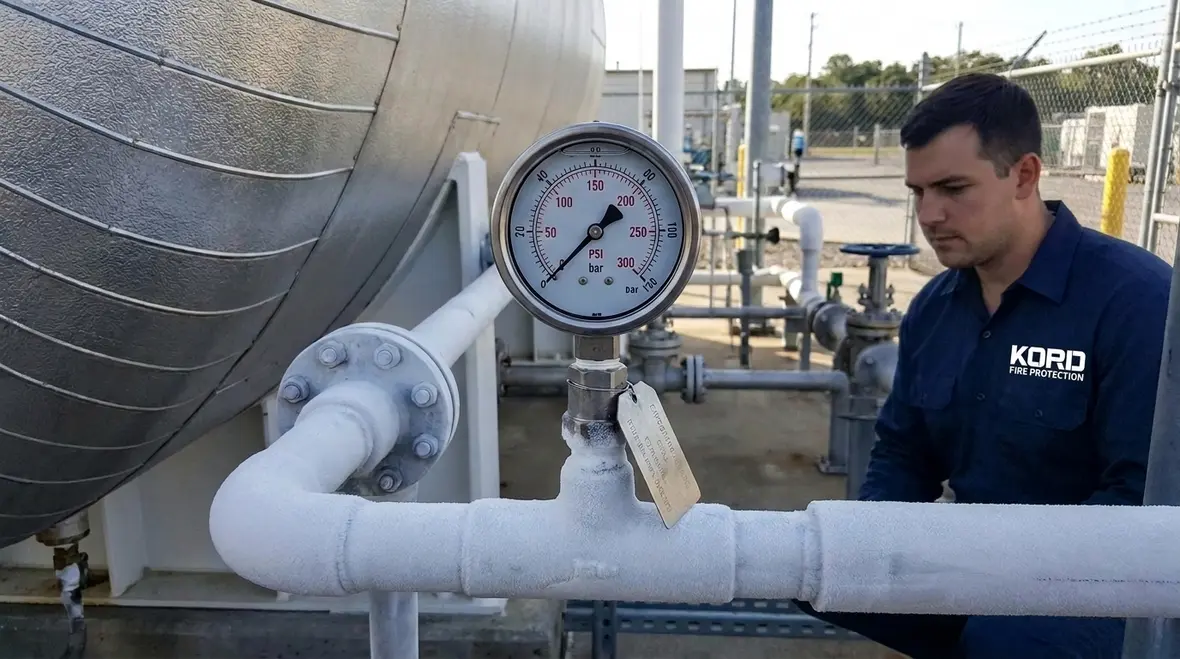
Pressure gauging and control do more than provide operators with a reading. In LNG service, pressure measurement informs how the system limits boil off, manages thermal conditions, and avoids conditions that could force reliance on emergency relief. Section 21.11 therefore addresses the entire chain, from sensor location and connection integrity to the reliability of control actions and the ongoing verification of gauge performance.
Commercial, industrial, and retail LNG sites often operate under tight uptime expectations. That makes disciplined inspection, calibration, and maintenance workflows essential. When instruments are treated like “set and forget” components, small errors compound into unsafe operating behavior.
What NFPA 52 Section 21.11 covers for LNG container pressure measurement and control
Section 21.11 focuses on pressure gauging and control arrangements used on LNG containers. The intent is to ensure that pressure information remains accurate, available, and protected, and that control functions respond predictably during normal operations and foreseeable upset conditions.
Key compliance objectives facilities must meet
- Reliable pressure indication through appropriate pressure sensing and gauge performance.
- Protected instrumentation that resists impact, vibration damage, and environmental degradation.
- Control system dependability so that control actions occur at the correct pressures and with adequate repeatability.
- Ongoing verification through inspection and testing practices that confirm calibration and functional performance.
From a practical standpoint, “compliant” means the instruments provide correct readings and the control devices act correctly when readings reach defined thresholds. It also means facilities can demonstrate that verification happens at the correct interval and with documented results.
How gauges, sensors, and control actions should work in real operations
In LNG container applications, pressure sensing must handle cryogenic service conditions and avoid measurement errors caused by trapped vapor, incorrect impulse line configuration, or sensor drift. Control actions based on pressure require a stable signal path and robust settings management, including how setpoints are established and protected against unauthorized changes.
Pressure measurement chain that commonly drives audit findings
- Sensing element condition: Degradation of sensing diaphragms, corrosion or embrittlement effects, and drift in transducer outputs.
- Impulse line integrity: Blockage, leakage, or improper routing can distort readings and create delayed response.
- Signal and display accuracy: Mismatch between what operators read and what the control logic uses, especially after upgrades or replacements.
- Control response behavior: Control valves, relays, controllers, and interlocks must respond within expected tolerances.
Common failure points facilities should actively manage
- Calibration gaps: Gauges or transmitters recalibrated irregularly or with incomplete documentation.
- Damaged sensing hardware: Physical impacts to sensors, loose fittings at cryogenic connections, and compromised insulation that leads to condensation or freezing issues.
- Configuration drift: Control setpoints modified during maintenance without formal change control.
- Discrepancy between indicator and control: Operators rely on a gauge while the control logic relies on a different transmitter or scaled input.
Inspection, testing, and maintenance: the part that keeps compliance sustainable
NFPA 52 Section 21.11 compliance depends on verification activities, not just initial installation. Commercial owners and operators typically need a repeatable process that aligns with facility risk, manufacturer guidance, and the inspection expectations commonly assessed during safety reviews.
What a strong compliance program looks like
- Documented calibration and functional testing for gauges and transmitters.
- Impulse line inspection where applicable, including checks for blockage and proper connection integrity.
- Control logic verification to confirm that control actions occur at the intended thresholds.
- Protection and housekeeping to prevent physical damage and environmental exposure from degrading instrumentation.
- Maintenance traceability with work orders, calibration certificates, and change control records.
Facilities that manage multiple LNG assets often find that consistent procedures reduce variability across shifts and contractors. Kord Fire Protection supports owners with inspection planning, documentation discipline, and ongoing testing support for systems that must perform reliably under audit scrutiny.
For additional technical resources related to compliance documentation workflows, see Kord Fire Protection’s guidance here: Kord Fire Protection commercial fire safety services.
Commercial compliance challenges that affect NFPA 52 LNG pressure gauging control requirements
Even well-designed pressure gauging systems can drift out of compliance due to operational realities. Retail fueling environments, industrial process facilities, and commercial LNG sites often face rapid maintenance cycles, vendor swaps, and equipment modifications that change the measurement and control behavior over time.
Three high-impact operational pressures
- Uptime constraints: Scheduling calibration windows late in a cycle increases the risk of incomplete testing or delayed corrective actions.
- Staff turnover and shift handoffs: If procedures and acceptance criteria are not standardized, errors in interpretation and documentation increase.
- Instrument substitutions: Replacements with different ranges, scaling factors, or signal types can create unrecognized differences between indicator and control logic.
What inspectors and auditors look for
- Clear evidence of accuracy verification for gauging devices.
- Proof that control setpoints and behavior align with the safety basis.
- Repeatable records that demonstrate inspection and maintenance occurred when required and with correct test methods.
- Evidence of protection from damage and that instruments remain in approved condition.
When these elements are missing, facilities can appear compliant on paper while operating with degraded measurement certainty. That gap is precisely where Kord Fire Protection helps teams reduce risk through practical, ongoing service support.
Practical compliance checklist for pressure gauging and control systems
The following checklist helps commercial operators translate NFPA 52 expectations into day to day execution. It supports internal audits, contractor oversight, and maintenance scheduling.
| Area | What to verify | Documentation to keep |
|---|---|---|
| Gauges and transmitters | Calibration status, range match, and functional accuracy | Calibration certificates and test results |
| Impulse lines and connections | Leak integrity, routing condition, and obstruction prevention | Inspection notes and corrective work orders |
| Control logic and setpoints | Setpoint integrity, interlock function, and response timing | Configuration change records and functional test evidence |
| Protection and physical condition | Damage resistance, secure mounting, and environmental exposure control | Visual inspection reports and deficiency tracking |
Using this checklist as a baseline, facilities can standardize how crews validate NFPA 52 LNG pressure gauging control requirements across devices, locations, and service vendors.
Frequently Asked Questions
Get NFPA 52 pressure gauging compliance support you can defend
Pressure gauging and control systems require more than installation. They require verification, disciplined documentation, and maintenance that protects accuracy over time. Kord Fire Protection helps commercial LNG operators plan inspections, manage testing workflows, and maintain records that stand up during safety reviews. Contact Kord Fire Protection to evaluate your current pressure gauging setup, identify gaps, and build a practical compliance maintenance plan for ongoing readiness.

Join Our Newsletter!
Get the latest fire safety tips delivered straight to your inbox From our Newsletter.