
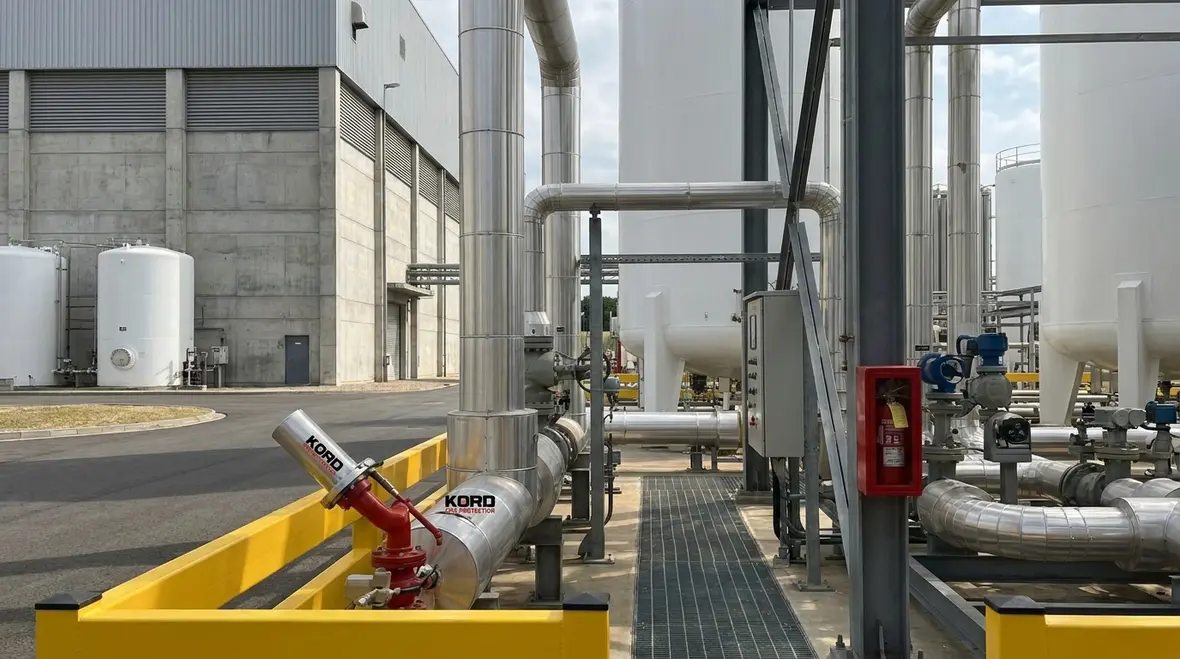
NFPA 52 Section 19.6: LNG Supplemental Siting and Construction Requirements
Quick Answer
NFPA 52 Section 19.6 establishes how LNG facilities must be located and built when additional or supplemental arrangements are used beyond baseline siting and construction provisions. It focuses on hazard control, separation from exposures, build quality, component selection, and verification practices that support safe operation.
For facilities that need a practical view of inspection readiness and acceptance verification, Kord Fire Protection’s NFPA 20 Chapter 14 fire pump acceptance testing requirements resource offers a useful example of how documentation, testing logic, and field verification come together on real projects.
What NFPA 52 Section 19.6 is trying to prevent
NFPA 52 treats LNG as a high-consequence hazard because failures can release flammable vapor, generate rapid pressure and heat effects, and create ignition and fire propagation risks. Section 19.6 addresses “supplemental” LNG siting and construction scenarios, where commercial owners may expand, modify, or add arrangements that still must remain compatible with the overall fire protection intent.
In practical terms, the NFPA 52 LNG supplemental siting construction requirements drive owners to think in layers: where equipment sits, how it is protected, how it is built to avoid common failure modes, and how systems are verified to operate as designed throughout the life of the facility.
When Section 19.6 applies to commercial projects
Section 19.6 typically becomes relevant when a facility uses additional siting and construction measures, adds capacity, changes the configuration, or introduces supplemental arrangements that affect how hazards are managed. Commercial, industrial, and retail operators commonly encounter these triggers during:
- Tank or equipment additions that alter separation distances and exposure profiles
- Piping reroutes that change potential leak points and ignition likelihood
- Building-adjacent or site-adjacent LNG placement where existing facility constraints influence design
- Turnkey vendor substitutions or value engineered equipment that can affect compliance assumptions
For compliance teams, the main challenge is that supplemental design decisions often happen in parallel across engineering, procurement, and construction. Section 19.6 requires consistency between the hazard analysis, the final layout, and the as-built construction. Kord Fire Protection supports the “design to field verification” gap through documentation review, inspection planning, and ongoing maintenance program alignment.
How supplemental siting requirements reduce ignition and exposure risk
Supplemental siting requirements focus on controlling where LNG hazards can impact people, buildings, and critical property. In a commercial environment, this frequently means managing the relationship between LNG equipment and:
- Public and noninvolved areas
- Operating areas with higher occupant activity
- Adjacent structures, storage, parking, loading zones, and utility corridors
- Potential ignition sources such as electrical panels, engines, motors, and hot work locations
Operationally, siting compliance is not only about static distance. It also includes how wind patterns, grade changes, drainage, and physical obstructions can affect vapor accumulation. Supplemental siting solutions must remain effective under normal operations and reasonably anticipated abnormal events such as minor leaks, line depressurization, or delayed ignition detection.
Common compliance failure points during siting
- As-built layout drift: Field changes move equipment, affect separation, or alter access routes without updating the hazard basis.
- Utility corridor conflicts: Cable trays, manifolds, and vents get relocated, changing exposure paths and ignition risk zones.
- Drainage and collection surprises: Grade and containment assumptions do not match real site conditions.
- Access route constraints: Fire service access or inspection pathways become blocked by later tenant improvements.
Construction requirements: what “built to code” must mean on site
Section 19.6 construction requirements aim to ensure LNG equipment and associated systems are installed and assembled in a way that prevents premature degradation, uncontrolled leak behavior, and ineffective mitigation. In commercial and industrial settings, “built correctly” depends on more than materials and specifications. It depends on installation mechanics and quality assurance.
Installation and workmanship controls that matter
Owners typically need to confirm that construction details support safe operation under cryogenic conditions. Key control areas include:
- Welding and joint integrity: Welding procedures and qualification, plus inspection of critical joints, directly influence leak likelihood.
- Valve and connection selection: Correct materials and pressure-temperature ratings reduce brittle failure and gasket incompatibility.
- Support and anchorage: Proper support geometry limits mechanical stress and prevents alignment drift that can stress seals and flanges.
- Thermal management: Insulation continuity and cryogenic protection reduce heat transfer that can undermine containment strategy.
- Electrical classification and bonding: Incorrect grounding or damaged enclosures increase ignition potential and fault risk.
From a fire protection perspective, construction compliance also affects how mitigation systems work. If detection placement, cable routing, or panel locations do not match the design intent, detection may fail to trigger ventilation, shutdown, or alarming quickly enough to manage vapor and ignition risk.
Testing, commissioning, and acceptance verification
Supplemental siting and construction requirements must be verified through acceptance testing and commissioning steps that reflect real operational logic. Common acceptance artifacts include:
- As-built drawings showing final separation, elevations, and routing
- Inspection and test reports for critical components (pressure systems, relief paths, alarms)
- Calibration records for detection, monitoring, and shutdown systems
- Documentation for construction deviations and formal change control
Kord Fire Protection helps organizations ensure that verification is not a checkbox. The focus stays on whether systems can actually perform under field conditions and whether maintenance teams will be able to inspect and test them reliably over time.
Maintenance and inspection: the compliance lifecycle after turnover
Many LNG incidents begin long after initial construction. Section 19.6 expectations continue through operations because supplemental arrangements can create unique inspection pathways, access constraints, and failure points. Commercial facilities often add tenants, rearrange material staging, or update landscaping, which can unintentionally alter clearance and inspection effectiveness.
To keep compliance durable, facilities should implement a maintenance program that includes:
- Scheduled inspections for cryogenic insulation condition, supports, and visible corrosion or damage
- Detector functional checks aligned with documented logic and setpoints
- Testing of shutdown and alarm circuits to confirm coordinated response under realistic scenarios
- Relief system and vent path verification to ensure pathways remain unobstructed
- Access management for clear paths to valves, panels, sampling points, and fire protection interfaces
For teams managing multiple commercial assets, the biggest practical obstacle is maintaining a consistent inspection standard across contractors and shifts. Kord Fire Protection supports reliable ongoing compliance by aligning field inspection methods with the facility’s specific supplemental siting and construction basis, then translating that into actionable checklists and maintenance practices.
For additional context on how fire protection professionals evaluate system readiness and inspection performance, refer to Kord Fire Protection resources at Kord Fire Protection.
Facility managers checklist: implementing NFPA 52 Section 19.6 readiness
Facilities that handle supplemental LNG arrangements can use a focused checklist to reduce last minute compliance surprises. The goal is to confirm that the final configuration matches the safety case, the construction details support safe operation, and the ongoing maintenance plan preserves that outcome.
| Area | What to confirm | Typical operational risk if missed |
|---|---|---|
| Siting alignment | As-built separation, elevations, and access routes match the approved hazard basis | Vapor accumulation in unexpected zones and delayed intervention |
| Ignition control interfaces | Electrical enclosures, bonding, and equipment placement remain as designed | Higher probability of ignition during a release |
| Construction workmanship | Joint integrity, proper supports, insulation continuity, and correct materials | Leak likelihood and accelerated component degradation |
| Commissioning verification | Detection and shutdown logic, alarms, and test results reflect installed conditions | Systems fail to respond with the needed speed and coordination |
| Maintenance access | Inspections can be performed without obstructing valves, panels, or vent paths | Undetected degradation and inaccessible critical components |
Frequently Asked Questions
Conclusion and call to action
NFPA 52 Section 19.6 requires more than design intent. It demands that supplemental LNG siting and construction are verified as-built, commissioned correctly, and maintained so safety functions remain effective throughout operations. For commercial owners, Kord Fire Protection helps close the gap between engineering assumptions and field reality through compliance-focused inspection planning, documentation review, and ongoing maintenance support. Contact Kord Fire Protection to validate your Section 19.6 readiness and reduce compliance risk before issues become operational problems.

Join Our Newsletter!
Get the latest fire safety tips delivered straight to your inbox From our Newsletter.


