NFPA 52 Section 16.1 Application: LNG Site Safety, Fire Protection, and Gas Detection Coverage
Quick Answer: NFPA 52 Section 16.1 sets the framework for how LNG facilities apply safety measures, including fire protection and gas detection, to control ignition sources, limit hazardous conditions, and support emergency response. Proper coverage depends on risk-based area classification, system performance, and disciplined maintenance.
Facilities managing fire protection program demands across multiple systems can also review fire protection services in Southern California for a broader view of inspection, testing, troubleshooting, and repairs that support ongoing compliance. Kord Fire also provides methane gas detection and related fire protection services that fit naturally into risk-based site safety planning.
Why Section 16.1 Matters for the NFPA 52 LNG site safety fire protection application
NFPA 52 Section 16.1 supports LNG facility safety by aligning fire protection, detection, and emergency readiness with the facility’s hazards. In practice, the NFPA 52 LNG site safety fire protection application must translate into verifiable system coverage, documented inspection and testing, and operational controls that keep gas hazards from escalating into a fire or explosion scenario.
Compliance teams often focus on design documentation, but regulators and insurance underwriters look for operational proof: equipment functionality, alarm and shutdown performance, calibration integrity, and response readiness. These expectations create a continuous maintenance and verification burden that many commercial, industrial, and retail-adjacent facilities underestimate when commissioning is complete.
What Section 16.1 “application coverage” usually requires on-site
Section 16.1 application language generally drives the facility to ensure safety functions cover the right locations, hazards, and operating modes. That includes both fixed fire protection systems and gas detection systems that trigger alarms, mitigate progression, and support evacuation or shutdown actions. Successful applications typically address four operational pillars.
1) Defined hazard areas and credible release scenarios
Facilities must identify where an LNG release could produce a flammable mixture and where ignition could occur. That identification affects detector placement, coverage boundaries, alarm zoning, and the logic behind automatic shutdown or ventilation actions.
2) Detection and alarm performance aligned to risk
Gas detection systems must be able to identify hazardous concentrations quickly enough to support safe actions. Coverage is not only “how many sensors,” but also how the system behaves during normal operation, startup, maintenance bypass, calibration, and abnormal environmental conditions.
3) Fire protection coverage that supports incident control
Fire protection functions may include fixed detection-integrated suppression, water deluge strategies, shielding and protection of critical equipment, and emergency access support. The fire protection plan must account for LNG-related heat release risks, cooldown or chilling conditions, and the practicality of protecting key assets during emergency operations.
4) Emergency response enablement and system interlocks
Section 16.1 application outcomes often depend on reliable interlocks, clear alarm management, and documented response procedures. Interlocks that fail to operate as designed, or alarm delays caused by configuration drift, can defeat the intent of the safety system.
How NFPA 52 fire protection and gas detection coverage is implemented operationally
The most common compliance gaps appear when documentation and field performance diverge. A strong NFPA 52 LNG site safety fire protection application requires operational controls that keep both detection and fire protection aligned over the facility lifecycle.
Detector placement, environmental impacts, and coverage proof
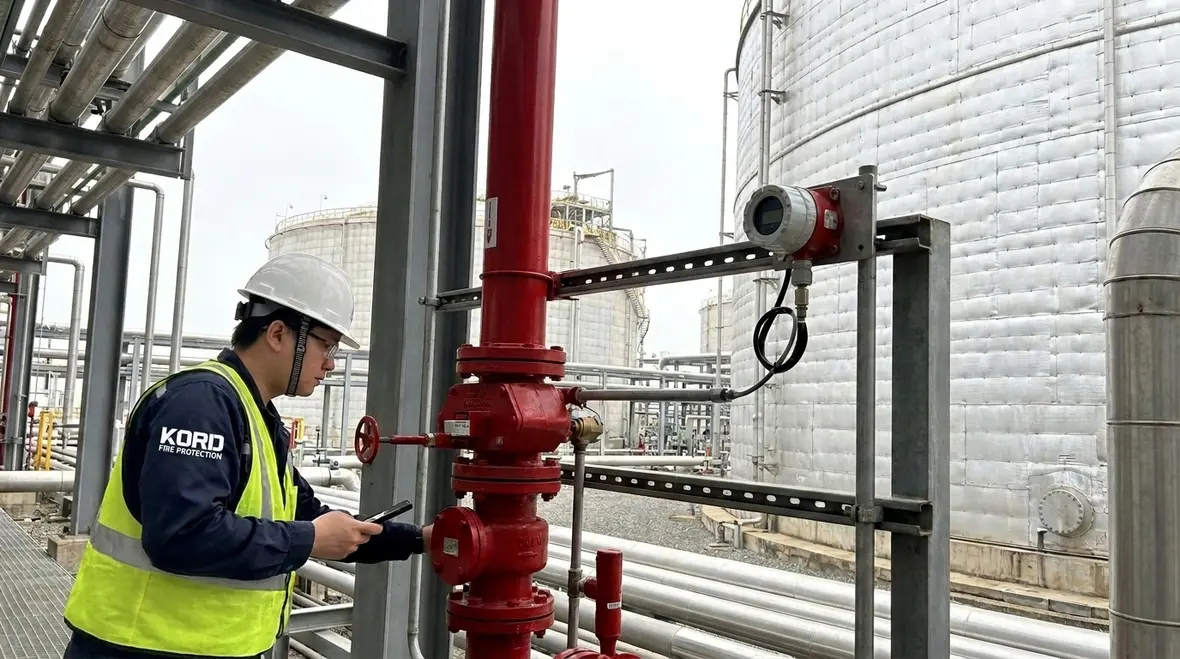
Technicians must confirm that detectors remain positioned, unobstructed, and functional under real operating conditions. Common failure points include contamination, paint overspray, sensor exposure to solvents or cleaning agents, sensor drift, and sampling line issues when applicable.
Facilities should support ongoing coverage validation with practical checks such as response function verification during scheduled maintenance windows, alarm setpoint verification where required, and evidence that the alarm response routing reaches responsible personnel.
Alarm logic, zoning, and “what happens next”
Detectors only provide value when the system alarm and control logic reliably drives the intended safety actions. That typically includes:
- Clear mapping of detector or zone to annunciation.
- Defined operator actions and escalation steps.
- Automatic actions such as shutdown, ventilation control, or emergency procedures where applicable.
- Alarm management that prevents nuisance alarms from degrading response discipline.
Interlocks and shutdown performance under abnormal conditions
Interlocks that depend on power quality, network communications, or control system dependencies must be tested for realistic failure modes. A common oversight is treating the interlock as “commissioned once” rather than maintaining test schedules that confirm ongoing performance.
Inspection, testing, and maintenance expectations that keep coverage defensible
Section 16.1 application compliance is sustained through disciplined maintenance. The difference between passing and failing is often the maintenance record quality, not the original equipment selection.
Gas detection maintenance and calibration controls
Good programs include calibration procedures with documented gas cylinder traceability, acceptance criteria for sensor response time, and verification that the system returns to normal operation after maintenance. Facilities should also control bypasses carefully, with strict time limits and approvals.
Where devices include controllers, junction boxes, sampling systems, or networked monitoring, technicians should verify:
- Sensor health status, fault reporting, and trouble signal routing.
- Connectivity and data integrity for annunciation and control.
- Linearity and stability against the facility’s documented thresholds.
- Correct software configuration and event logs.
Fire protection inspection integrity and operational readiness
Fire protection systems must remain capable of performing during an emergency. That includes verifying readiness status, field device condition, and functional performance where the standard requires it. Common failure points include valve position drift, corroded components, clogged strainers, inhibited deluge readiness, and blocked drains or discharge pathways.
Just as importantly, facilities need practical evidence that personnel can actuate manual response and manage emergency controls under stress.
Documentation, records, and audit readiness
Commercial LNG environments frequently experience audits from AHJs, internal risk management teams, and third-party insurers. Records should connect each asset to its test procedure, date, results, acceptance criteria, and corrective actions. When calibration or repairs occur, the facility should show verification that the system returned to an acceptable safety state.
Common compliance challenges in the NFPA 52 LNG site safety fire protection application
Even well-designed systems fail in the field due to operational drift, maintenance gaps, and unclear ownership. The following issues repeatedly surface during compliance reviews.
1) Under-scoped coverage versus real operating modes
Facilities sometimes design detection and fire protection coverage for one normal condition, then change operating patterns without updating hazard assessments or maintenance frequencies. Updates in routing, equipment additions, or temporary works can alter release behavior.
2) Deferred calibration and “out of service” time creep
Calibration deferrals create drift and reduce confidence in alarm performance. Similarly, prolonged device bypasses increase the chance that a fault remains unnoticed until a true emergency.
3) Alarm fatigue and incomplete escalation paths
Nuisance alarms lead to reduced attention. When escalation paths are unclear, teams lose valuable seconds during the early incident phase.
4) Lack of integrated testing between detection and fire protection
Detection and fire protection are often maintained by different teams with different schedules. Integrated verification confirms that the full safety chain works as intended, including control inputs and outputs.
Why Kord Fire Protection supports ongoing Section 16.1 compliance
NFPA 52 LNG site safety fire protection application success depends on more than installation drawings. It depends on ongoing performance verification, disciplined inspection and testing, and maintenance documentation that stands up to audits. Kord Fire Protection supports facilities with practical, schedule-driven testing and maintenance workflows designed to reduce operational drift and keep safety systems aligned with current risk realities.
For facility teams that need a streamlined approach to maintaining detection reliability and fire protection readiness, Kord Fire Protection provides experienced support across the compliance lifecycle. Learn more by reviewing Kord Fire Protection.
Frequently Asked Questions
Conclusion and Call to Action
To implement the NFPA 52 LNG site safety fire protection application effectively, facilities must treat Section 16.1 as an operational system, not a one-time design requirement. Conduct coverage verification, maintain disciplined calibration and testing, and confirm detection to fire protection performance through integrated checks. Engage Kord Fire Protection to strengthen audit readiness with reliable maintenance support, clear documentation, and performance-driven schedules. Contact Kord Fire Protection today to assess your current safety system readiness and maintenance program alignment.

Join Our Newsletter!
Get the latest fire safety tips delivered straight to your inbox From our Newsletter.