
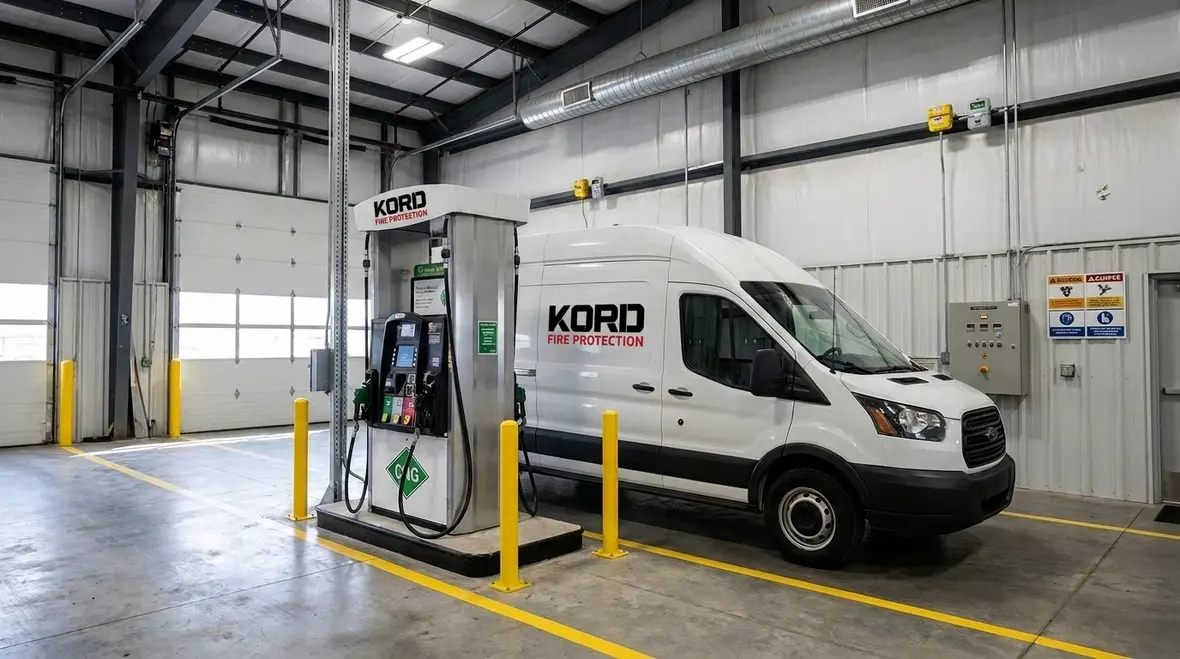
NFPA 52 Section 11.3: CNG Supplemental Requirements for Indoor Stations
Quick Answer: NFPA 52 Section 11.3 adds supplemental safety provisions for indoor CNG fueling stations. These requirements address ventilation, ignition control, equipment siting, leak detection, emergency response, and inspection readiness. Compliance depends on documented installation quality and ongoing maintenance to keep hazards controlled over time.
For broader documentation and inspection workflow planning, facilities can also review fire protection compliance auditing guidance from Kord Fire Protection to support the recordkeeping and verification side of indoor station readiness.
Why NFPA 52 indoor CNG supplemental requirements matter for indoor stations
Indoor CNG stations operate in environments that can trap gas if a release occurs. That is why NFPA 52 indoor CNG supplemental requirements in Section 11.3 focus on preventing ignition, controlling ventilation and accumulation, and ensuring detection and shutdown functions work when conditions change. For commercial, industrial, and retail facilities, the practical challenge is that compliance is not a one-time installation task. It becomes a lifecycle program that must match tenant operations, building management practices, and the realities of wear, dust, corrosion, and electrical degradation.
What Section 11.3 typically requires for indoor station hazard control
Section 11.3 supplements the baseline fueling station requirements by raising expectations for how the system prevents ignition sources and limits the consequences of a release. While exact wording depends on the station configuration, inspectors generally look for consistent implementation across several functional areas.
1) Air movement, ventilation performance, and accumulation prevention
Indoor CNG supplemental requirements commonly center on maintaining ventilation that can manage a credible release. The facility must demonstrate that air movement supports gas dilution and removal so that flammable mixtures do not form in protected areas.
Common compliance failure points:
- Ventilation fans installed but not integrated with the station controls and shutdown logic.
- Inadequate placement of ventilation intakes and exhaust paths, especially where turbulence and recirculation occur.
- Filters, louvers, or dampers that degrade airflow over time without an inspection trigger.
- Documentation gaps showing ventilation design basis and as-built verification.
Operational expectation: The station should operate with a documented ventilation strategy and a maintenance plan that confirms airflow and control responses at practical intervals.
2) Ignition source control in classified or hazardous locations
Indoor spaces demand stricter ignition control because a release can concentrate in pockets. Section 11.3 supplemental provisions generally require appropriate equipment selection and installation practices for environments where flammable concentrations may develop.
Key controls typically verified:
- Electrical equipment selection and proper wiring methods that align with the intended hazardous area classification approach.
- Control system components located to minimize the likelihood of ignition during a release.
- Prohibited ignition sources managed by design and monitored operational procedures.
- Bonding and grounding continuity where required to address static and electrical hazards.
Failure mode to watch: Retrofitted building equipment, replacement motors, or maintenance changes that introduce nonconforming components after commissioning. These changes often bypass the station hazard review and create hidden compliance drift.
3) Leak detection and automatic shutdown readiness
For indoor stations, leak detection and shutdown performance becomes a core risk control. Section 11.3 generally expects that detection capabilities and control actions are reliable, tested, and maintained.
What inspectors tend to verify:
- Sensor placement that reflects air stratification, airflow patterns, and credible release pathways.
- Alarm setpoints and interlock behavior that drive ventilation and shutdown actions as designed.
- Functional testing records showing detector response checks and calibration where applicable.
- Correct wiring, housekeeping around detectors, and protection from physical damage.
Common failure points: Sensors that drift out of calibration, obstructions that alter local airflow, or control logic overrides that remain enabled after maintenance work.
How to implement Section 11.3 in commercial facilities without creating “compliance drift”
Commercial facilities rarely stay static. HVAC upgrades, tenant buildouts, dock work, and electrical modifications can change airflow, access, and equipment performance. The result can be a station that once met NFPA expectations but no longer maintains the design intent.
Build a practical compliance management workflow
- Pre-job hazard review: Require a station-specific review for any electrical, ventilation, or equipment replacement work.
- As-built document control: Maintain a living set of drawings, control diagrams, and component lists for the indoor station.
- Defined maintenance scopes: Assign responsibility for detector checks, ventilation inspection, alarm verification, and interlock functional tests.
- Training refresh cycles: Ensure facility operators understand what alarms mean and which actions are required before reset.
Align station controls with building management systems
Indoor stations often interface with facility controls for ventilation and monitoring. This can create a compatibility challenge when facility software updates or building setpoints change.
Critical integration checks:
- Interlock logic must not rely on a building schedule or occupancy mode that can mask a required response.
- Alarm routing must provide actionable information to onsite responders and maintenance staff.
- Change-control procedures must treat the station interface as a safety-critical system.
When station interfaces are managed as part of a broader facility program, risk controls remain intact and NFPA 52 indoor CNG supplemental requirements stay meaningfully implemented, not just documented.
That same coordination issue shows up in wider building controls too, which makes fire protection system integration with building automation controls a useful related read when indoor station alarms, ventilation, and monitoring have to behave like one sane plan instead of five separate opinions.
Inspection, testing, and maintenance: what “good” looks like in Section 11.3 compliance
Compliance depends on verified performance. For indoor stations, the most consequential issues often appear during routine inspection and maintenance rather than during initial installation.
Recommended verification categories for indoor station readiness
| Functional Area | What to Verify | Why It Matters Indoors |
|---|---|---|
| Ventilation performance | Airflow condition, damper response, fan operation, obstructions | Prevents accumulation and limits flammable mixtures |
| Gas detection | Detector status, calibration condition, alarm outputs | Detects releases early and initiates protective actions |
| Automatic shutdown and interlocks | Functional response to alarm and release simulations | Stops fueling and limits hazard escalation |
| Ignition source controls | Equipment status, wiring integrity, hazard area compliance | Prevents ignition of released gas |
| Housekeeping and access | Detector cleanliness, protected routing, clear access to components | Prevents hidden failures and delayed response |
Where maintenance work most often breaks compliance
- Detector obstructions: Dust loading, ceiling storage, or temporary barriers.
- Unplanned replacements: Like-for-like assumptions that fail when upgraded equipment has different operating characteristics.
- Control overrides: Alarm silencing during maintenance that is not removed afterward.
- Ventilation changes: Building HVAC balancing or weatherproofing work that alters airflow pathways.
To reduce these risks, Kord Fire Protection supports commercial owners and facility teams with ongoing inspection planning, verification of critical safety functions, and maintenance support that protects both life safety and operational continuity.
Working with fire protection professionals: how Kord Fire Protection supports ongoing compliance
Indoor CNG stations require coordinated performance across detection, ventilation, shutdown logic, and ignition control. Even when equipment is installed correctly, inspections and maintenance must confirm that performance remains within acceptable conditions.
Kord Fire Protection helps commercial facilities manage compliance by supporting documentation readiness, scheduling critical functional checks, and identifying drift early. For additional guidance on fire protection compliance workflows, explore Kord Fire Protection.
Frequently Asked Questions
Conclusion and next step
Indoor CNG compliance under NFPA 52 Section 11.3 depends on more than installation. It requires verified ventilation performance, reliable detection and shutdown behavior, controlled ignition exposure, and maintenance practices that prevent compliance drift from routine facility changes. If your indoor station operates in a commercial or retail environment with ongoing tenant and building updates, contact Kord Fire Protection to review your inspection and maintenance program and strengthen your NFPA 52 indoor CNG supplemental requirements readiness.

Join Our Newsletter!
Get the latest fire safety tips delivered straight to your inbox From our Newsletter.


