
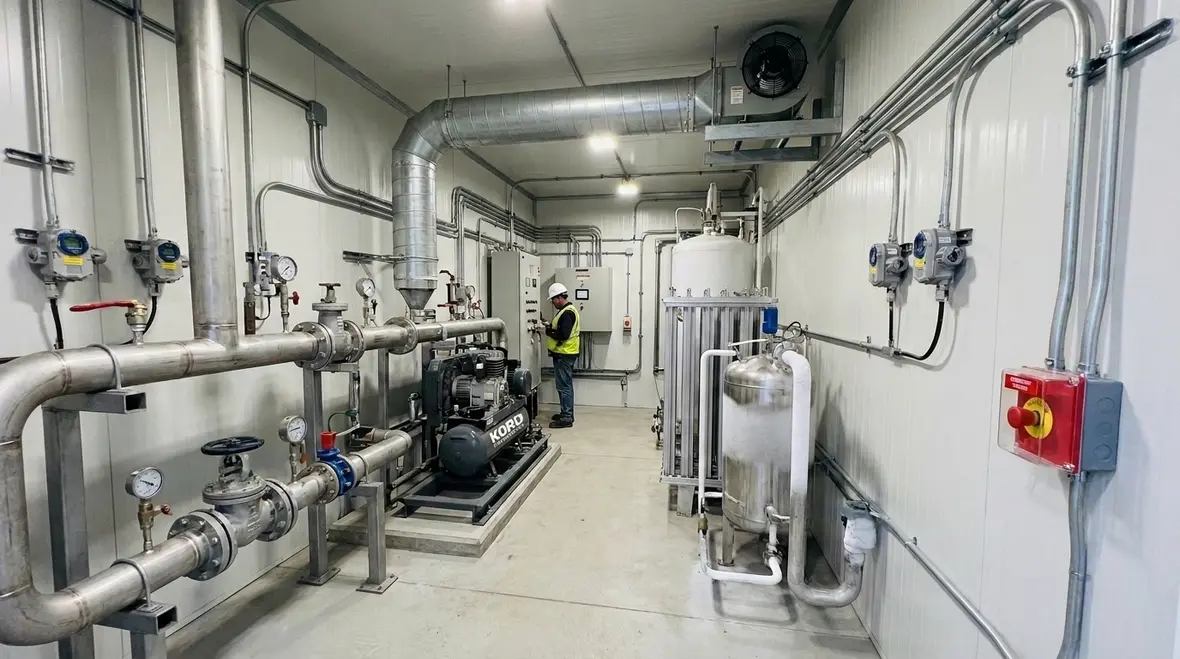
NFPA 52 Section 11.1 Scope: Indoor Installation of CNG and LNG Station Equipment
Quick Answer
NFPA 52 Section 11.1 defines when and how equipment for CNG and LNG stations is permitted to be installed indoors. It establishes scope boundaries, prescriptive intent, and the compliance expectations that follow for ventilation, electrical classification, detection, and inspection readiness.
For facilities building out lifecycle compliance programs, it helps to pair this section with operations and maintenance requirements for CNG facilities, since scope decisions only matter if the resulting systems stay functional after commissioning.
What does the NFPA 52 indoor CNG LNG station installation scope cover?
The NFPA 52 indoor CNG LNG station installation scope in Section 11.1 focuses on indoor installation of station equipment, including how the standard applies to enclosures and indoor spaces where CNG or LNG components operate. In practice, it drives facility design and compliance planning for commercial, industrial, and retail sites that need safe operation without relying on open-air installation conditions.
For operators and facility owners, this section functions as the entry point into the indoor requirements that follow. It also clarifies what is considered “station equipment” versus other building systems, which affects which parts must meet specific fire and life safety criteria.
Section 11.1 Scope in plain terms: indoor station equipment boundaries
NFPA 52 Section 11.1 establishes the application limits for indoor placement of CNG and LNG station components. While the broader NFPA 52 framework covers multiple station configurations and locations, Section 11.1 specifically addresses indoor conditions where potential hazards can accumulate rather than dissipate naturally.
From a compliance standpoint, this scope boundary matters because it determines whether indoor mechanical rooms, equipment enclosures, sheltered pump areas, or dedicated indoor spaces must be designed and maintained to the standard. When the space falls within the indoor scope, the facility then must align supporting systems such as ventilation, gas detection, emergency shutdown, and electrical installation practices with NFPA 52 requirements.
Common “scope confusion” that triggers delays
-
Mixed-use occupancies: Some retail or industrial sites place station equipment in shared buildings. The indoor scope decision affects which building areas must meet station equipment hazard controls.
-
Partial enclosures: Facilities sometimes treat a sheltered bay as “outdoor.” If it behaves like an enclosure in operation, indoor scope requirements may apply.
-
Retrofitting operational changes: A change in equipment layout or gas handling method can alter whether an area is treated as part of indoor station equipment.
Why indoor installation changes the safety and compliance picture
Indoor spaces reduce natural dispersion and can concentrate flammable gas or cryogenic hazards. As a result, indoor CNG and LNG installations require tighter controls and more dependable emergency and monitoring performance. This is where Section 11.1 acts as the gatekeeper for the detailed indoor provisions that follow in NFPA 52.
Operational mechanisms that increase risk indoors
-
Ventilation dependence: Indoor mitigation relies on mechanical ventilation performance and control logic rather than open air.
-
Detection reliability: Gas detection must activate alarms and shutdown actions that prevent continued release.
-
Electrical classification sensitivity: Indoor environments can increase the consequence of faults, requiring correct equipment selection and protection.
-
Cryogenic management for LNG: LNG introduces additional hazards related to cold effects and vaporization behavior upon release, which can still produce flammable vapor clouds indoors.
Design and installation items directly tied to the Section 11.1 scope
Once a facility determines that equipment installation falls under the indoor scope, compliance expectations expand beyond equipment placement. The following categories typically become central during design reviews, commissioning, and inspection.
1) Ventilation and air movement control
Indoor CNG and LNG equipment spaces need ventilation that maintains safe conditions and supports emergency response. Facilities often struggle with ensuring airflow paths remain effective during normal operations, maintenance activities, and after door closures or dampers change positions. Commissioning should confirm not just that fans run, but that activation logic produces the required response under alarm conditions.
2) Gas detection, alarm strategy, and shutdown interfaces
Indoor installations typically require fixed detection capable of identifying a release promptly. The functional interfaces between detectors, annunciation, and emergency shutdown systems must be verified for correct wiring, correct alarm thresholds, and correct fail-safe behavior. A frequent failure point involves drift in sensor performance, improper calibration intervals, or incorrect acknowledgment and reset procedures that reduce system effectiveness during actual incidents.
3) Emergency shutdown reach and reliability
In indoor spaces, shutdown actions must mitigate release before conditions worsen. Compliance reviews focus on how quickly shutdown valves respond, whether emergency stop devices are appropriately placed, and whether shutdown logic prevents restart in unsafe states. Facilities also need a documented method for restoring normal operation after an event without bypassing protective functions.
4) Electrical installation and ignition source control
Indoor placement requires careful attention to ignition source control, cable routing, equipment rating, and protection methods. Common commercial facility problems include mismatched equipment ratings, incorrect conductor terminations, and unplanned modifications that change the electrical classification boundaries.
5) Clear access, separation, and maintenance practicality
Indoor environments must support inspection access and safe maintenance operations. Maintenance crews need access to detectors, shutoff devices, and electrical enclosures without defeating segregation, ventilation paths, or detector placement intent. Poor access planning often leads to recurring nonconformances, ineffective inspections, and delayed maintenance.
Inspection and maintenance expectations for indoor station equipment
Design compliance alone does not meet operational safety expectations. For indoor installations, recurring inspection and maintenance determine whether the system remains in the safe operating envelope over time. Many commercial and industrial facilities view NFPA 52 compliance as a one-time acceptance step, but indoor systems require disciplined lifecycle management.
High value inspection focus areas
-
Detection system performance: Verify calibration status, functional tests, alarm event history, and sensor placement integrity.
-
Ventilation verification: Confirm fan operation, damper response, control logic, and that no physical obstructions affect airflow.
-
Emergency shutdown testing: Ensure activation sequence works as intended and that restoration procedures remain controlled.
-
Physical integrity checks: Inspect fittings, supports, labeling, and visible signs of damage or abnormal wear.
-
Electrical condition monitoring: Review terminations, panel condition, and any evidence of moisture intrusion or deterioration.
Commercial facility compliance challenge: “small changes” with big impact
Retail and industrial facilities frequently undergo tenant changes, HVAC tuning, electrical panel upgrades, and layout modifications. Each change can inadvertently affect indoor mitigation systems. A strong maintenance program includes change control, documentation review, and verification testing after alterations that touch ventilation, detection, or shutdown circuits.
For facilities that need dependable ongoing compliance, Kord Fire Protection’s inspection, testing, and maintenance services support commercial inspection, testing, and maintenance programs designed to keep indoor CNG and LNG safety systems functional and inspection ready.
How to use Section 11.1 during commissioning, audits, and plan review
Section 11.1 should be treated as a scoping tool during early planning and as a verification checkpoint during commissioning and audits. Effective teams align design intent with the indoor hazard control strategy from the beginning, then confirm results through functional testing.
Recommended workflow for project teams
-
Define the indoor boundary: Identify the room or enclosure limits that fall under indoor station equipment scope, including any semi-enclosed spaces.
-
Map indoor controls: Link scope decisions to detection, ventilation, alarms, electrical installation, and emergency shutdown requirements.
-
Commission by function: Test detection to alarm and shutdown actuation sequences, confirm ventilation control response, and verify fail-safe behavior.
-
Document maintenance access: Ensure inspection points, calibration access, and emergency controls remain reachable without defeating protective intent.
-
Set lifecycle schedules: Establish recurring inspection, calibration, and functional testing schedules aligned with facility risk and manufacturer requirements.
Featured compliance outcome
When the indoor scope is correctly interpreted, teams reduce rework risk during inspections, minimize commissioning delays, and maintain system performance during long-term operation.
Frequently Asked Questions
Conclusion and Call to Action
Accurately applying NFPA 52 Section 11.1 prevents costly design rework and supports reliable indoor mitigation performance throughout the equipment lifecycle. Facility teams should verify indoor boundaries early, commission by function, and implement disciplined inspection and maintenance. Contact Kord Fire Protection to develop an inspection and testing plan for indoor CNG and LNG station equipment, with documentation that supports audits and keeps your systems operating safely.

Join Our Newsletter!
Get the latest fire safety tips delivered straight to your inbox From our Newsletter.


