
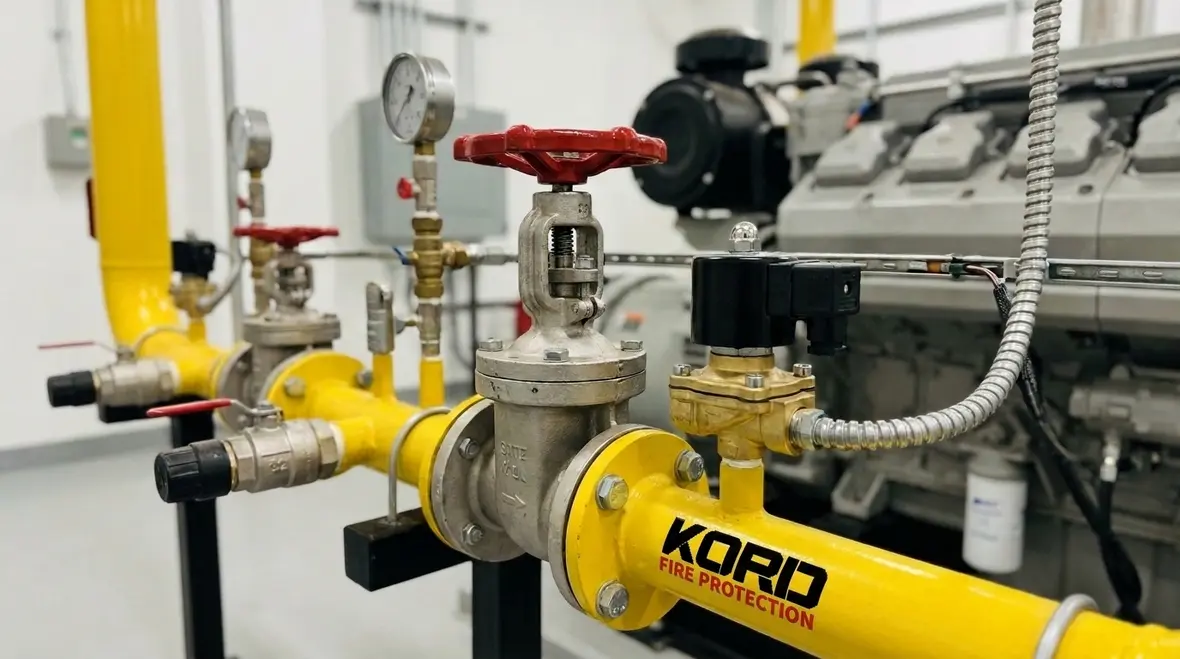
NFPA 37 Section 5.5: Valves in Gaseous Engine Fuel Systems
Quick Answer: NFPA 37 Section 5.5 establishes performance, placement, and maintenance expectations for valves serving gaseous engine fuel systems. It aims to maintain reliable shutoff and safe fuel control under normal and abnormal operating conditions. Compliance requires documented inspection, testing, and correct valve selection.
For facilities tightening inspection routines and documentation, Kord Fire Protection also offers broader fire protection services in Southern California that naturally support code-focused maintenance planning and deficiency follow-up.
Why NFPA 37 fuel gas valve requirements engines matter in real facilities
Fuel valves form the control boundary between stored gaseous fuel and the engine fuel system. In commercial settings, the operational reality is that valves get exposed to vibration, thermal cycling, contamination, actuator wear, and occasional misuse during maintenance. The NFPA 37 fuel gas valve requirements engines are intended to reduce the likelihood of leaks, stuck valves, delayed shutoff, and unsafe operating states during start up, running, and shutdown sequences.
Facilities that serve retail, industrial, and institutional loads also face layered compliance expectations: local fire codes, insurance requirements, and internal life safety programs. NFPA 37 Section 5.5 provides a specific target for valve selection and ongoing performance verification, so service teams can treat valves as safety critical components, not just plumbing hardware.
What Section 5.5 expects from valves on gaseous engine fuel systems
NFPA 37 Section 5.5 focuses on valves used in gaseous engine fuel systems and the requirements needed to support safe fuel control. While interpretations can vary by system configuration, the intent remains consistent: valves must be suitable for gaseous fuel service, located and arranged to support safe operation, and maintained so they perform their safety function when required.
1) Valve suitability and design for gaseous fuel service
Valves must be appropriate for the fuel type and operating conditions. In practice, compliance failures often trace back to mismatch between valve materials and fuel constituents, incorrect pressure rating, or improper selection of actuator or sealing components. Even small deviations can lead to seepage, increased friction in moving parts, or compromised seals under thermal cycling.
2) Arrangement that supports safe isolation and control
Valve location and configuration must support safe isolation of the engine fuel train. For commercial facilities, this includes designing the system so that shutdown scenarios produce predictable results and do not create unintended flow paths. Technicians should verify labeling, access, and functional zoning so that valve operation during planned work does not create hazardous temporary conditions.
3) Performance that holds under abnormal conditions
Valves in gaseous engine fuel systems must maintain safe behavior during events such as emergency shutdown or loss of normal operating control. Common failure modes include actuator malfunction, stem packing degradation, debris accumulation, and seat wear that increases leakage. A structured inspection program is required to detect drift toward failure before a safety event occurs.
Where compliance breaks down: common valve failure points
Commercial operations typically uncover problems during seasonal outages, after construction work, or following changes to fuel supply components. The most frequent valve issues align closely with the expectations behind NFPA 37 Section 5.5. Understanding these points helps facilities target inspections efficiently.
Sticking or slow operation
Valves can stick due to contamination, corrosion, or actuator wear. Slow closure during a shutdown sequence can extend the window where gas can flow. Service teams should check not only actuation but also closure time, repeatability, and mechanical smoothness under normal system pressure ranges.
Leakage due to seat and seal wear
Leakage is one of the highest consequence failure modes in gaseous fuel systems. Seat erosion, packing deterioration, and micro damage from handling or installation can lead to seepage. Facilities must treat leakage checks as an essential part of compliance and not as an optional service add on.
Control and interlock mismatches
Even when the valve itself performs correctly, incorrect wiring, interlock logic, or control signal timing can prevent required shutoff. This becomes a compliance risk when the valve does not receive the command sequence expected during emergency operation.
Improper maintenance practices
Replacement of components without verifying compatibility, failure to document test results, or incomplete restoration of supports and electrical connections can undermine system safety. NFPA 37 Section 5.5 compliance typically requires maintenance records that show the valve remains fit for its safety function.
Inspection, testing, and maintenance practices that align with Section 5.5
Facilities often ask what inspection looks like in day to day terms. The practical answer is that NFPA 37 Section 5.5 compliance relies on a repeatable verification process. That process should cover valve condition, operational performance, and leak integrity, supported by documentation.
Establish a valve criticality inventory
Commercial sites should maintain an inventory of all fuel gas valves serving the gaseous engine fuel system. Each valve entry should include manufacturer, model, size, pressure rating, fuel compatibility basis, actuator type, installation location, and maintenance history. This inventory supports faster troubleshooting and more consistent testing.
Use procedure driven testing and recordkeeping
Valve testing should follow documented procedures tied to the equipment and control system design. Records should include test method, acceptance criteria, results, and corrective actions. Without records, facilities risk gaps during audits, insurance reviews, and incident investigations.
Verify mechanical and control function together
Technicians should confirm that valve actuation commands, interlocks, and the actual valve movement align with system intent. This includes verification of control signals, actuator operation, and valve movement confirmation where instrumentation exists.
Address maintenance intervals and component aging
Thermal cycling and vibration can accelerate wear. Maintenance intervals should reflect actual duty cycles and documented performance trends. When repeated tests show drift toward leakage or slow operation, corrective action should occur before the valve fails its safety function.
How commercial facilities should manage valve access, labeling, and safe work
Valve safety is not only mechanical. It is operational, procedural, and organizational. In retail and industrial environments, work coordination frequently drives compliance outcomes.
Maintain clear labeling and accessible operation points
Valves must be identifiable and accessible so that technicians can perform shutdown and isolation tasks without guessing. Unlabeled valves lead to wrong valve operation and create unsafe temporary configurations during maintenance.
Control lockout and temporary bypass conditions
When systems require temporary configurations, facilities need controlled procedures that maintain safe isolation boundaries. Technicians should ensure that temporary modifications do not defeat the purpose of safety valves and that they are removed promptly when work completes.
Coordinate with facility life safety programs
Fire safety and mechanical maintenance teams should align on valve inspection schedules, alarm testing, and emergency shutdown verification. This alignment is often where compliance succeeds or fails, especially at multi tenant sites and facilities with contractor driven maintenance.
Partnering for ongoing NFPA 37 valve compliance: where Kord Fire Protection fits
Many facilities understand the standard requirements but struggle with execution: scheduling tests around uptime, maintaining documentation, tracking recurring performance drift, and ensuring that valves and control logic remain aligned after maintenance events. Kord Fire Protection supports commercial operators with structured inspection, testing, and maintenance coordination so valve performance stays within safety expectations over time.
For additional guidance on protecting gaseous systems and supporting compliant life safety practices, Kord Fire Protection provides resources at Kord Fire Protection. Facilities can also explore practical insights on proactive maintenance for fire pump system reliability to strengthen inspection planning, documentation habits, and long term readiness.
Frequently Asked Questions
Conclusion: take action on valve readiness now
NFPA 37 fuel gas valve requirements engines are only effective when facilities verify real valve performance over time. A practical compliance program includes a valve inventory, procedure based testing, documented results, and corrective action when operation or leakage trends emerge. Engage Kord Fire Protection to strengthen ongoing inspections, testing, and maintenance coordination for gaseous engine fuel systems. Start with a system review and establish a schedule that keeps valves reliable between audits and operations.

Join Our Newsletter!
Get the latest fire safety tips delivered straight to your inbox From our Newsletter.



