
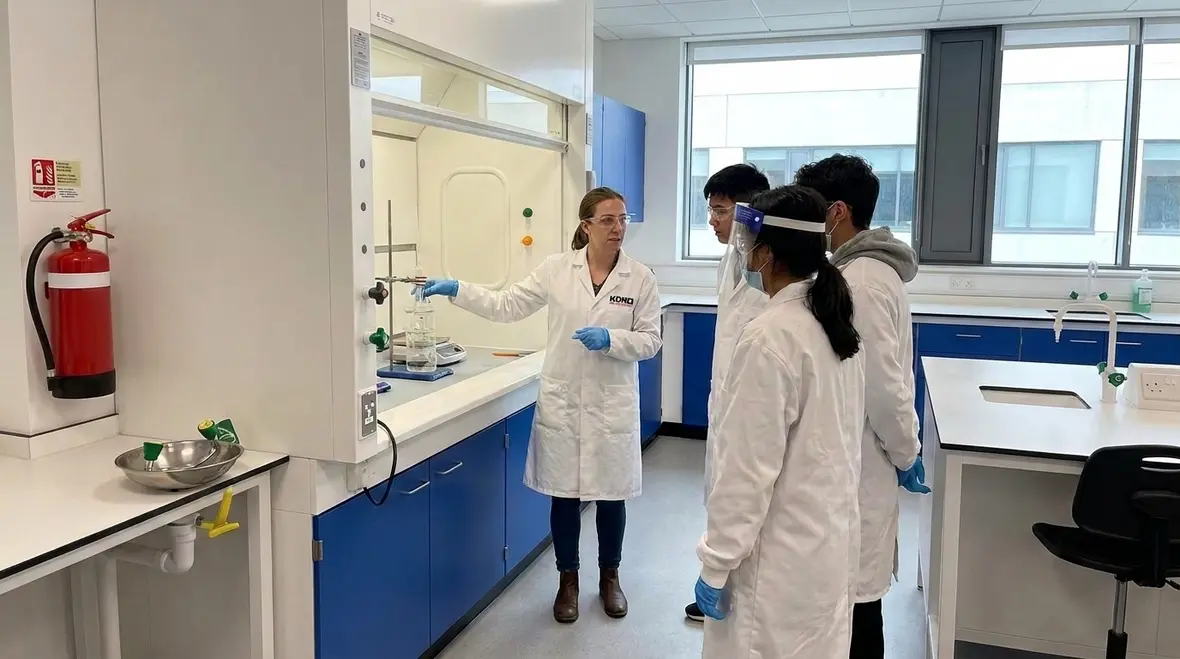
NFPA 45 Section 12.2: Instructor Responsibilities in Teaching Labs
Quick Answer
NFPA 45 Section 12.2 assigns clear duties to lab instructors to ensure safe, compliant teaching operations. The section focuses on training delivery, hazard communication, supervision, and preventing unsafe practices during experiments. For commercial facilities, documenting instructor control and maintaining equipment readiness supports audit readiness.
If your facility depends on documented system readiness to support instructor verification, review Kord Fire Protection’s inspection, testing, and maintenance services as part of a stronger lab compliance workflow.
Why NFPA 45 laboratory instructor responsibilities matter in teaching labs
Teaching laboratories combine learning objectives with real-world chemical, electrical, and process hazards. NFPA 45 laboratory instructor responsibilities are the practical controls that keep those hazards from becoming incidents. Instructors are not only educators. They operate as the frontline safety managers during hands-on instruction, ensuring procedures match the approved safety framework, protective systems are used correctly, and student actions stay within safe operating limits.
In commercial, industrial, and retail settings that host training labs, the compliance burden often extends beyond the classroom. Facility management must align instructor practices with site procedures, inspection documentation, and ongoing maintenance of fire protection and life safety equipment.
NFPA 45 Section 12.2 at a practical level: instructor control during instruction
NFPA 45 Section 12.2 establishes instructor responsibilities tied directly to safe teaching operations. While the exact wording varies by edition, the intent remains consistent: instructors must actively manage the learning environment so that students perform experiments safely and in accordance with established procedures.
Core expectations instructors must operationalize
- Pre-lab hazard briefing: Instructors communicate hazards, controls, and emergency actions before any student begins work.
- Method and procedure control: Instructors ensure students follow the approved steps, particularly during ignition, heating, pressurization, gas handling, and chemical transfer.
- Supervision and intervention: Instructors remain present and correct unsafe behaviors immediately rather than after the fact.
- Verification of readiness: Instructors confirm that required protective equipment and laboratory safety features are in place and functioning as intended.
- Emergency preparedness: Instructors train students on response actions and ensure evacuation and incident reporting procedures are understood.
What instructors must verify before students start experiments
Many compliance failures do not occur during a “big” event. They occur at the start of an activity when conditions are assumed rather than verified. Instructors should use a repeatable readiness process tied to the specific experiment and facility hazard controls.
Common readiness checks that prevent real incidents
- Engineering controls: Confirm local exhaust ventilation or fume control measures are operating before flammable or toxic vapors are generated. If ventilation status cannot be verified, the instructor controls the work scope until the condition is corrected.
- Ignition control: Ensure hot work, heating mantles, open flames, and energized equipment are permitted by the experiment plan and managed with appropriate clearances and supervision.
- Fire protection interface: Confirm that fire suppression or detection related features serving the lab are unobstructed and accessible for maintenance and emergency use.
- Personal protective equipment: Verify required PPE is issued and used correctly. PPE compliance is not a checkbox. It is a supervised behavior.
- Spill and neutralization supplies: Confirm spill kits and relevant neutralizers are present for the chemicals used in that session.
For commercial facility leaders, instructor readiness checks should link to inspection and maintenance programs so that “verified” means “documented.” Kord Fire Protection supports this operational chain by aligning fire protection service, testing, and documentation practices with ongoing compliance needs.
For additional guidance on compliant maintenance support, see Kord Fire Protection’s full fire protection services.
Supervision during experiments: where instructors prevent escalation
NFPA 45 laboratory instructor responsibilities are most visible when an activity deviates from the plan. Instructor supervision should be structured so that hazards remain controlled even when student skill levels vary.
High-risk moments that require active instructor presence
- Chemical transfer and container handling: Instructors monitor decanting, dispensing, and labeling to prevent incompatible mixing or wrong chemical use.
- Heating and evaporation: Instructors watch for runaway reactions, overheating, and vapor accumulation. They confirm that heat sources match the documented procedure.
- Gas or compressed systems: Instructors verify regulators, connections, and shutoff access. They control how students test, purge, and operate gas lines.
- Waste accumulation: Instructors manage where waste is stored, when containers are swapped, and how labels remain readable during the session.
Corrective action expectations
Instructors should immediately stop or slow unsafe steps. If a hazard control fails, for example, ventilation performance is questionable or protective equipment is missing, the instructor pauses the activity, implements an alternate safe path if allowed, and documents the condition for corrective maintenance or procurement follow-up.
Documentation and training records: making instructor accountability auditable
Instructor accountability becomes defensible when training and supervision actions can be shown through documentation. NFPA 45 Section 12.2 expectations should translate into consistent records suitable for internal review, contractor coordination, and regulatory inquiries.
Recommended documentation sets that support compliance
- Session lesson plans including experiment objectives, hazard notes, control measures, and emergency actions.
- Student briefing records showing that pre-lab hazard communication occurred.
- Instructor supervision logs for sessions with elevated risk, nonstandard setups, or changes from the original procedure.
- Equipment readiness documentation tied to facility inspection and maintenance schedules.
Commercial facilities often face audit friction when fire protection systems are maintained but not operationally integrated into classroom readiness. Kord Fire Protection helps close that gap by providing a service framework that supports testing, inspection outcomes, and ongoing reliability for systems that instructors depend on during emergency response and daily operations. Visit this commercial fire safety audit guide to review service capabilities.
Common failure points and how to prevent them
In teaching labs, the failure pattern is usually repeatable. Instructors, facilities, and vendors can reduce incident likelihood by addressing the most common breakdowns in the instructor safety chain.
Failure point 1: Training delivered but not supervised
Students can receive a briefing and still perform unsafe steps when attention drifts. The fix is active supervision during the exact phases that create risk, paired with immediate correction and a clear pause and restart process.
Failure point 2: Hazard controls assumed to be “always on”
Ventilation, detection, and suppression interfaces can degrade if maintenance lapses or if access is restricted by stored materials. The fix is to define “verification moments” in each lesson plan and to keep facility service schedules aligned with those moments.
Failure point 3: Emergency actions known in theory but not practiced
Instructors should ensure students know where to go, how to report a problem, and what shutdown actions apply to the experiment. The fix is targeted emergency instruction relevant to that session’s hazards.
Failure point 4: No feedback loop to improve procedures
Near misses, spills, and abnormal observations should feed into lesson plan updates and equipment maintenance requests. This is how instructor practices evolve and stay aligned with NFPA 45 expectations over time.
Frequently Asked Questions
Conclusion and call to action
NFPA 45 Section 12.2 makes instructor supervision and hazard control a measurable part of lab delivery, not an implied responsibility. Facilities that align lesson plans, readiness checks, and maintenance documentation reduce incident risk and simplify audits. Kord Fire Protection helps commercial operations keep the fire protection and life safety systems that instructors rely on in dependable condition. Contact Kord Fire Protection to align your testing and maintenance program with your teaching lab workflow.

Join Our Newsletter!
Get the latest fire safety tips delivered straight to your inbox From our Newsletter.



