
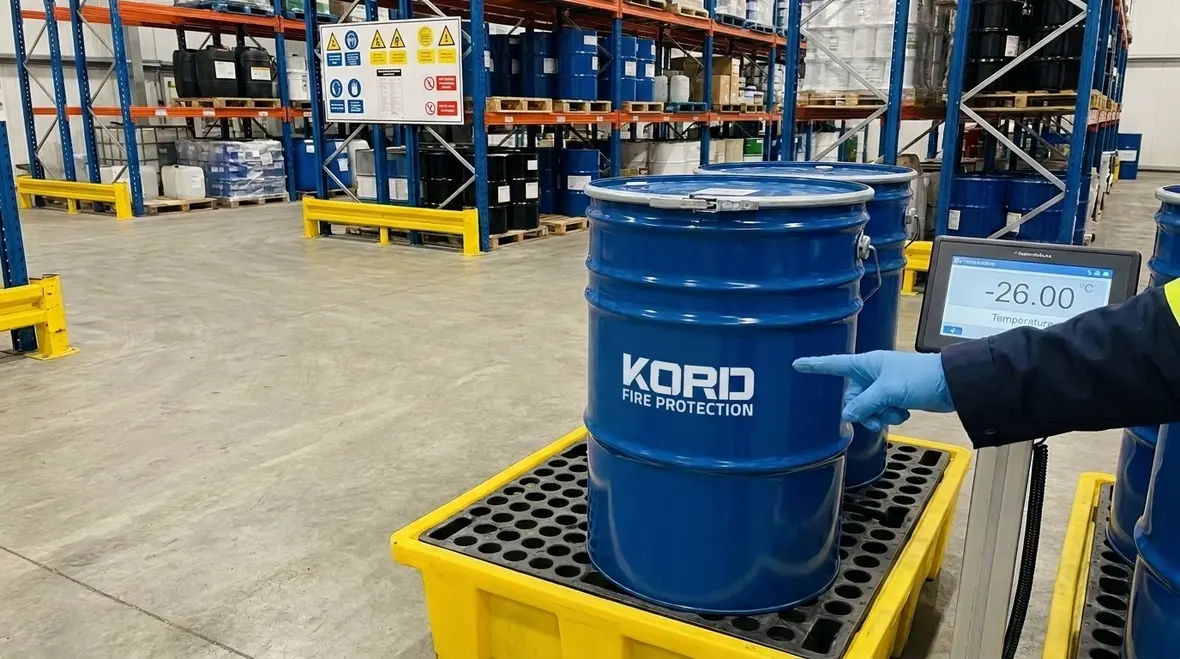
NFPA 35 Section 8.3: Organic Peroxide Formulations
Quick Answer: NFPA 35 Section 8.3 establishes how organic peroxide formulations must be controlled, documented, and verified to support safe storage, handling, and use. Facility compliance hinges on formulation limits, container integrity, temperature and contamination controls, and ongoing inspection readiness.
Facilities that need stronger inspection and maintenance follow-through around these hazards often benefit from fire protection inspection and preventive maintenance support from Kord Fire Protection, especially when formulation control has to hold up during real day to day operations.
What NFPA 35 Section 8.3 Requires, in Plain Terms
NFPA 35 organic peroxide formulation requirements focus on ensuring that organic peroxides perform predictably under industrial conditions. Section 8.3 ties safe operation to formulation control, container and closure condition, compatibility management, and verification practices that reduce the risk of decomposition, runaway reactions, and accelerated breakdown. In commercial facilities, the practical challenge is that formulation control is not a one time documentation task. It becomes an operational discipline involving receiving inspection, storage conditions, maintenance of associated equipment, and procedures that prevent contamination or mismatch of products.
Because the consequences of a formulation error can escalate quickly, facilities typically align internal programs with NFPA 35 expectations through documented controls, inventory traceability, and inspection schedules. For many commercial sites, Kord Fire Protection supports ongoing readiness by reviewing hazardous operations workflows, validating inspection coverage, and helping facilities close gaps before they become findings.
Where Compliance Breaks Down Most Often
Facilities usually stumble in recurring, operational areas rather than in lack of general awareness. The most common failure points include:
- Product mismatch during receiving: Similar labels, partial shipments, or outdated SDS packages can lead to incorrect storage placement and improper handling practices.
- Weak traceability: Batch identification and formulation documentation may not travel with the product into storage areas.
- Contamination risks: Dirty containers, damaged closures, or incorrect transfer practices can introduce contaminants that affect stability.
- Temperature excursions: Storage conditions that drift outside required ranges can reduce safety margins.
- Inadequate inspection readiness: Maintenance schedules for storage systems, leak detection, and related mechanical equipment do not align with real operational exposure.
From an incident prevention standpoint, these gaps often combine. For example, a receiving mismatch can place a formulation into a storage environment not suited to its stability needs. A subsequent container integrity issue can then increase vulnerability to accelerated decomposition.
Key Elements of NFPA 35 Organic Peroxide Formulation Control
NFPA 35 Section 8.3 centers on formulation governance. Facilities typically build compliance programs that ensure formulation characteristics remain within specified boundaries and remain consistent from receipt through use. These controls are implemented through procedures and verified through inspection and documentation.
1) Documentation and batch traceability
Commercial facilities commonly implement a formulation record set that includes product identity, supplier documentation, SDS alignment, and batch identifiers. The goal is simple: a technician should be able to connect the formulation to the correct handling procedures without interpretation or guesswork. Traceability also supports maintenance decisions, because formulation driven stability risk influences what equipment checks and inspection intervals are practical.
2) Integrity of containers and closures
Formulations can become unsafe when containers or closures allow loss of inhibitor effectiveness, ingress of contaminants, or altered material properties. Compliance efforts usually include receiving inspection criteria, defined acceptance and rejection thresholds, and a clear process for isolating questionable containers. Facility staff often need training that treats container integrity as a fire safety control, not just a chemical handling issue.
3) Preventing contamination during storage and transfer
Organic peroxide formulations can be sensitive to contamination. Operational controls typically include dedicated transfer practices, cleaning verification for hoses and pumps, and controls that prevent cross contamination between compatible and non compatible chemicals. Common failure patterns include reusing equipment without verified cleaning status and using general purpose fittings that are not compatible with peroxide service. For related reading, see NFPA 33 Section 16.3: Preventing Contamination of Organic Peroxides.
4) Temperature and environmental controls
Temperature management influences stability. Facilities typically establish and maintain storage environmental controls, including monitoring, alarms, and response procedures for excursions. Operational readiness also requires verification that monitoring devices and associated alarm systems stay calibrated and functional. Equipment failures related to cooling or ventilation are often indirect causes of non compliance because they reduce margin and can accelerate degradation. A useful companion resource is NFPA 33 Section 16.4: Storing Organic Peroxides Safely.
5) Inhibitor and concentration considerations
Some peroxide systems rely on formulation parameters that must remain within controlled limits. Many facilities reference documentation that includes the inhibitor and concentration details to support stable operation. For example, concentrations often discussed in peroxide safety planning fall in ranges such as 0.5% to 1.0% depending on the peroxide type, supplier data, and stability program requirements. The critical compliance point is not the range alone. It is the requirement to follow the formulation controlled by the applicable NFPA 35 and supplier documentation approach for the specific product.
How Inspections and Maintenance Should Support Section 8.3
NFPA 35 compliance does not end at paperwork. Section 8.3 expectations become visible during inspections through evidence that the facility’s controls actually function. A strong maintenance and inspection program typically includes:
- Receiving and storage inspection checks: Container condition, labeling verification, closure integrity, and batch identification checks.
- Operational monitoring: Temperature monitoring verification, alarm test frequency, and documented response actions.
- Mechanical equipment readiness: Pumps, transfer hoses, valves, and associated seals that contact peroxide solutions should be included in preventive maintenance planning.
- Housekeeping and segregation audits: Ensuring that peroxide formulation storage remains free from ignition hazards and incompatibles per the facility’s established hazard segregation plan.
- Change management: Procedures for updated SDS, formulation revisions, or packaging changes that trigger operational review before use.
Commercial sites that process and store organic peroxides typically benefit from a structured compliance cadence. Kord Fire Protection can support this operational cadence by helping facilities align documentation, inspection coverage, and maintenance verification with the realities of how technicians receive, store, and transfer peroxide formulations.
Practical Compliance Workflow for Commercial and Industrial Operations
Facilities often achieve the best results when they standardize the workflow from delivery to use. A practical workflow that supports NFPA 35 organic peroxide formulation requirements commonly includes:
Receiving step
- Verify product identity and batch code against receiving documents.
- Confirm SDS currency and formulation details are current in the facility chemical management system.
- Inspect container condition and closure integrity. Reject or isolate damaged containers per written procedures.
Storage step
- Place products in designated peroxide formulation storage areas with controlled environmental conditions.
- Verify monitoring devices operate correctly and alarms are configured and tested.
- Maintain segregation and prevent contamination from incompatible chemicals or debris.
Transfer and use step
- Use peroxide rated transfer equipment and maintain verified cleaning status.
- Follow formulation specific handling procedures without improvisation.
- Document any deviations, interruptions, or container issues immediately.
Closeout and learning loop
- Confirm formulation documentation aligns with inventory records after receiving and during use.
- Use near misses, alarm events, and container condition findings to update training and procedures.
For additional context on how commercial facilities operationalize fire and life safety readiness, Kord Fire Protection often coordinates hazard focused programs and documentation support. For an overview of the organization’s commercial approach, visit Kord Fire Protection.
Frequently Asked Questions
Conclusion and Call to Action
NFPA 35 Section 8.3 compliance succeeds when formulation controls become operational reality: traceability at receiving, integrity checks in storage, contamination prevention during transfer, and disciplined monitoring and maintenance. Facilities that treat these as recurring fire safety tasks reduce uncertainty and strengthen inspection readiness. Kord Fire Protection can help commercial, industrial, and retail sites build and maintain a defensible compliance program through documentation support, inspection readiness, and ongoing maintenance alignment. Contact Kord Fire Protection to schedule a compliance-focused review.

Join Our Newsletter!
Get the latest fire safety tips delivered straight to your inbox From our Newsletter.



