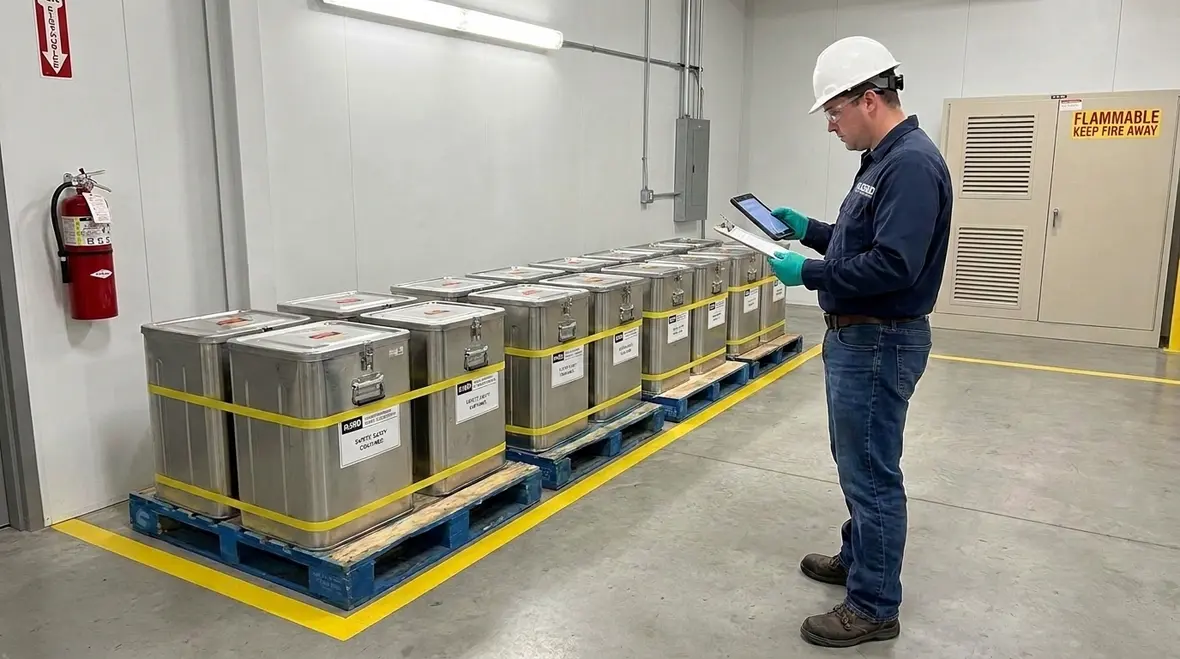
NFPA 35 Section 8.1: Nitrocellulose Requirements
Quick Answer: NFPA 35 Section 8.1 sets baseline safety controls for nitrocellulose handling, emphasizing ignition hazard management, segregation, protected storage practices, and inspection-ready operational procedures. Compliance depends on how facilities control heating, contamination, housekeeping, and transfer operations during everyday work.
What NFPA 35 nitrocellulose handling requirements expect in Section 8.1
Facilities that handle nitrocellulose must implement controls that reduce ignition sources, limit hazardous conditions, and maintain system integrity over time. When organizations address NFPA 35 nitrocellulose handling requirements in Section 8.1, they typically need more than a single written policy. They need an operational program that covers how material is received, stored, handled, transferred, and monitored, plus how those controls are verified through inspection and maintenance.
Facilities that want to strengthen inspection readiness can also benefit from a broader look at fire suppression system impairments, especially where documentation drift and equipment reliability tend to sneak up on operations.
How Section 8.1 frames the ignition risk: controls first, documentation always
Section 8.1 focuses on preventing ignition and managing consequences if abnormal conditions occur. In practical terms, compliance is achieved through a layered approach that combines administrative procedures and physical safeguards. Commercial facilities often fail compliance not because they lack equipment, but because they cannot prove the equipment is functioning, staff understand operating boundaries, or cleaning and transfer practices drift over time.
1) Handling and transfer procedures must stay consistent
NFPA 35 controls commonly require that handling does not introduce contamination, heat, or mechanical conditions that can increase ignition potential. Transfer operations typically need defined steps for staging, container integrity, control of airborne contamination, and controlled movement pathways. High turnover and shift-to-shift variation are frequent failure points. If the written procedure does not match the real workflow, inspection readiness declines quickly.
2) Storage arrangement and separation prevent escalation
Even when quantities are limited, improper layout increases risk by allowing incompatible conditions to converge. Section 8.1 compliance often requires that nitrocellulose storage and processing areas maintain appropriate separation from ignition sources and other combustibles, while still supporting routine operations. Facilities that expand storage patterns without updating fire safety documentation frequently end up with blocked access, inconsistent labeling, or changes that undermine the original hazard assessment.
3) Housekeeping is an engineering control in disguise
Housekeeping is frequently treated as a janitorial task, but for nitrocellulose it functions as a hazard control. Accumulated residue, poor waste handling, and inconsistent cleanup schedules can increase ignition potential and reduce the reliability of other safeguards. A robust compliance program aligns cleaning frequencies with operational risk and verifies completion with checklists that managers actually review.
Operational program essentials: procedures, training, and “inspection proof” records
Section 8.1 compliance typically requires more than training sign-in sheets. Inspectors look for evidence that procedures are used, understood, and audited. A strong operational program includes controlled documents, role-based training, and recorded inspections that connect directly to equipment and work practices.
Training must cover abnormal conditions, not only normal steps
Staff should understand what to do when containers are damaged, when transfer conditions change, or when cleanup reveals unexpected residue. Training should include how to stop work safely, how to notify supervisors, and how to preserve the site for inspection. This is where many commercial operations underperform because they focus on “how” rather than “how to respond.”
Written procedures need to match equipment and layout
Typical gaps include outdated maps, storage charts that no longer match reality, and procedures that assume equipment availability that maintenance teams cannot guarantee. Kord Fire Protection supports commercial facilities by aligning documentation and field practices so that inspection evidence is coherent, current, and defensible.
Common compliance gaps that trigger findings during walkthroughs
Below are frequent failure points encountered during commercial compliance reviews tied to nitrocellulose handling controls.
Inconsistent container handling and deterioration
Dented, degraded, or improperly sealed containers can change hazard profiles. Facilities should implement routine verification of container condition, labeling, and staging practices. If staff cannot consistently identify “do not use” conditions, the control system breaks down.
Blocked access and degraded protective features
Access pathways are often maintained at the start of compliance, then degraded by routine staging. Even minor obstructions can create response delays and can obstruct inspection and testing access. Audits should include path checks and verification of protective feature availability.
Housekeeping drift between scheduled audits
Over time, cleaning intervals and waste practices become inconsistent, especially across shifts or contractors. Compliance depends on continuous supervision and evidence that cleanup happens as required and is verified.
Maintenance gaps that undermine reliability
Fire protection systems and related safety controls require periodic testing and corrective maintenance. If maintenance records are incomplete, the facility cannot demonstrate that protective measures remain in serviceable condition.
Maintenance and inspection readiness: building a defensible compliance system
NFPA 35 controls work best when they are maintained like critical assets. A facility should plan inspection readiness as an ongoing workflow, not a last-minute preparation event. Kord Fire Protection helps commercial, industrial, and retail operations sustain compliance through practical testing, documentation support, and maintenance coordination.
For a deeper look at how fire protection organizations approach inspection and ongoing readiness, see this related resource: fire suppression inspections.
What “good” looks like during inspections
- Procedures reflect current site conditions, equipment configuration, and storage patterns.
- Housekeeping schedules and waste handling practices match the hazard level and production realities.
- Staff training includes abnormal condition response and stop work authority.
- Testing and maintenance records are complete, current, and traceable to the systems relied upon for safety.
- Walkthroughs confirm access, labeling, segregation, and operational control points remain in place.
How to implement Section 8.1 controls in real commercial environments
Implementation success depends on integration with daily work, not just policy creation. Commercial facilities face practical constraints such as limited storage footprints, shared corridors, contractor scheduling, and variable production volume. The facility program should adapt through controlled staging rules, clear transfer pathways, and routine supervision.
Retail and light industrial operations: prevent “process creep”
Even when handling occurs in smaller quantities, the risk remains. Retail or mixed-use industrial spaces often experience process creep, where materials are temporarily staged in non-approved areas. Management should enforce staging boundaries and ensure workers understand what “temporary” means and when it becomes a noncompliant practice.
Industrial operations: manage production variability with tighter control points
Industrial workflows frequently change with product runs. The compliance program should define control points that do not change, such as verified storage segregation, container condition standards, waste rules, and inspection routines. During ramp ups, facilities should add supervisory checks to prevent shortcuts.
Frequently Asked Questions
Next step: get Section 8.1 readiness verified
Review your nitrocellulose handling workflow against NFPA 35 Section 8.1, focusing on transfer practices, storage segregation, housekeeping controls, and inspection documentation quality. Then schedule a compliance-focused verification with Kord Fire Protection to identify gaps, prioritize fixes, and maintain reliable testing and maintenance records. Act now to reduce operational drift and strengthen inspection readiness.
Join Our Newsletter!
Get the latest fire safety tips delivered straight to your inbox From our Newsletter.