
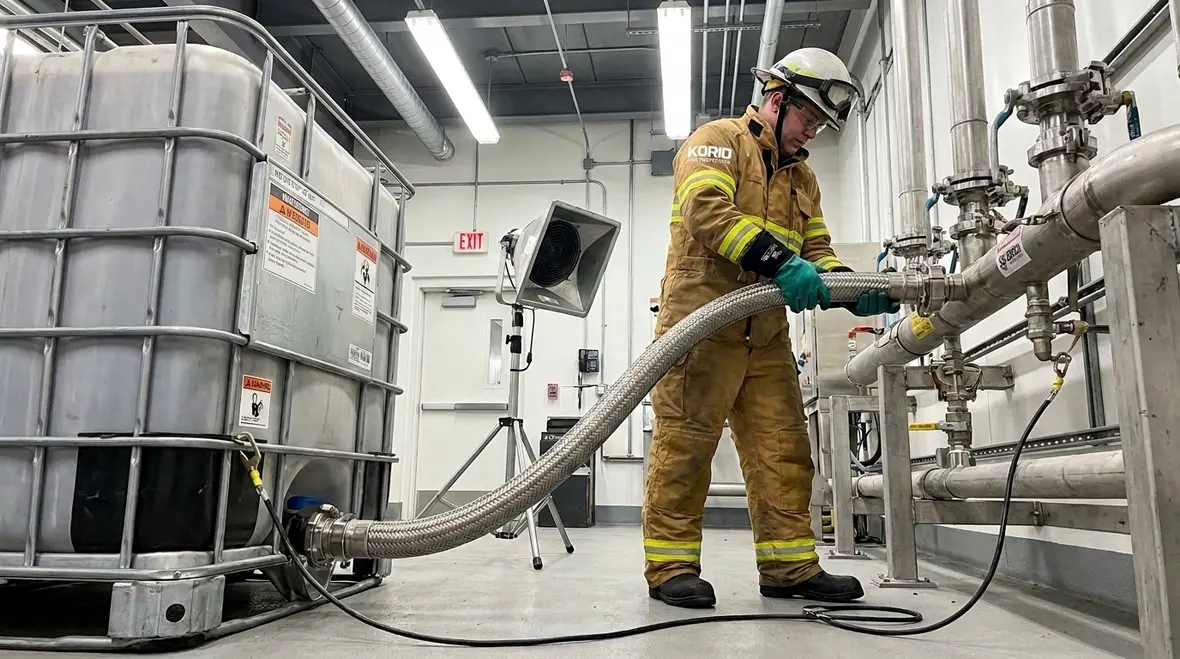
NFPA 35 Section 8.2: Monomer Requirements for Safer Handling and Compliance
Quick Answer
NFPA 35 Section 8.2 sets performance focused expectations for safely handling monomers in industrial settings. It addresses container integrity, transfer controls, ignition source management, venting, spill preparedness, and inspection routines. Facilities that align procedures, equipment, and maintenance reduce fire and reactivity risk.
For facilities tightening their overall fire protection readiness, it can help to pair process safety reviews with broader fire protection services so inspections, maintenance, and compliance planning stay coordinated across the property.
What does NFPA 35 Section 8.2 require for monomer handling?
NFPA 35 monomer handling processing requirements focus on preventing fires, explosions, and uncontrolled polymerization hazards associated with reactive monomers. In real commercial facilities, compliance typically fails not because staff ignore safety, but because equipment condition, inspection cadence, and transfer details drift over time. Section 8.2 is built to close those gaps through clear expectations for containers, transfer areas, control of ignition sources, and emergency readiness.
Monomer hazards that drive Section 8.2 controls
Monomers can present multiple fire safety challenges at once: flammability, vapor accumulation, and chemical instability. Section 8.2 requirements are therefore operational, not just administrative. Facilities must treat monomers as materials that demand controlled pathways from receipt to storage to transfer and processing.
Key risk mechanisms facilities must control
- Ignition and flame propagation: Vapors can ignite from routine electrical systems, static discharge, hot surfaces, and improper equipment selection.
- Reactivity and contamination: Many monomers are sensitive to heat, contaminants, and inhibitors changes that can trigger runaway reactions.
- Release and accumulation: Leaks at connections, valves, pumps, hoses, and fittings can accumulate in low or enclosed areas.
- Polymerization during abnormal conditions: Incorrect heating, blocked vents, or improper transfer practices can drive hazardous heat buildup.
Because commercial, industrial, and retail environments often share buildings with offices, warehouses, and customer service areas, the practical impact of Section 8.2 extends beyond the process room into general fire safety coordination, access control, and emergency response planning.
Container, storage, and transfer: the operational core of compliance
Section 8.2 expectations typically translate into a tight set of field practices: maintain container integrity, control transfer methods, and prevent unsafe conditions around transfer points. The goal is to limit both the likelihood of release and the likelihood that a release becomes an ignition or reactivity event.
Container and connection integrity
Common failure points include degraded gaskets, worn hose ends, loose flange connections, and fittings that are incompatible with the monomer chemistry. NFPA 35 requirements drive a verification mindset: use correct compatibility materials, inspect connections before each transfer cycle, and ensure closures and caps remain serviceable.
Transfer controls for safe movement of monomers
During transfers, facilities must prevent vapor ignition and uncontrolled release. Typical controls include closed transfer where feasible, bonding and grounding to reduce static hazards, and managing transfer rates to prevent abnormal pressures and heat buildup. Transfer areas must also maintain clear access for operation and emergency response, with ignition source controls consistent with the hazard classification.
For facilities that use pumps, hoses, or manifolds, compliance depends on equipment condition and documentation. Kord Fire Protection supports ongoing readiness by aligning inspection practices with your operational schedule and by identifying deterioration trends before they become findings during audits. If fire pump performance is part of your bigger reliability picture, this look at commercial fire pump maintenance signs fits naturally into that conversation.
Ventilation, pressure relief, and vapor control in Section 8.2
Even when transfer procedures are correct, poor vapor control can undermine NFPA 35 compliance. Section 8.2 emphasizes maintaining safe pathways for vapors and preventing situations that can trap pressure or heat. Facilities should treat venting systems as active safety equipment, not passive infrastructure.
What commercial teams often miss
- Blocked or partially obstructed vents: Accumulated residue or improper maintenance can restrict flow.
- Incorrect vent routing: Routing that discharges near ignition sources or into enclosed spaces increases risk.
- Unknown inspection history: Without documented checks, teams cannot demonstrate that venting remains effective.
- Improper sealing during maintenance: Reassembled components can leave gaps or misalignments that affect performance.
Effective compliance includes coordinated maintenance with clear acceptance criteria and verification tests. Kord Fire Protection can help structure recurring inspection and testing to confirm that ventilation, relief, and vapor control functions remain aligned with hazard conditions.
Ignition source management and hot work controls
Ignition source control is central to NFPA 35 monomer handling processing requirements. Facilities need a defensible method to manage ignition risks around monomer transfer and processing, including electrical equipment selection, static control practices, and operational procedures that limit hazardous energy sources.
Controls that must be operational, not just written
- Electrical classification awareness: Ensure that devices and panels in monomer areas match the intended hazard environment.
- Static control: Confirm bonding and grounding practices are followed and verified where transfers occur.
- Hot work management: Implement permit requirements that integrate monomer process states, purge conditions, and safe staging.
- Housekeeping and spill control: Remove residues that can create ignition pathways or interfere with normal ventilation.
In mixed-use or multi-tenant buildings, ignition source control also requires coordination with facilities management. Kord Fire Protection brings field-experienced guidance for commercial environments where process areas are adjacent to warehouses, maintenance bays, or customer-adjacent operations.
Inspections, maintenance, and documentation that withstand audits
Section 8.2 compliance is sustained through inspection and maintenance practices that match how the equipment behaves in service. NFPA 35 monomer handling processing requirements typically expect that critical safety components remain functional and that the facility can show evidence of recurring checks.
Inspection focus areas that commonly drive findings
- Hoses, fittings, and transfer manifolds: Look for cracks, swelling, blistering, and seal degradation.
- Piping and valve leak points: Track packing wear, corrosion, and seal performance.
- Relief and vent equipment: Confirm accessibility, condition, and any required verification activities.
- Emergency readiness equipment: Ensure spill response, alarms, and suppression or mitigation systems remain available and in serviceable condition.
To support a stronger compliance posture, facilities should standardize checklists, train maintenance staff on hazard context, and integrate findings into corrective action workflows. If your site needs a structured approach to recurring fire protection and safety assurance, review the Kord Fire Protection service overview here: Kord Fire Protection.
Frequently Asked Questions
Conclusion and call to action
NFPA 35 Section 8.2 requires more than policies. It requires reliable equipment, verified vapor and ignition controls, and disciplined inspections that keep monomer transfer and processing safe. If your facility handles monomers, engage a commercial fire safety partner to validate your program, tighten maintenance routines, and support audit readiness. Contact Kord Fire Protection to assess your current practices and develop a practical compliance and maintenance plan.

Join Our Newsletter!
Get the latest fire safety tips delivered straight to your inbox From our Newsletter.



