
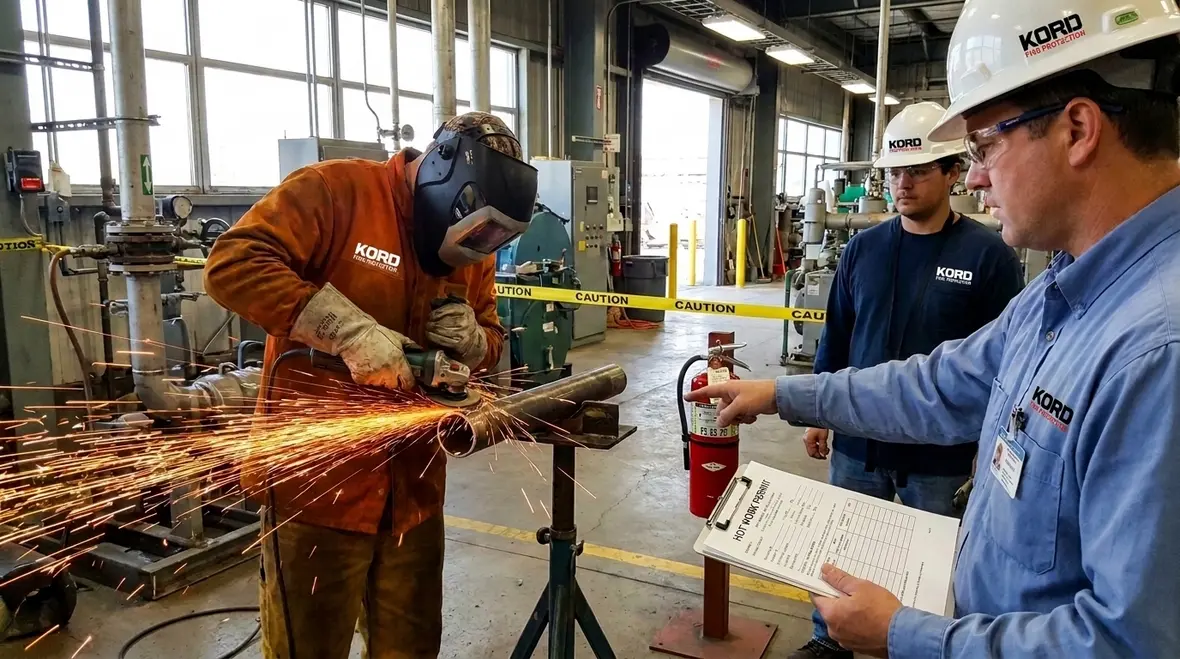
NFPA 35 Section 9.3 Hot Work Requirements: Hot Work Permit Plant Requirements Explained
Quick Answer
NFPA 35 Section 9.3 requires controlled hot work using a formal permit system, documented fire watch and safeguards, and verification that ignition and fuel sources are addressed before and during the task. For most facilities, the NFPA 35 hot work permit plant requirements also drive inspection, monitoring, and post work clearance.
Facilities tightening these controls often also benefit from stronger fire protection system documentation practices, since permits, follow up inspections, and closure records tend to become the paperwork equivalent of “trust me, it was fine” unless someone keeps the file cabinet honest.
What Section 9.3 Actually Demands Before Any Torch Fires Up
NFPA 35 treats hot work as a high consequence activity because ignition sources can persist long after the work ends. Section 9.3 establishes a structured process that begins before hot work starts and extends through completion and post work monitoring. This helps commercial facilities, industrial plants, and large retail operations avoid common failure points such as incomplete area control, missing verification steps, and ineffective fire watch practices.
In practical terms, compliance planning focuses on what must be controlled, who verifies it, and how the facility proves ongoing protection. Many sites incorporate the NFPA 35 hot work permit plant requirements into their work order workflow so the permit becomes a gating item for safety, not an afterthought.
Hot Work Permit Controls: Scope, Authorization, and Area Qualification
Under NFPA 35 Section 9.3, hot work cannot be treated as a “standard maintenance task” unless the permit process confirms conditions are safe to proceed. Facilities typically define hot work categories and document the authorization path. A compliant hot work permit process addresses:
- Scope of work, including welding, cutting, brazing, grinding, torch applied tasks, and similar ignition producing operations
- Location identification, down to the specific area, adjacent rooms, and any above ceiling or concealed spaces that could be exposed
- Time and duration, so the safety controls match the actual operating window
- Personnel accountability, including the person completing the permit, the hot work operator, and the approving authority
- Conditions precedent, including verification that combustible materials, ignition hazards, and unsafe atmospheres have been eliminated or managed
Commercial and retail facilities often struggle with “shared space” realities such as tenant adjacent operations, maintenance access corridors, and after hours deliveries. The permit must reflect those realities, not just the immediate work booth or shop area.
Pre Job Hazard Verification: Cutting Through the Most Common Compliance Gaps
Section 9.3 hot work controls depend on hazard verification, not assumptions. Before ignition sources begin, the facility must ensure that combustibles and ignition pathways are controlled. Common problem areas include:
1) Inadequate area cleaning and removal of combustibles
Hot work can ignite dust layers, residue on beams, combustible wall coverings, or paper and packaging stored nearby. Effective pre job controls document removal, covering, or relocation of combustibles within the hazard radius defined by the task and geometry of the space.
2) Failure to manage hidden ignition pathways
Fire can travel through cracks, conduits, cable trays, floor penetrations, and duct systems. Facilities must verify that where sparks or slag can land, the structure and voids are protected. This includes confirming that ventilation does not carry sparks to exposed combustibles.
3) Incomplete assessment of flammable vapors and residues
NFPA 35 emphasizes ignition source control in atmospheres where flammable vapors, gases, or residues may be present. Even if visible containers are removed, residual materials can remain in sumps, trenches, and equipment cavities. Permit documentation should confirm the method used to determine safe conditions.
4) Weak or inconsistent line of fire watch coverage
Fire watch actions require defined boundaries and authority. A common failure is assigning the fire watch to someone who lacks training time, is not empowered to stop work, or cannot access the area quickly enough to respond to smoldering ignition.
Controls During Hot Work: Safeguards, Fire Watch, and Equipment Mechanisms
Hot work permit plant compliance does not end when the torch turns on. Section 9.3 expects ongoing safeguards during the task, including maintaining protective barriers, controlling sparks and slag, and ensuring monitoring is active while the hazard exists. Effective operational controls typically include:
- Spark and slag protection, using appropriate shielding and noncombustible curtains or barriers sized for the work
- Fire extinguisher readiness, with equipment compatible with the anticipated hazards and placed within immediate access range
- Fire watch responsibilities, including continuous or appropriately defined observation intervals and the ability to initiate emergency response
- Hot work operator controls, such as safe housekeeping around the work zone and controlled movement of equipment
- Maintaining safe conditions, including periodic verification if conditions change during the job
From a mechanism standpoint, the main risk driver is not only the visible flame or arc. Sparks can embed into dust and insulation, and slag can remain hot enough to ignite hours later. Facilities therefore need to treat the “during work” period as a precursor to post work risk.
Post Work Requirements: Why Smoldering Creates Late Ignition Events
One of the most overlooked realities in hot work management is delayed ignition. Section 9.3 supports structured post work monitoring to confirm the area remains safe after the operator leaves. Facilities typically establish:
- Post work inspection intervals, with defined checks for smoldering, smoke, unusual heat, or re ignition indicators
- Extended fire watch or monitoring based on the combustible load, ventilation conditions, and task type
- Permit closure criteria, so the permit does not close until the risk is verified, not simply because the job ended
Commercial sites that operate late, have overnight tenant activity, or store seasonal inventory often require tighter coordination. Post work verification should account for operational changes after the task, such as HVAC start up, product movement, or evening cleaning that can disturb settled embers.
How Kord Fire Protection Supports Ongoing Compliance and Inspection Readiness
Hot work compliance relies on more than a form. It depends on functioning fire protection assets, correct operational readiness, and documented inspection practices that align with NFPA expectations. Kord Fire Protection helps commercial facilities maintain the systems and processes that support hot work risk controls, including maintenance planning, testing coordination, and ongoing readiness reviews.
For further guidance that complements hot work permit procedures, facilities can review best practices for fire protection system documentation and broader fire protection compliance auditing through Kord Fire Protection.
Frequently Asked Questions
Next Step: Make Your Hot Work Process Auditable
Review your current hot work permit workflow against NFPA 35 Section 9.3 by verifying hazard controls before work starts, confirming monitoring during the task, and enforcing post work clearance criteria. Then partner with Kord Fire Protection to strengthen inspection readiness and maintenance coordination for the protection systems your hot work depends on. Start with a gap assessment of your permit process, training records, and post work documentation today.

Join Our Newsletter!
Get the latest fire safety tips delivered straight to your inbox From our Newsletter.



