
NFPA 34 Section 9.4: Notification and Interlocks for Fire Protection
Quick Answer
NFPA 34 Section 9.4 requires fire protection notification and interlock functions to alert occupants and coordinate connected fire protection actions. These systems must be designed to operate reliably, be inspected, and fail in a safe manner to support timely response and reduce fire risk in commercial operations.
For facilities that also need a stronger handle on connected water based system performance, fire pump testing requirements are worth reviewing alongside notification and interlock planning. It is a natural companion topic when alarm logic, supervisory signals, and equipment response all need to behave like a coordinated team instead of a committee.
What NFPA 34 Section 9.4 actually demands
NFPA 34 Section 9.4 focuses on how fire protection systems notify people and how they coordinate with other protective functions through interlocks. In practice, NFPA 34 fire protection notification interlocks link detection and alarm control logic to specific actions such as shutting down hazardous operations, initiating engineered fire protection equipment, and managing door control, ventilation, or process controls. The goal remains the same: deliver dependable signaling and ensure that critical equipment transitions occur in the correct sequence.
For commercial, industrial, and retail occupancies, compliance hinges on more than writing a system description. It hinges on operational logic, wiring integrity, setpoint alignment, commissioning records, and ongoing maintenance that preserves the intended sequence of operation over time.
Where notification and interlocks show up in real facilities
Notification and interlocks typically appear across multiple facility functions. Common commercial configurations include:
- Alarm notification and evacuation coordination: visible and audible notification appliances tied to the system control panel logic and occupant notification strategy.
- Fire pump and water based system interfaces: alarm signaling, start command verification, supervisory status monitoring, and supportive control interlocks.
- Special hazard controls: interlocked actions such as HVAC shutdown, damper closure, or process shutdown where required by the fire protection concept.
- Door and compartment management: interlocks with door holders or release systems where listed and installed as part of the fire and life safety strategy.
- Supervisory signaling for abnormal system states: trouble, supervisory, and maintenance signals that support operational readiness.
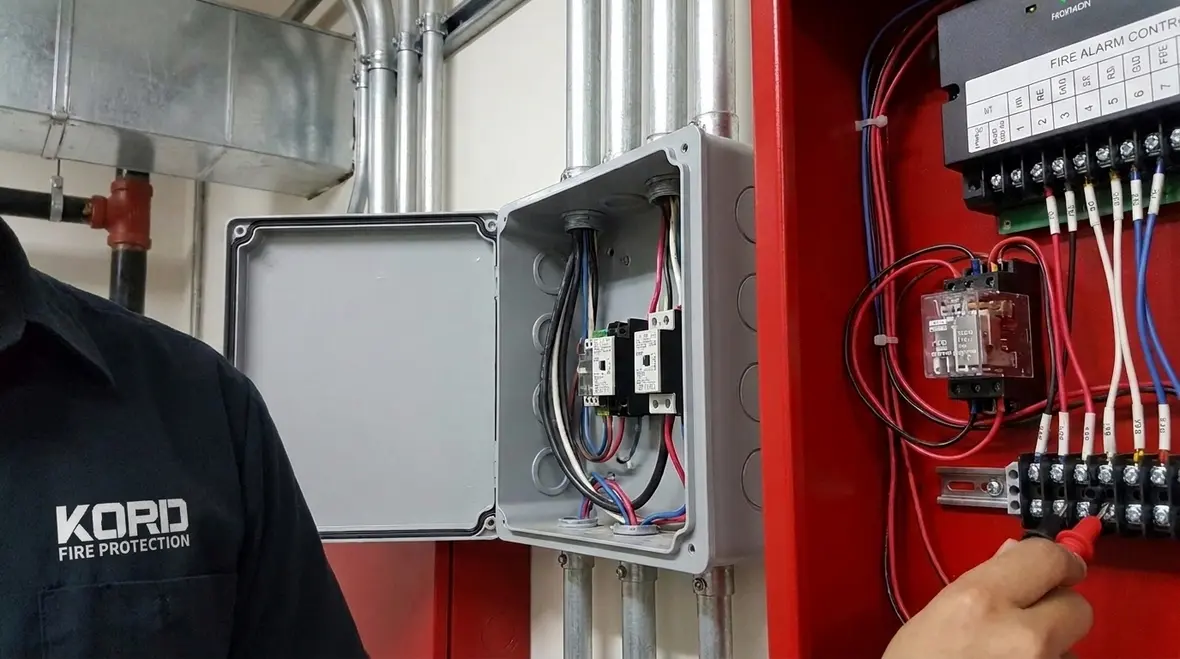
Facilities often implement these controls through a combination of fire alarm control unit outputs, relay modules, PLC inputs, or dedicated control panels. The implementation details determine whether the interlocks truly execute as intended during alarms, supervisory conditions, and off normal transitions.
How NFPA 34 fire protection notification interlocks are designed to work
Section 9.4 centers on the performance of notification and interlock logic. Strong designs follow a repeatable logic framework that reduces ambiguity during an incident:
1) Defined alarm states and output mapping
System designers define which alarm condition drives which output. Interlock outputs should map cleanly to notification and protective actions, such as:
- Which alarm level triggers occupant notification.
- Which alarm level triggers process shutdown, ventilation control, or equipment actuation.
- Which condition only triggers supervisory signaling versus full actuation.
When mapping becomes inconsistent across drawings, device labels, and control logic, the system can appear compliant on paper while failing operationally.
2) Interlock sequence and timing
Interlocks frequently require correct sequence and timing, for example, sounding notification while simultaneously initiating equipment that supports occupant movement or hazard control. If timing is too short, connected equipment may not be ready. If timing is too long, occupants could face delayed signaling and preventable escalation. Inspection and testing should confirm sequence behavior under realistic operational conditions.
3) Fail safe behavior and safe reversion
Notification and interlocks must handle abnormal conditions without creating dangerous transitions. Common safe behavior expectations include:
- Supervision of power loss or wiring faults where required.
- Fail safe outputs that do not cause hazardous behavior if control power is interrupted.
- Controlled reversion after alarm conditions clear to avoid unintended restart or reenergization.
In practice, many failures come from relay contacts drifting, terminal block corrosion, incorrect end of line supervision, or changes to process equipment that alter input and output behavior without updating control logic.
Common compliance and maintenance challenges (and how to prevent them)
Commercial facilities frequently encounter the same operational failure points when notification and interlock logic evolves over time. The issues often fall into predictable categories.
Challenge: Control logic drift from remodels and equipment swaps
Renovations, tenant changes, and process upgrades often modify hardware or control interfaces. Unless documentation updates and functional testing keep pace, interlocks may:
- Trigger the wrong equipment.
- Trigger only part of the intended sequence.
- Trigger at an incorrect alarm level.
Preventive action includes change management that ties engineering revisions to verification testing of each interlock output.
Challenge: Device labeling and as built mismatch
Interlocks rely on accurate mapping. Inadequate labeling or inconsistent point names can cause maintenance technicians to test the wrong circuit. That leads to “paper acceptance” rather than verified performance.
Challenge: Wiring and connection integrity
Field issues commonly include loose terminations, incorrect supervision resistor placement, or intermittent faults due to moisture exposure. These can produce partial operation during drills, which undermines confidence and increases response time.
Challenge: Lack of functional testing for interlocks
Many programs focus on detector sensitivity checks and basic alarm verification, then overlook the interlock portion of the system. Section 9.4 requires that connected actions occur correctly. A compliant maintenance program should therefore test notification performance and connected interlock responses as an integrated system.
To support ongoing compliance, Kord Fire Protection helps commercial facilities maintain notification and interlock integrity through inspection, testing, documentation review, and corrective action planning. For additional guidance on service scope and expectations, see NFPA 20 Chapter 14 fire pump acceptance testing requirements and request a tailored maintenance and testing plan.
Testing and inspection approach for notification and interlocks
A practical test strategy verifies that the system meets the intent of Section 9.4, not only that components function independently. A strong approach includes:
Pre test readiness checks
- Confirm latest drawings, point lists, and sequence of operations match the current field configuration.
- Verify labeling, terminal strip numbering, and wiring run identification.
- Review prior inspection and correction history for recurring trouble points.
Functional testing of notification
- Initiate alarm conditions to verify audible and visible output behavior.
- Confirm programmed alarm routing matches the notification strategy for the occupancy.
- Verify supervisory and trouble signals behave as expected during faults.
Functional testing of interlocks
- Simulate alarm states that should activate each interlocked output.
- Verify each connected device reaches the intended state in the required sequence.
- Confirm interlock signals do not activate when conditions are not met.
- Verify post alarm reversion behavior is correct and safe.
Facilities should document results in a manner that allows future technicians to confirm the same logic, sequence, and output behavior during subsequent testing cycles.
FAQs about NFPA 34 fire protection notification interlocks
Conclusion and call to action
NFPA 34 Section 9.4 requires notification and interlocks to operate as an integrated life safety and protective response, not as isolated components. Commercial facilities protect their occupants and reduce operational risk when they verify the sequence, supervision, and fail safe behavior through documented functional testing. If your facility needs an interlock performance review, testing plan, or maintenance program alignment, contact Kord Fire Protection today to schedule a compliance focused assessment.

Join Our Newsletter!
Get the latest fire safety tips delivered straight to your inbox From our Newsletter.



