
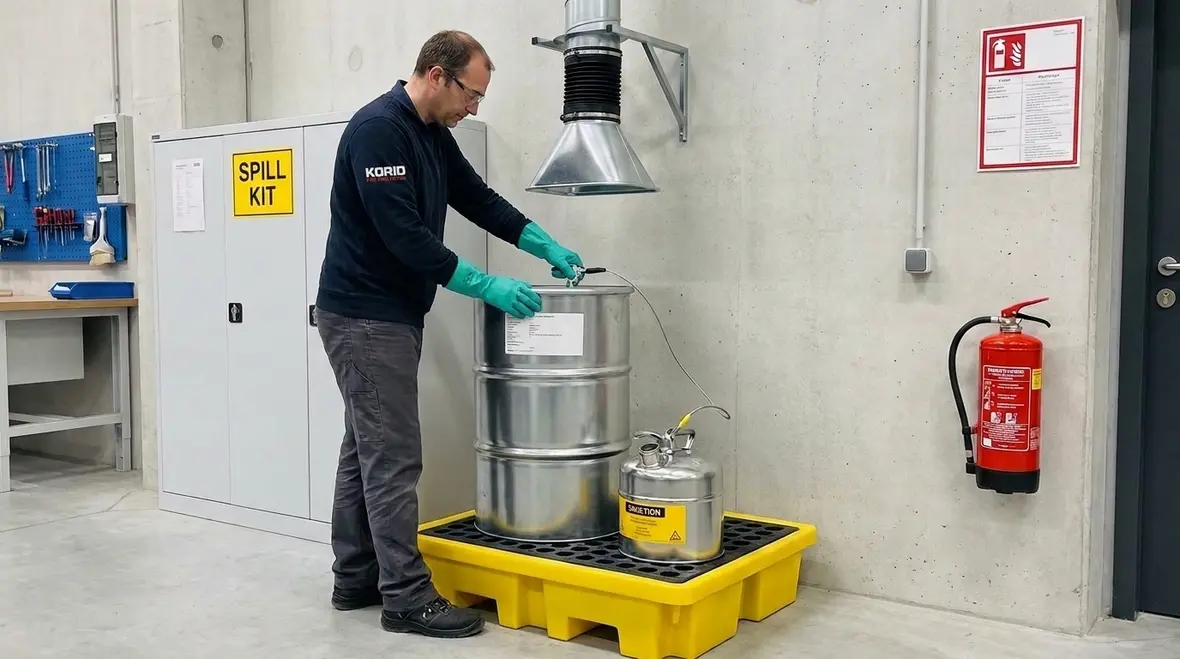
NFPA 34 Section 8.5: Handling Liquids at the Point of Final Use
Quick Answer
NFPA 34 Section 8.5 governs how facilities manage flammable and combustible liquids at the point of final use, including safe container handling, transfer controls, ignition source management, and maintenance of spill protection. Compliance reduces release risk, limits fire growth, and supports dependable operational control.
What does NFPA 34 Section 8.5 require at the point of final use?
NFPA 34 point of final use liquid handling focuses on the period when liquids are actively used for their intended process, not just when they are stored or transported. Commercial facilities frequently fail here because procedures, equipment condition, and housekeeping controls drift over time. Section 8.5 addresses the practical controls that prevent leaks, minimize vapor accumulation, and limit ignition exposure at the work location where the liquid is opened, dispensed, mixed, or applied.
For facilities such as machine shops, maintenance bays, laundries, coating areas, retail service counters, and light industrial production lines, the compliance challenge often comes down to consistent day-to-day execution. Kord Fire Protection supports ongoing program readiness through inspections, documentation support, and targeted corrective actions aligned with NFPA expectations and facility realities. For a broader look at how records and logs support inspection success, review fire safety system documentation for compliance.
NFPA 34 point of final use liquid handling: key operational controls
1) Manage containers and openings as the process begins
At the point of final use, liquids typically move from closed storage into working containers, drums, portable cans, reservoirs, or application systems. NFPA 34 expectations emphasize that openings, transfers, and decanting operations receive the same discipline as broader fire safety systems because the ignition potential is highest when vapors and residues are exposed.
- Keep containers closed when not actively dispensing.
- Use compatible, labeled containers rated for the product and intended service conditions.
- Control decanting and manual pouring practices to reduce splashing and aerosolization.
- Provide secondary containment where leaks could reach ignition-prone equipment or electrical components.
2) Prevent vapor accumulation and keep ventilation effective
In practice, the most common failure is not the absence of ventilation, but ventilation that becomes ineffective due to obstructions, duct damage, changes in layout, or poor capture performance. Section 8.5 requirements align with the core intent of limiting vapor release and preventing ignition-capable vapor concentrations at the point of use.
- Verify ventilation settings and operational status during normal shift operations.
- Ensure local exhaust capture remains positioned for the actual dispensing height and flow pattern.
- Control idle equipment, fans, and dampers so they remain functional during active use.
- Document maintenance actions that could change airflow characteristics.
3) Control ignition sources within the immediate work area
Ignition source management includes more than eliminating obvious flame sources. It requires controlling electrical, mechanical, and static electricity risks that become relevant when vapors and fine mist are present. In commercial environments, ignition risks often come from portable tools, motors, switches, and poor grounding practices during transfer and refill.
- Use equipment designed or managed for the hazardous location classification where required.
- Implement static control practices for transfer and dispensing operations.
- Maintain good housekeeping to remove spilled residues that can later re-evaporate.
- Restrict use of spark producing tools near open product containers.
How do facilities comply day to day: procedures, training, and verification?
NFPA 34 point of final use liquid handling succeeds only when procedures match real workflows. Many organizations write procedures for peak operating conditions but fail to address routine deviations such as “quick top-offs,” unplanned container swaps, or temporary staging of materials during maintenance.
Written procedures that reflect real workflows
- Define allowable container types, transfer methods, and dispensing limits for each process.
- Specify steps for opening, transferring, closing, and labeling working containers.
- Require spill response triggers for minor drips and active leaks, not only major events.
- Set rules for when ventilation must be running and when tools may be energized.
Training that covers failure points
Training should focus on the practical causes of releases at point of use: damaged hoses, worn fittings, improper gasket selection, container mis-match, and poor spill response habits that push residue into drains or onto hot surfaces.
- Train operators to recognize early signs of deterioration such as softening, swelling, and cracking.
- Require competency checks after any equipment change or process modification.
- Include guidance for handling product in varying ambient conditions that affect evaporation rates.
Verification during routine inspections
Inspections should confirm that controls remain effective during normal operations, not only during walkdowns. Facility teams commonly overlook issues that develop between formal inspections, including partially blocked local exhaust, inconsistent spill kit replenishment, or missing caps and degraded seals.
Kord Fire Protection helps facilities build inspection and maintenance routines that support consistent compliance outcomes, including corrective action tracking and practical documentation that aligns with commercial inspection expectations.
Equipment and maintenance: what breaks first at the point of final use?
Section 8.5 compliance often depends on mechanical integrity. At the point of final use, systems experience frequent handling cycles and repeated exposure to chemicals, heat, and contamination. The most common failure points include seals, hoses, dispensing nozzles, and containment interfaces.
Common equipment failure points
- Hoses and fittings: cracking, permeation, loose clamps, and gasket mismatch that create slow leaks.
- Nozzles and valves: stuck check valves, worn O-rings, and drips caused by erosion or residue buildup.
- Pouring spouts and funnels: poor fit that produces splashing or vapor release.
- Secondary containment: damaged berms, clogged sumps, or missing drain plugs that negate containment value.
- Spill response equipment: expired absorbents, incomplete kits, and missing compatible neutralizers or pads.
Maintenance controls that reduce release risk
- Use a documented inspection interval for hoses, fittings, and seals based on service history and product compatibility.
- Ensure spill containment remains clean and functional so it can accept released liquid immediately.
- Verify that ventilation and exhaust systems remain free of obstructions.
- Replace components at defined condition thresholds, not only after visible failure.
For complementary guidance on broader fire protection program maintenance and inspection planning, facilities can also review Kord Fire Protection resources at commercial fire suppression systems and services.
Inspection readiness: how authorities and insurers evaluate real conditions
During inspections, evaluators typically look for evidence that the facility controls hazardous liquid behavior during active use. They often focus on “process moments” where ignition potential peaks: refilling, decanting, mixing, and open-container periods. The goal is to confirm the controls are understood, implemented, and maintained.
What inspectors typically validate
- Working container practices, including closing discipline and labeled identity.
- Secondary containment availability and condition at the point of final use.
- Ventilation operation during dispensing and mixing activities.
- Housekeeping and spill residue control on floors, ledges, and near electrical hardware.
- Operator training records and written procedures that reflect actual practices.
Common nonconformities that trigger corrective actions
- Spill kits present but not maintained, missing absorbents, or incompatible materials.
- Open containers staged beyond the work area without immediate containment.
- Drips and residue accumulating around valves, pumps, and hose connections.
- Ventilation turned off during production “breaks” despite continued dispensing.
- Improvised transfer solutions that bypass defined methods or controls.
Kord Fire Protection provides structured support for commercial facilities managing recurring inspection pressure, helping teams identify likely gaps before formal evaluations and implementing corrective action systems that sustain compliance.
Frequently Asked Questions
Conclusion and next step
NFPA 34 Section 8.5 requires disciplined, verifiable controls during the moments when liquids are handled at the point of final use. Facilities should validate container practices, ventilation performance, ignition source controls, and the maintenance condition of hoses, valves, and spill protection. Kord Fire Protection can help commercial teams assess current conditions, prioritize corrections, and sustain readiness through practical inspection and maintenance support. Schedule a compliance review to close gaps before the next inspection cycle.

Join Our Newsletter!
Get the latest fire safety tips delivered straight to your inbox From our Newsletter.



