
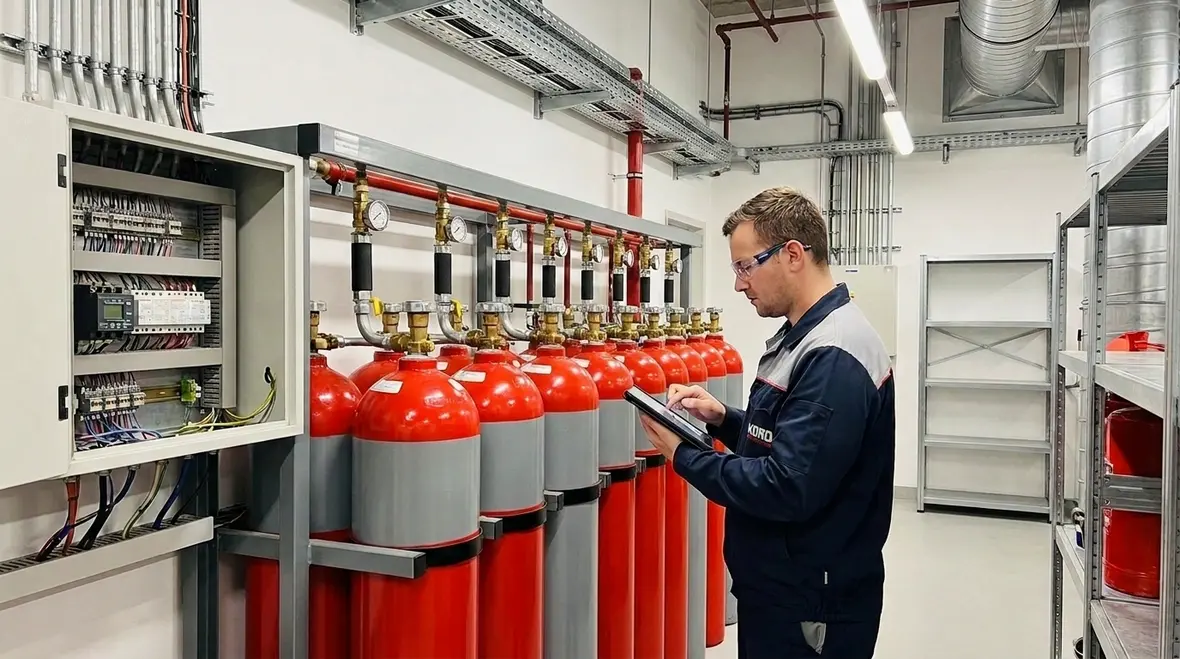
NFPA 34 Section 9.8: CO2, Dry Chemical, Clean Agent, Water Mist, and Hybrid Systems
Quick Answer
NFPA 34 Section 9.8 establishes detailed requirements for fire extinguishing systems using CO2, dry chemical, clean agents, water mist, and listed hybrid approaches. It focuses on system selection, design intent, installation safeguards, operational reliability, and ongoing inspection and maintenance to keep hazards protected.
For facilities reviewing broader protection planning, fire protection services in Southern California can help connect suppression, alarm, inspection, and maintenance work into one compliance-focused service path.
What does NFPA 34 Section 9.8 actually require?
NFPA 34 Section 9.8 addresses gaseous, particulate, clean agent, water mist, and hybrid extinguishing systems used to protect industrial and commercial hazards. For facilities planning or upgrading protection, the section drives how these agent types operate in practice, including expectations for equipment compatibility, controls, and the procedures needed to maintain reliability over time.
For many operators, the key compliance goal is to ensure the installed system performs as intended under real operating conditions, not just on acceptance testing day. That is where NFPA 34 CO2 dry chemical clean agent water mist systems become a practical maintenance and operations issue, especially in retail back-of-house storage, light industrial processing, and commercial service areas.
Agent behavior matters: CO2, dry chemical, clean agents, and water mist
Section 9.8 ties system effectiveness to the physical properties and discharge characteristics of each agent type. Commercial facilities often experience performance drift from common real world issues such as environmental temperature swings, contamination of nozzles, corrosion, improper cylinder handling, and mismatched control logic.
CO2 systems
CO2 relies on reducing oxygen concentration through enclosure or volumetric design intent. Compliance challenges frequently involve the integrity of room boundaries, door operation, and ventilation conditions that can defeat concentration buildup. Controls and interlocks must align with the hazard mode of operation. If fans cycle, dampers fail, or evacuation sequencing is bypassed, protection may degrade even though the system technically discharges.
Dry chemical systems
Dry chemical extinguishes by interrupting chemical chain reactions and forming a barrier on certain fuels. The trade reality is residue accumulation that affects housekeeping requirements, equipment cleanliness, and detector performance. In many facilities, repeated minor discharges for training expose wear points such as clogged discharge lines or partial valve seating that only becomes obvious during later inspections.
Clean agent systems
Clean agents primarily work through interference with combustion chemistry and concentration effects. These systems require accurate storage conditions, correct manifold configurations, and strict adherence to flooding concepts. Operators often underestimate how maintenance and cylinder pressure verification affect performance. Even small deviations from listed operating parameters can reduce effectiveness.
Water mist systems
Water mist relies on controlling droplet size, distribution, and heat absorption. Compliance success depends on nozzle integrity, pressure management, filtration, and the ability to maintain discharge patterns under flow and obstruction scenarios. Common failure points include mineral scaling, altered spray characteristics from partially blocked nozzles, and hydraulic system drift due to aging components.
How hybrid systems change the compliance conversation
Hybrid systems combine agent types to address hazards where a single suppression method may not provide reliable performance. NFPA 34 Section 9.8 treats hybrid designs as integrated systems with coordinated controls, sequencing expectations, and clear intent for how each agent contributes during discharge.
In practice, hybrid systems raise additional operational risks:
- Sequencing errors between detection, warning, agent release, and ventilation control.
- Interference between discharge patterns, especially where piping runs or nozzle placements overlap.
- Maintenance complexity, because multiple agent subsystems require different inspection and verification methods.
Facilities should treat hybrid systems as a combined reliability program, not parallel checklists. Kord Fire Protection typically coordinates inspection planning across detection, actuation, power supplies, valves, and discharge devices so that recurring compliance work does not introduce new incompatibilities.
Inspection, testing, and maintenance: where NFPA 34 compliance often breaks
NFPA 34 Section 9.8 places emphasis on readiness, functional integrity, and the ongoing ability to achieve suppression goals. Commercial sites commonly face compliance gaps due to inconsistent maintenance schedules, partial component replacement, and incomplete documentation.
Common inspection and verification pressure points
- Detection and control verification: Confirms that the detection circuit, release logic, and warning sequences function as designed during supervisory and alarm conditions.
- Cylinder and pressure-related checks for CO2 and clean agent systems: Ensures gauges, regulators, and actuator components remain within listed operating expectations.
- Valve and actuator integrity: Confirms correct seating, flow paths, and absence of binding that can prevent full discharge.
- Piping, nozzles, and obstructions for dry chemical and water mist: Validates line continuity, strainers, filtration, and discharge distribution.
- Contamination and residue management: Ensures buildup from dry chemical discharges does not impair detectors, wiring, or discharge components.
Operational failures that look like “it should work”
Even when inspections identify components as “present and connected,” functional failure can occur from:
- Ventilation fans running contrary to release intent.
- Enclosure boundaries changed by renovations, open doors, or altered HVAC flow paths.
- Equipment moved or added since commissioning, blocking discharge pathways.
- Training discharges that create residue and require post discharge cleaning and re-verification.
Kord Fire Protection supports facilities with documentation and reliability focused service planning. The service value is not only meeting inspection intervals, but also correcting the underlying causes that drive repeat failures, including component drift, environmental stressors, and installation changes over time.
To support broader system life cycle compliance, facilities often also review related fire protection guidance such as this resource on maintaining commercial equipment readiness: Kord Fire Protection commercial fire safety services.
Design and installation details that affect real-world performance
NFPA 34 Section 9.8 requirements are not limited to discharge hardware. Systems perform based on the full chain of reliability from detection and control to agent release and hazard coverage. Installations that technically “pass” can still underperform when common design assumptions do not match how the space operates.
Key design and installation considerations
- Hazard classification alignment: Ensures agent selection matches fuel properties, configuration, and exposure conditions.
- Room integrity and ventilation interfaces: Supports CO2 and clean agent enclosure performance and mitigates ventilation override risk.
- Distribution accuracy: Ensures dry chemical discharge and water mist spray patterns align with listing and design intent.
- Control panel and release power reliability: Verifies that standby power, interlocks, and fail states prevent inadvertent discharge or missed releases.
For commercial and retail operators, the biggest compliance challenge typically comes from change. Renovations, added racking, new HVAC schedules, and modified door behavior can undermine hazard assumptions that were valid at original commissioning.
Frequently Asked Questions
Next step: keep systems reliable, not just compliant
Facilities that manage NFPA 34 CO2 dry chemical clean agent water mist systems should treat Section 9.8 as an operational reliability framework. Schedule a service review to confirm detection to discharge sequencing, verify agent hardware readiness, assess discharge distribution risks, and document corrective actions. Kord Fire Protection helps commercial, industrial, and retail sites maintain dependable performance through inspection planning, testing support, and maintenance that addresses common failure causes. Contact Kord Fire Protection today to build a compliance-ready maintenance plan.

Join Our Newsletter!
Get the latest fire safety tips delivered straight to your inbox From our Newsletter.



