
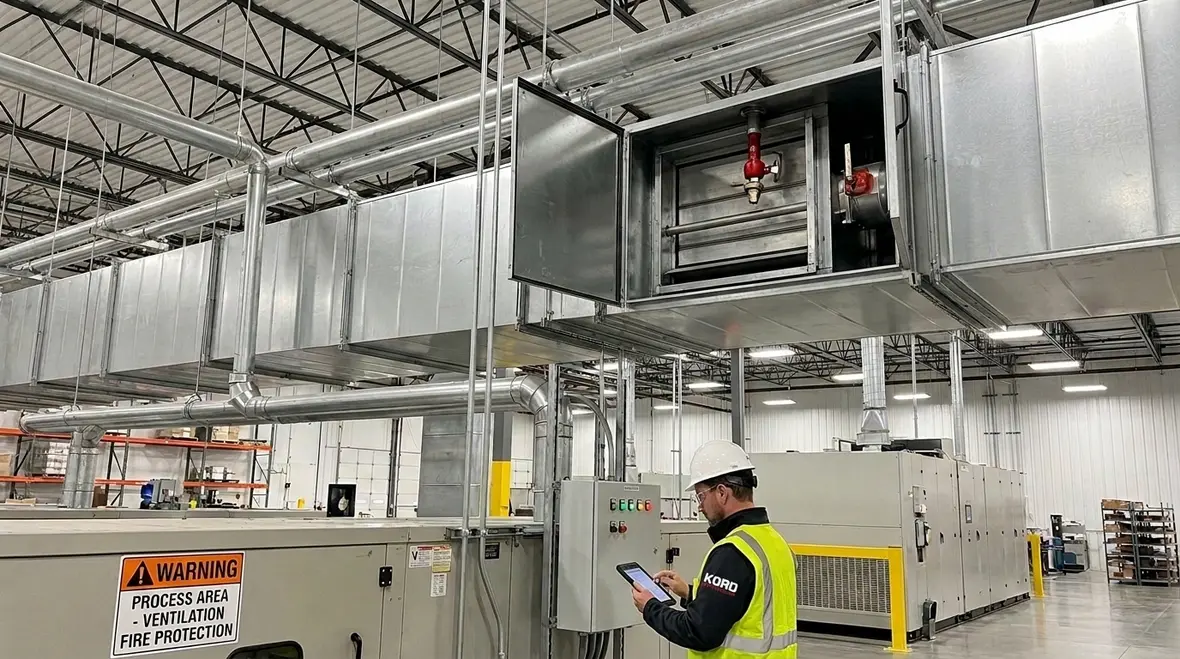
NFPA 34 Section 9.3: Protecting Ventilation Systems From Process Fire
Quick Answer: NFPA 34 Section 9.3 addresses how to protect ventilation systems when process fires could enter ductwork, fans, or connected air distribution components. Effective NFPA 34 ventilation system fire protection relies on correct detection, isolation, suppression, and disciplined inspection and maintenance.
For facilities reviewing duct related protection details, Kord’s article on fire dampers and why every building needs them offers useful context near the top of the planning process.
Why Section 9.3 Matters in Real Facilities
Section 9.3 focuses on a practical risk most commercial and industrial facilities eventually face: a process fire starts upstream, then smoke, flame, and hot gases migrate through ventilation openings, ducts, plenums, or air handling equipment. This migration can quickly turn a localized incident into a facility wide failure that endangers occupants, damages high value assets, and disrupts essential operations.
In the context of NFPA 34 ventilation system fire protection, compliance does not stop at installing a device. It requires selecting the right protection method for the ventilation configuration, verifying operation through inspections, and maintaining system performance so controls and protective features work when needed.
What NFPA 34 Section 9.3 Typically Requires
While exact requirements depend on the fuel, process conditions, and the ventilation system design, Section 9.3 commonly drives the following protection concepts:
- Fire and smoke control through the ventilation path when process hazards communicate with ducts, fans, or air moving equipment.
- Prevention of fire spread between the process area and other parts of the building.
- System behavior under abnormal conditions such as fan operation during a fire, damper position changes, and interruption of airflow when needed.
- Ongoing inspection, testing, and maintenance to sustain protective performance.
In facility compliance programs, this usually translates into a documented approach that ties hazard classification to the selected protection strategy and verifies that the strategy actually actuates in the required time window.
How Ventilation Fires Actually Spread Through Ducts
Understanding the failure modes helps teams choose the correct protection method and set effective inspection criteria. Common pathways include:
1) Flame and hot gases enter duct openings
Openings near process equipment can become ignition portals. Once hot gases enter the duct system, temperatures can rise quickly, damaging fan components, wiring, and control devices.
2) Fans can propagate combustion
Mechanical airflow may push flames and ember containing gases further into the building. If a fan remains running during a fire condition, the ventilation system can become a distribution mechanism rather than a safe exhaust pathway.
3) Dampers fail due to lack of maintenance or wrong configuration
Dampers and fire stopping features can fail for several reasons: obstructed blades, stuck fusible links, degraded actuator performance, miswired control logic, or incorrect reset procedures after prior actuations.
4) Detection delays degrade performance
If detection is poorly located or not coordinated with the process hazard, the system may actuate late. Late actuation increases fire size, complicates evacuation decisions, and can overwhelm limited suppression capabilities.
These mechanisms drive the practical goal of NFPA 34 ventilation system fire protection: isolate and mitigate fire spread through the ventilation path, not just respond after conditions worsen.
Protection Methods: What to Verify During Design and Compliance Reviews
Facilities typically rely on a combination of protective features. The compliance question is not “is there protection,” but “does the protection sequence achieve the required functional outcome.” Key verification areas include:
Detection and actuation coordination
Review detector types, spacing, placement, and wiring supervision. Confirm that detection signals reach the correct control panels and that the actuation sequence matches the intent of Section 9.3. Common compliance issues include detector placement that does not reflect process plume behavior and control logic that does not prioritize fire isolation.
Fire and smoke damper performance
Where dampers exist, teams should verify the following:
- Correct damper type for the application and temperature ratings
- Fail safe position and supervisory status
- Operational checks that demonstrate full closure travel
- Accessibility of actuators, linkages, and reset mechanisms
Also verify that building envelope penetrations and duct wall interfaces include appropriate fire stopping, because a closed damper cannot compensate for compromised duct boundaries.
Fan shutdown and airflow control
When the ventilation system could spread fire, the design should control fan operation. Inspect control sequences to confirm that fans shut down or transition to a safe mode under fire conditions, as required by the system’s hazard assessment. A frequent operational gap occurs when the site relies on “normal shutdown” logic rather than fire prioritized control.
Suppression and duct protection where applicable
Some systems require suppression strategies suitable for ducted ventilation fire scenarios. In those cases, verify the coverage concept, agent release logic, and post discharge procedures. Suppression equipment must remain serviceable and correctly maintained, or it becomes a non functional asset at the worst time.
Maintenance and inspection readiness
Commercial facilities often struggle with inspection access and recordkeeping. A compliant program ensures technicians can reach dampers, test connections, detectors, and control components without bypassing protective features. Kord Fire Protection supports this operational reality through ongoing inspection, testing, documentation, and maintenance coordination, helping facilities keep their ventilation protection aligned with inspection expectations.
For further fire protection scope planning and documentation alignment, teams can reference Kord Fire Protection for commercial service support, or review Kord’s broader approach to the full lifecycle of fire protection servicing to connect inspection, maintenance, and verification into one program.
Common Compliance Challenges in Commercial, Industrial, and Retail Settings
Section 9.3 is often where design intent meets field conditions. The most common challenges include:
- Process changes without ventilation protection updates, such as new burners, added production lines, or revised airflow patterns.
- Storage and housekeeping interference that blocks detector coverage or restricts damper movement.
- Afterhours operational overrides that alter control sequences to manage comfort or downtime, unintentionally undermining fire protection logic.
- Reset practices that do not restore full protective performance after actuation or partial fault conditions.
- Shared systems across multiple hazard zones that require zone specific isolation and clear control logic.
To address these issues, many mature facilities apply a change management process that triggers a protection re evaluation when process parameters or ventilation configurations change. That approach reduces the likelihood of “compliant on paper” systems that fail during operational testing.
Frequently Asked Questions
Next Steps: Build a Verifiable Protection Program
Facilities should confirm that the ventilation hazard assessment, protection method selection, and control sequences align with NFPA 34 Section 9.3, then validate performance through documented testing and maintenance. Engage Kord Fire Protection to support inspections, functional testing readiness, and ongoing service planning so NFPA 34 ventilation system fire protection remains reliable across process changes and routine operations.

Join Our Newsletter!
Get the latest fire safety tips delivered straight to your inbox From our Newsletter.



