
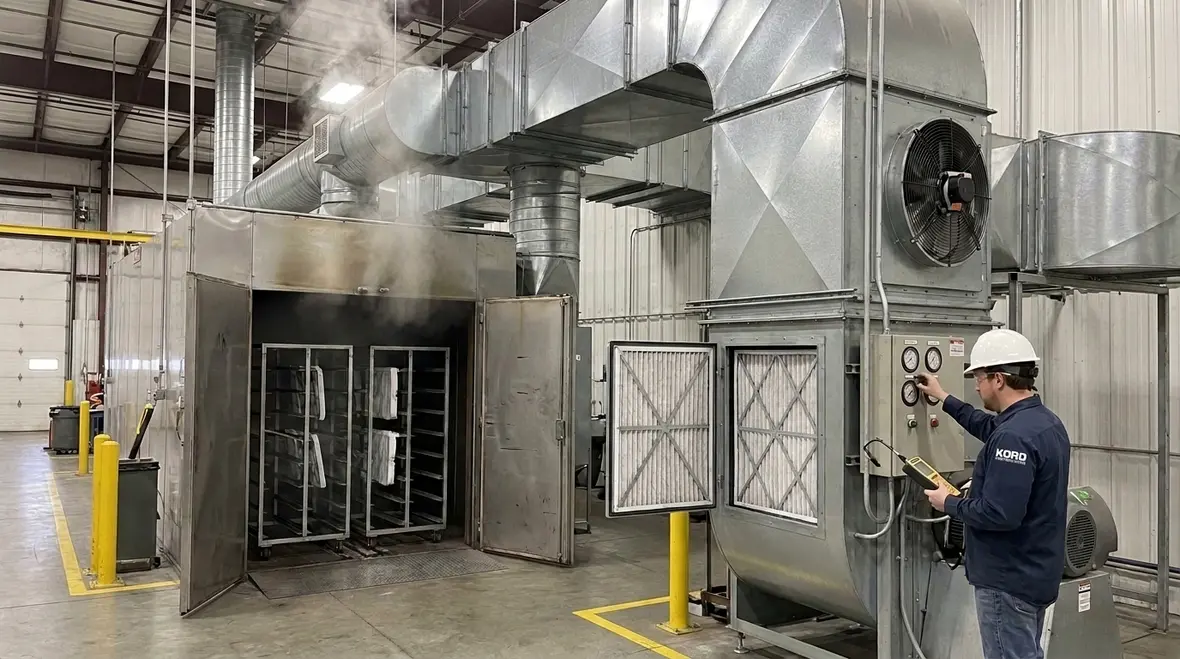
NFPA 34 Section 7.12: Ventilation for Drying Areas
Quick Answer: NFPA 34 Section 7.12 requires drying areas to be ventilated so flammable vapors, dusts, and combustion byproducts do not reach hazardous concentrations. Facilities must size exhaust and make up air appropriately, maintain controls, and verify performance through inspection and maintenance.
Facilities working on broader inspection readiness can also review commercial building fire safety with Kord Fire Protection technicians to connect ventilation performance with documentation, testing, and real-world system verification.
Why NFPA 34 drying area ventilation requirements matter in real buildings
Drying operations concentrate heat, solvents, moisture, and sometimes combustible residues in a defined space. When vapors accumulate, ignition sources can convert an otherwise controlled process into a flash fire or fire propagation event. That is why NFPA 34 drying area ventilation requirements in Section 7.12 focus on maintaining safe vapor concentrations through designed airflow, effective exhaust, and reliable air movement.
In commercial, industrial, and retail occupancies, the compliance challenge rarely comes down to “having a fan.” Instead, it comes down to documenting that the ventilation system performs as intended after installation, modifications, filter changes, duct routing changes, and ongoing maintenance gaps.
What Section 7.12 expects from ventilation in drying areas
NFPA 34 Section 7.12 addresses ventilation as a core means of controlling hazardous atmospheres in drying areas. The intent is to prevent the buildup of flammable or combustible vapors and residues by removing contaminated air and supplying replacement air in a way that sustains safe conditions throughout the drying process.
1) Air removal and containment at the source
Effective drying area ventilation requires removal of contaminated air where vapors are generated. This typically means local exhaust concepts that capture vapors before they disperse into the broader space. When exhaust is poorly positioned, short circuited, or overridden by HVAC airflows, vapors can spread across the room and increase risk.
2) Proper airflow direction and pressure control
Ventilation systems must manage airflow patterns so the drying area does not become a vapor reservoir. Facilities frequently achieve this using exhaust design and make up air strategies that avoid backflow and uncontrolled mixing. If pressure relationships shift during operating modes, such as door opening, pallet movements, or simultaneous warehouse ventilation, the ventilation outcome can degrade even when equipment is “running.”
3) System performance that matches operating conditions
Drying conditions change. Loads vary. Doors open. Products off gas at different rates based on chemistry and temperature history. NFPA 34 Section 7.12 supports ventilation approaches that remain effective during normal operating ranges, not just at a single design point.
How to size and configure drying area exhaust for compliance
Ventilation for drying areas must be engineered to remove and dilute hazardous constituents to safe levels. In practice, compliance efforts succeed when engineering calculations are paired with field verification.
Match exhaust rates to the drying process, not just the room
Drying area ventilation requirements cannot rely solely on room volume. The critical drivers include solvent use, drying temperature, duration, product throughput, and the expected vapor generation rate. Many failures occur when the exhaust system is sized for the original product and then the facility later switches to a different coating, adhesive, or drying profile without revalidating ventilation.
Provide make up air to sustain air movement without creating new hazards
Exhaust removes air; the room must receive replacement air. Make up air that is not coordinated can reduce exhaust effectiveness or push vapors into other zones. It can also introduce ignition hazards if heaters or fans are not compatible with the hazard classification and ducting design.
Ensure ducting and airflow paths stay within engineered limits
Duct routing changes, partially blocked ductwork, collapsed flexible connections, and undersized transitions can all reduce capture efficiency. Filters that are not maintained are a common failure point: as pressure drop increases, the exhaust air volume decreases, and vapors accumulate closer to the source.
Inspection, testing, and maintenance: the compliance reality
NFPA 34 ventilation requirements depend on ongoing performance, not only initial installation. Commercial facilities typically meet compliance expectations by combining scheduled inspections, measurements, and corrective maintenance with clear operational procedures.
What inspectors and internal safety teams usually verify
- Exhaust and make up air operation: Fans and dampers operate in the intended mode during drying.
- Airflow performance: Measured airflow values remain within design tolerances.
- Capture effectiveness: Evidence supports that vapors do not escape to adjacent workspaces.
- Maintenance records: Filter changes, duct inspections, and motor or belt service occur at defined intervals.
- Control and interlock function: Ventilation controls fail safe and do not get bypassed.
Common failure points that lead to unsafe conditions
- Dirty or mismanaged filtration: Increased resistance lowers airflow and reduces dilution.
- Damper misalignment or stuck dampers: Seasonal HVAC changes and maintenance can disrupt airflow balance.
- Undocumented modifications: New racks, different product quantities, or added heaters can change vapor release patterns.
- Exhaust fan degradation: Motor wear, belt slippage, and wheel buildup reduce CFM over time.
- Operational drift: Staff practices such as leaving doors open longer than planned can undermine ventilation effectiveness.
Operational procedures that support safe ventilation outcomes
Compliance improves when procedures specify when ventilation must start, when it must continue, and how changes in product or drying schedules trigger reassessment. Facilities should include ventilation verification steps into start up and shift turnover practices, especially after maintenance or any change to drying chemistry.
Integration with commercial fire safety systems and facility standards
Ventilation does not operate in isolation. In real commercial and industrial environments, drying areas also rely on ignition control, safe housekeeping, electrical protection, and fire prevention practices. Ventilation interacts with other safety systems through airflow patterns, door management, and equipment placement.
Working with a specialist helps reduce compliance gaps
Facilities often underestimate the amount of documentation and field verification required for ongoing compliance. Kord Fire Protection supports commercial clients with practical, service oriented compliance work that aligns fire protection program needs with real operational constraints, helping facilities maintain ventilation performance and readiness over time.
For facilities developing or refining their broader fire prevention and protection program, manufacturing fire suppression planning with Kord Fire Protection can support inspection and testing planning that complements ventilation compliance goals.
Frequently Asked Questions
Conclusion and call to action
NFPA 34 Section 7.12 protects drying areas by requiring ventilation that reliably prevents hazardous vapor accumulation. To maintain compliance, facilities must verify airflow performance, control damper and fan operation, and manage maintenance such as filtration and duct inspections. Kord Fire Protection helps commercial clients keep drying area ventilation systems tested, documented, and ready for ongoing operations. Schedule a ventilation compliance and performance review to reduce risk and strengthen inspection readiness.

Join Our Newsletter!
Get the latest fire safety tips delivered straight to your inbox From our Newsletter.



