
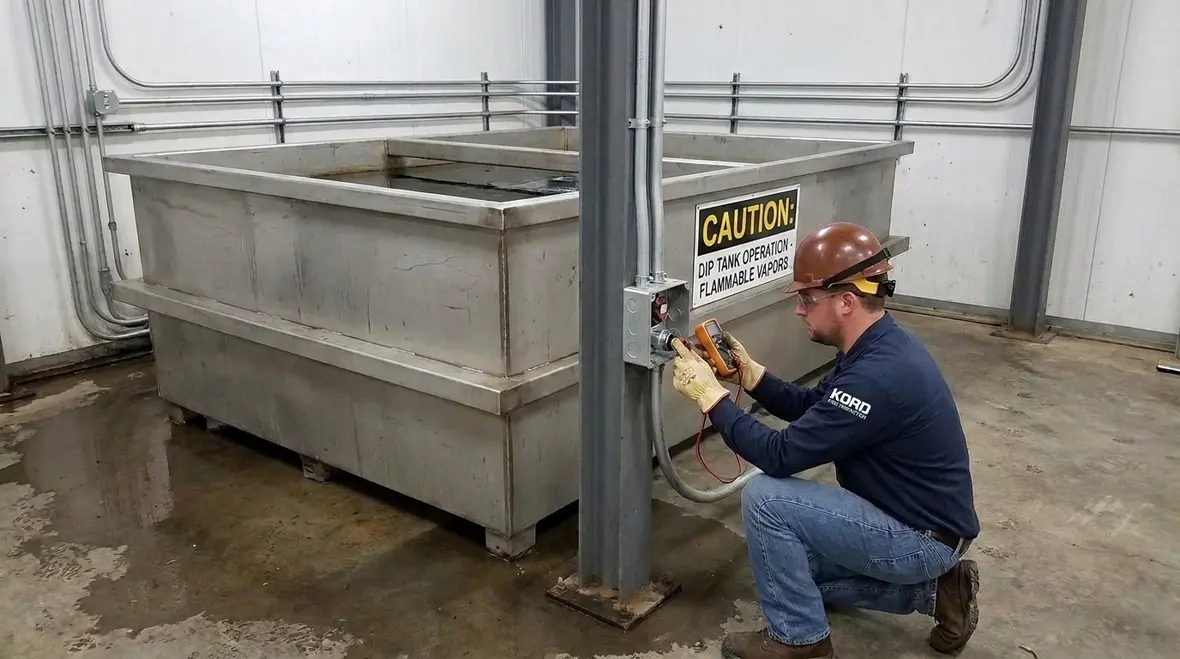
NFPA 34 Section 6.4: Electrical Rules for Areas Adjacent to Open Processes
Quick Answer: NFPA 34 Section 6.4 sets electrical installation and equipment requirements for the areas next to open dipping processes to reduce ignition risk from electrical sources. Compliance depends on proper classification, safe wiring practices, and ongoing inspection, testing, and maintenance of equipment in proximity to flammable vapors.
If you are tightening documentation and inspection readiness around process-adjacent hazards, Kord Fire’s fire safety inspections and preventive maintenance services fit naturally into the workflow discussed below.
Why Section 6.4 matters near open dipping tanks
Facilities that operate open dipping processes create an environment where flammable vapors, mists, or residues can migrate from the process area into surrounding spaces. NFPA 34 electrical areas adjacent open dipping processes must be designed and maintained to control ignition sources such as arcing, overheating, improper grounding, and damaged enclosures. These requirements matter because typical failures occur during modifications, routine maintenance, and aging of seals, conduit systems, and electrical fittings.
In practice, the biggest compliance challenges include inaccurate boundary determination, equipment installed “temporarily” during shutdowns, unverified replacement parts, and deterioration of weatherproof or corrosion resistant components in wet chemical environments.
What Section 6.4 regulates in practice
NFPA 34 Section 6.4 focuses on electrical installations in areas adjacent to open dipping processes. The goal is straightforward: prevent electrical equipment or wiring methods from becoming an ignition source if flammable vapors are present.
Common operational drivers that influence the electrical risk
- Open liquid agitation and surface area: Higher agitation and larger tank surface area increase vapor and mist release.
- Process temperature: Warmer solutions can intensify evaporation and vapor concentration.
- Ventilation effectiveness: Poor capture or short circuiting of exhaust can allow vapors to accumulate near electrical equipment.
- Chemical variability: Solvent and coating chemistry affects vapor behavior, residues, and the likelihood of flammable mixtures.
Commercial facility reality checks
Industrial and retail locations that support finishing operations often have shared electrical rooms, common cable trays, and general purpose lighting and receptacles near work bays. Section 6.4 compliance often requires coordination between production and electrical contractors so that equipment placement does not drift over time as layouts change.
How facilities typically establish the “adjacent area” boundary
Even when the detailed classification method involves engineering judgment and site specific documentation, the practical outcome must be defensible during inspections. For NFPA 34 electrical areas adjacent open dipping processes, teams typically confirm which locations can be affected by flammable vapors based on process operation and ventilation performance.
Operational procedure inputs that support the classification
- Normal operating conditions and worst case scenarios, including start up, shut down, sampling, and filtration cycles.
- Measured or historically validated ventilation capture performance where available.
- Evidence of vapor migration and accumulation patterns using smoke testing, monitoring data, or documented field observations.
- Tank opening practices such as lid status, spray rates, and splashing that can promote vapor release.
Common failure points during compliance reviews
- Outdated diagrams: As equipment moves, cable routes and junction boxes remain unchanged on paper.
- “Same area” assumptions: Changing chemistry or temperature changes vapor behavior, but boundaries remain untouched.
- Maintenance blind spots: Damaged seals on enclosures or degraded conduit seals can invalidate original safety intent.
Electrical safeguards you must verify near open dipping processes
NFPA 34 electrical areas adjacent open dipping processes typically require that electrical equipment and wiring methods use appropriate construction, protection techniques, and installation practices. The exact implementation depends on the site’s hazard evaluation, but the inspection results often hinge on the same equipment mechanisms.
Ignition control: enclosures, connections, and fittings
- Explosion protected or suitable equipment selection: Equipment in affected areas must be rated for the hazards defined by the facility classification.
- Seals and integrity of conduit systems: Use of seals, correct fittings, and secure termination practices limits flame propagation and prevents vapor entry.
- Weather and chemical resistance: Wet chemical environments can corrode hardware, compromise gaskets, and degrade cable jacket integrity.
Overheating and electrical fault prevention
- Termination condition: Loose lugs and poor torque values can overheat terminations.
- Ingress protection and drainage: Condensation and chemical spray can accumulate in low points, leading to track paths or nuisance faults.
- Bonding and grounding continuity: Bonding failures can increase fault energy and compromise protection concepts.
Lighting and receptacles near process activity
General purpose fixtures or convenience power outlets often get installed during operational convenience rather than hazard review. Section 6.4 compliance commonly requires that lighting, switches, and any cord connected or plug installed devices match the electrical area requirements and the facility’s hazardous location determination.
Inspection, testing, and maintenance programs that hold up in the field
NFPA 34 electrical areas adjacent open dipping processes require more than initial compliance. The majority of enforcement and real world incidents correlate with maintenance gaps: damaged seals, incorrect replacements, neglected cleaning, and overlooked enclosure damage.
Maintenance tasks that directly reduce ignition risk
- Routine enclosure condition checks: Verify gaskets, seals, covers, and tightness of hardware after maintenance activity.
- Verification of replacement parts: Replace components with like for like ratings and manufacturer approved equivalents.
- Cable jacket and termination inspection: Look for abrasion, chemical attack, swelling, and water intrusion at glands and terminations.
- Cleaning and residue management: Remove corrosive deposits that can undermine insulation and create unintended conductive paths.
Document control and readiness
Facilities improve outcomes when they maintain a controlled record set that includes hazard documentation, equipment lists, one line diagrams, and inspection reports. Kord Fire Protection supports commercial teams by helping coordinate ongoing testing and documentation for process-adjacent electrical safety needs. For an operational overview of how inspections are structured across fire and life safety systems, facilities can reference Kord Fire Protection Fire Inspections.
How to build a defensible compliance workflow for adjacent electrical areas
Commercial facilities that run open dipping operations typically reduce risk by using a repeatable workflow that aligns production, electrical, and fire safety responsibilities.
Step by step workflow
- Confirm process conditions: Document chemistry, operating temperature, tank activity, and ventilation mode during normal and upset conditions.
- Define the affected zones: Establish the adjacent area boundaries using engineering judgment and available performance evidence.
- Inventory electrical equipment: Identify all luminaires, switches, receptacles, motors, junction boxes, and cable routes in and near affected boundaries.
- Validate installation suitability: Verify electrical ratings, wiring methods, enclosure integrity, seals, and termination practices.
- Implement inspection intervals: Add targeted checks for seals, corrosion, and enclosure damage frequency aligned to your environment.
- Control changes: Require review before layout changes, equipment swaps, or chemistry updates.
Where teams often underestimate effort
- Electrical scope creep during renovations that adds new fixtures without hazard review.
- Temporary lighting used during maintenance that remains in place longer than planned.
- Substitution of “equivalent” components that lack the correct protection concept.
Frequently Asked Questions
Next step: align your electrical setup with Section 6.4
If your facility has open dipping operations, confirm that every luminaires, switch, receptacle, motor, junction box, and cable route in NFPA 34 electrical areas adjacent open dipping processes remains properly rated and maintained. Kord Fire Protection can support your compliance program with coordinated inspections, documentation, and practical maintenance guidance so production changes do not silently erode safety.

Join Our Newsletter!
Get the latest fire safety tips delivered straight to your inbox From our Newsletter.



