
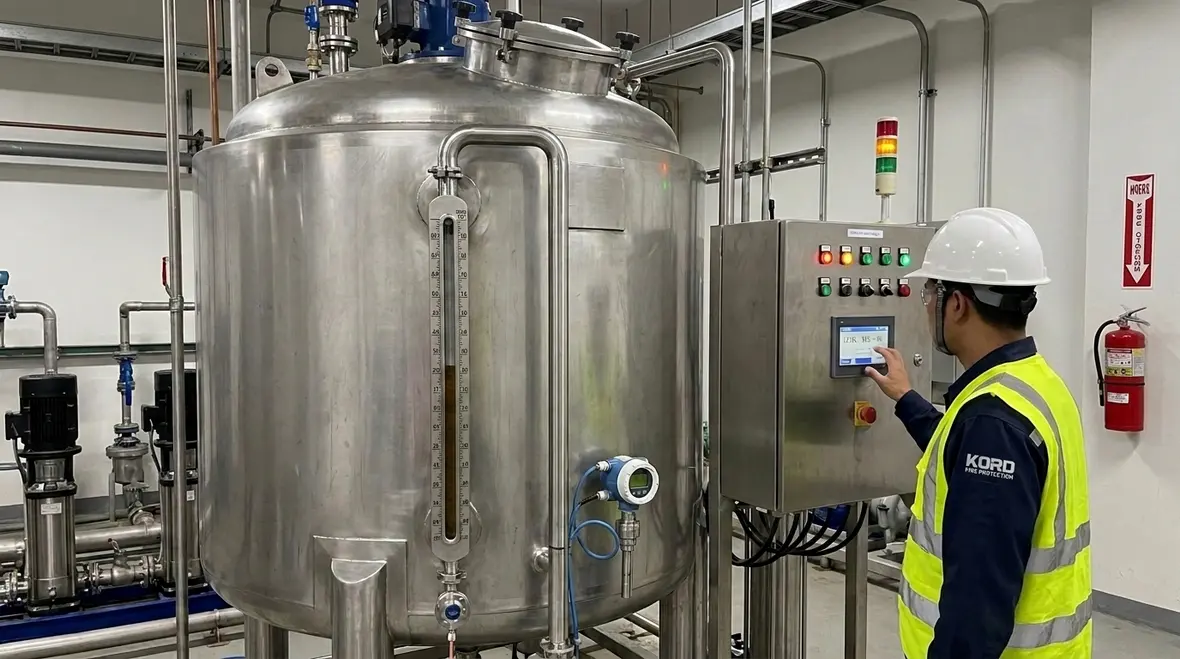
NFPA 34 Section 5.5: Liquid Level Requirements in Process Tanks
Quick Answer: NFPA 34 Section 5.5 sets operational liquid level controls for process tanks to reduce overflow, fuel accumulation, and ignition risk. It focuses on how facilities maintain usable levels, manage abnormal conditions, and verify tank instrumentation and controls through inspection and maintenance.
Facilities reviewing liquid level controls alongside broader fire protection planning can also explore fire protection services in Southern California for practical support with inspections, testing, troubleshooting, and documentation. ([kordfire.com](https://kordfire.com/fire-protection-services-southern-california/?utm_source=openai))
Why NFPA 34 Liquid Level Rules Matter for Process Safety
Commercial facilities that handle flammable and combustible liquids rely on stable tank operations to prevent releases that can escalate to fires, explosions, and evacuation events. In practice, the biggest compliance risk is not the normal operating range. It is the edge conditions: overfill during transfers, instrument drift, failed floats or transmitters, blocked vents, and alarms that are set correctly on paper but do not function under real maintenance conditions. That is why the NFPA 34 liquid level process tank requirements in Section 5.5 must be treated as an operational control system, not a one time installation checklist.
This article explains what Section 5.5 is trying to prevent, how facilities typically implement compliant level control, and where inspections often uncover gaps. It also highlights practical steps that align with commercial, industrial, and retail operating realities.
What Section 5.5 Is Designed to Prevent: Overflow and Uncontrolled Release
NFPA 34 process tanks support bulk storage and transfer operations. Section 5.5 focuses on liquid level management because level is directly linked to release scenarios. When levels exceed design or operational limits, common ignition pathways include hot surfaces, electrical fault events, static discharge during transfer, and ignition of vapors generated by exposed liquid or disturbed heads.
For risk management, Section 5.5 requirements typically drive three outcomes:
- Limit the likelihood of overflow during normal fill cycles and abnormal transfer conditions.
- Provide reliable indication and alarm functions so operators respond quickly to rising levels.
- Ensure protective responses occur automatically or are supported by documented procedures and trained supervision.
How Facilities Commonly Meet NFPA 34 Liquid Level Controls
NFPA 34 liquid level process tank requirements are implemented through a combination of mechanical devices, instrumented measurement, and control logic. The correct approach depends on the tank use, transfer method, and facility risk profile. In real inspections, compliant systems share these characteristics.
1) Instrumentation that operators can trust
Level measurement must reflect actual liquid level, not just an installed device. Common measurement methods include float systems, displacer level transmitters, guided wave radar, and level switches that create alarm and shutdown setpoints.
Key compliance emphasis typically includes:
- Independent high level detection separate from the normal level indicator where design calls for it.
- Appropriate setpoints aligned with tank geometry and safe operating envelope.
- Clear alarm and response procedures that match operator reality during shifts and maintenance windows.
2) Automatic protective action and defined operator response
Many facilities implement control strategies that stop a fill or transfer when a high level switch or alarm activates. In other designs, alarms trigger operator action within a defined time window. The core compliance idea remains consistent: when level rises beyond the allowable margin, the system must drive a protective response that prevents overflow.
Operationally, facilities often document:
- Transfer start, stop, and hold logic
- Alarm acknowledgement rules and escalation
- Bypass controls for maintenance with time limits and compensatory safeguards
3) Reliability under commercial maintenance practices
Commercial sites face interruptions. Valves get serviced, transmitters get calibrated, wiring gets repaired, and downtime gets scheduled. Section 5.5 expectations become fragile when maintenance changes do not preserve protective functionality.
Common practical controls include:
- Documented calibration intervals tied to vendor and risk level, not just vendor guidance.
- Functional testing routines for alarms and interlocks after maintenance.
- Inventory and spares for sensors, floats, and relays to prevent long periods of degraded protection.
Teams building a stronger inspection rhythm around these controls may also find Kord’s guide to ITM fire protection inspection testing maintenance helpful, especially when translating recurring service tasks into a documented readiness program. ([kordfire.com](https://kordfire.com/itm-fire-protection-inspection-testing-maintenance/?utm_source=openai))
Common Failure Points During Inspections
Inspections frequently reveal recurring problems that reduce the effectiveness of level controls, even when equipment is physically present. Addressing these gaps early lowers enforcement risk and improves incident readiness.
Level setpoints drift out of alignment
Setpoints can change unintentionally due to recalibration, firmware updates, or control system edits. When high level alarm points drift upward, the protective action may occur too late to prevent overflow. Facilities should treat setpoints as controlled configuration items with revision control.
Alarm devices exist but do not reliably trigger
Operational radios, annunciator panels, and control room screens often have multiple failure modes: muted outputs, broken horn circuits, alarm bypasses left engaged, or wrong tag mapping in the control logic.
A compliant program verifies that alarms are not only wired correctly, but also audibly and visibly effective at the time of operation.
Blocked or damaged measurement components
Float chambers, bridles, displacer chambers, and impulse lines can foul from residues, coatings, or service conditions. Radar devices can struggle with certain surface conditions and tank vapor conditions if not selected and maintained appropriately.
Facilities should incorporate inspection checks for contamination, mechanical binding, and signal quality where applicable.
Improper bypass during maintenance
Bypasses are sometimes required, but they create risk when extended or left undocumented. The most common gap is the absence of a time bounded bypass permit plus compensatory measures that maintain equivalent protection.
Inspection, Testing, and Maintenance: Keeping Level Control Effective
To sustain compliance and reduce incident probability, facilities should treat Section 5.5 as a lifecycle requirement. This means periodic functional testing, documented calibration, and verification of alarm and interlock performance.
Functional testing that reflects real transfer operations
Level switches and high level alarms should be tested in a way that mirrors normal operations. Test methods typically include simulating level or using test ports where installed. The goal is verifying the protective chain from detection to alarm annunciate to control action.
Calibration and verification with traceable documentation
Calibration should be documented with traceable records, including date, instrument serial numbers, results, and the adjusted values. Facilities should also confirm that corrected values are reflected in the control system configuration and setpoint tables.
Maintenance that preserves protective integrity
Whenever components are repaired or replaced, the facility should return the system to a known safe condition through post maintenance verification. This includes confirming device alignment, wiring integrity, and logic interlocks.
If your team is mapping tank controls into a bigger reliability review, Kord’s commercial fire safety audit step by step process is a useful companion for reviewing service records, inspection intervals, test logs, and corrective action history in a more structured way. ([kordfire.com](https://kordfire.com/commercial-fire-safety-audit-step-by-step-process/?utm_source=openai))
Partnering for Compliance: How Kord Fire Protection Supports Ongoing Readiness
Commercial tank operations often involve multiple stakeholders, including process engineers, maintenance teams, and control room staff. Kord Fire Protection helps facilities maintain readiness through practical inspections, testing coordination, and documentation support aligned with fire protection system performance expectations. Where liquid level controls connect to alarm and shutdown logic, Kord Fire Protection can assist in verifying that installed protection performs as intended across maintenance cycles. Kord’s service pages emphasize scheduled inspections, routine testing, preventive maintenance, repairs, and documentation support for keeping systems inspection-ready. ([kordfire.com](https://kordfire.com/?utm_source=openai))
For additional guidance on inspections and ongoing compliance planning, facilities can explore Kord Fire Protection services.
Frequently Asked Questions
Call to Action
Facilities should review their liquid level alarm and protective action chain now, verify setpoints, and confirm that maintenance practices do not degrade NFPA 34 liquid level process tank requirements. Engage Kord Fire Protection to support testing and documentation so your tank systems perform reliably, not just pass initial installation. Contact Kord Fire Protection today to schedule a compliance focused review.

Join Our Newsletter!
Get the latest fire safety tips delivered straight to your inbox From our Newsletter.



