
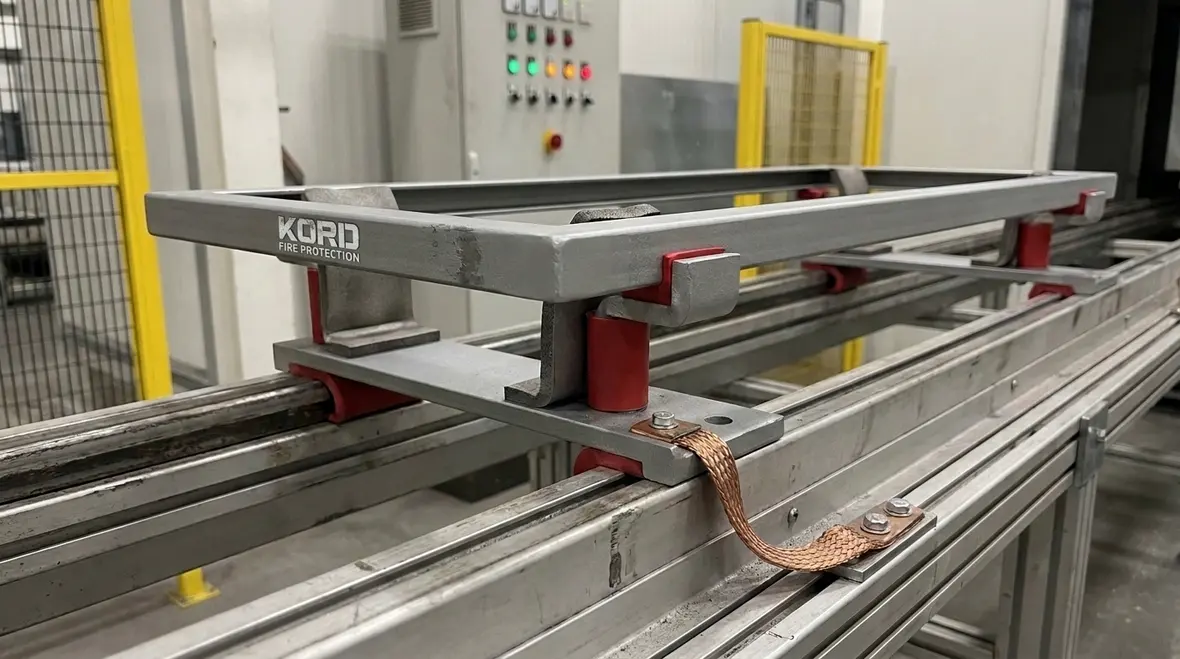
NFPA 34 Section 11.4: Supporting Workpieces During Electrostatic Detearing
Quick Answer: NFPA 34 Section 11.4 focuses on safe, reliable support of workpieces during electrostatic detearing to prevent unintended movement, arcing, damage, and ignition hazards. Proper fixtures, grounding and bonding, and inspection routines help facilities maintain compliant, repeatable operations.
Facilities that want stronger inspection routines and documentation can benefit from a broader inspection, testing, and maintenance approach, especially when electrostatic process safety and fire protection compliance need to stay aligned.
What NFPA 34 Section 11.4 requires for workpiece support
NFPA 34 Section 11.4 sets expectations for how facilities support workpieces during electrostatic detearing so the process remains controlled and safe. For compliance teams, the key risk is not only electrostatic behavior, but also what happens when a workpiece shifts, sags, contacts grounded surfaces, or experiences an unintended conductive path. In practice, effective NFPA 34 workpiece support electrostatic detearing means fixtures must hold the workpiece securely through handling, charging, and detearing while maintaining safe electrical and mechanical separation.
Facilities that overlook support details often encounter recurring issues during production changes, maintenance events, or fixture wear. Those failures frequently show up as inconsistent results, nuisance alarms, damaged parts, and, in worst case scenarios, ignition sources created by sparking or degraded electrical conditions.
Why workpiece support becomes a fire and process safety issue
Electrostatic detearing relies on predictable electrical and mechanical conditions. Workpiece support influences all of the following:
- Mechanical stability: Secure support prevents movement that can bring charged surfaces into closer-than-expected proximity to other conductive parts.
- Controlled electrical paths: Fixtures and contact points must not create unintended grounding or arcing routes.
- Surface protection: Damaged coatings, insulation breakdown, or worn contact pads can change how charge distributes and how sparks behave.
- Repeatability: Stable positioning maintains consistent detearing performance, reducing off specification cycles that prolong charging and operating time.
Commercial and industrial facilities that run multiple product SKUs often modify fixtures or adjust staging positions quickly. This is where compliance can drift if the workpiece support system lacks documented settings, verification checks, and a maintenance schedule.
How compliant fixtures and supports should be designed and used
Section 11.4 expectations translate into practical design and operational controls. Facilities should approach workpiece support as a safety system, not a production accessory.
1) Provide positive support throughout the detearing cycle
Workpiece supports must keep the workpiece positioned through loading, charging, detearing, and any dwell periods. Common safe design elements include:
- Rigid frames or purpose-built jigs that prevent sagging under process vibration and part weight.
- Contact points designed to avoid damage to insulation or coatings.
- Features that limit rotation or tilting, especially for irregular or high center of gravity parts.
2) Manage conductive contact points and insulation integrity
Support systems often use metal structures, conductive rails, or grounded bases. That can be acceptable when designed correctly, but it becomes a failure point if contact surfaces are worn, contaminated, or misaligned.
Facilities should verify the following at installation and after maintenance:
- Insulating components remain intact, correctly seated, and not degraded by chemical exposure.
- Any conductive paths are intentional and controlled, with appropriate separation where required.
- Contact pads or wear surfaces do not migrate or compress beyond safe limits.
3) Maintain safe separation from ignition-relevant conditions
Electrostatic systems can generate sparks under certain conditions. The support design should reduce opportunities for the workpiece to move into unsafe proximity with grounded structures, energized equipment components, or other conductive objects that can concentrate discharge.
In real operations, this requires consistent placement, verified fixture alignment, and controlled staging so workers do not “work around” missing positions, loose clamps, or incomplete locks during shift changes.
Common failure points during workpiece support and detearing
Most compliance problems do not start as intentional safety violations. They develop as small mechanical or electrical changes accumulate over time.
Fixture wear and alignment drift
- Worn bushings or loosened fasteners allow micro movement that changes discharge geometry.
- Repositioning of supports to accommodate new product dimensions without verifying the safety impact.
- Misaligned grounding contact points that intermittently make contact.
Contamination and material degradation
- Accumulated residue on insulating pads that reduces insulation performance.
- Coating damage that alters charge distribution and detearing consistency.
- Corrosion on metal fixtures that changes conductivity and can increase arcing tendency.
Inadequate inspection during maintenance and after downtime
Facilities often inspect electrical equipment more thoroughly than mechanical support systems. Yet Section 11.4 focuses on supporting workpieces, so inspections must include:
- Verification of clamp engagement, stops, and locks after service.
- Inspection for insulation cracking, chipping, or delamination.
- Documentation that fixture settings match the approved configuration.
Inspection, testing, and maintenance practices that hold up in audits
To sustain compliance for NFPA 34 workpiece support electrostatic detearing, facilities need a controlled program that aligns with commercial, industrial, and retail operating realities. Auditors typically look for procedure, evidence, and repeatability.
Documented inspection criteria
Establish written check points for supports and fixtures, including visible criteria (wear, cracks, deformation) and functional checks (secure positioning, clamp engagement, stop alignment).
Routine cleaning and residue control
Residue can degrade insulation and change discharge behavior. Use a cleaning routine that protects insulation surfaces and does not introduce incompatible chemicals.
Post maintenance verification
After any adjustment, part replacement, or fixture modification, facilities should perform verification before returning equipment to normal production. This includes checking physical positioning, contact integrity, and safe separation against the approved setup.
Operational training and change control
Train operators to recognize when supports do not lock correctly, when fixtures do not seat as designed, or when parts shift during staging. Add change control for product swaps that affect geometry so safety impacts get evaluated before production resumes.
If your facility wants stronger documentation and practical verification support, Kord Fire Protection helps commercial teams keep electrostatic process safety aligned with current requirements through ongoing inspections, testing, and maintenance coordination. For additional fire safety resources, use this link: Kord Fire Protection.
Implementation checklist for facility managers and safety leads
Use this checklist to close the gaps that commonly lead to nonconformities around workpiece support during electrostatic detearing.
| Area to verify | What good looks like | Evidence to keep |
|---|---|---|
| Fixture integrity | No deformation, secure clamps, stable stops | Inspection records, photos, replacement logs |
| Insulation and insulating parts | Intact, correctly seated, no cracking or residue buildup | Preventive maintenance checklists |
| Electrical contact points | Intended contact only, no intermittent or accidental grounding | Post maintenance verification notes |
| Operational settings | Approved configuration maintained for each product type | Work instructions, setup sheets, change control records |
| Training and change control | Operators understand unsafe signs and escalation paths | Training rosters, procedure acknowledgments |
Frequently Asked Questions
Conclusion and call to action
NFPA 34 Section 11.4 makes workpiece support a core safety control for electrostatic detearing. Facilities that maintain stable fixtures, protect insulation, control conductive contact, and document inspections reduce both compliance risk and process variability. If you want a practical, audit ready approach, contact Kord Fire Protection to support ongoing inspections, testing, and maintenance coordination for your electrostatic operations.
For more context on long-term service planning, Kord also covers the full lifecycle of fire protection servicing, which fits naturally with maintaining inspection records, verification steps, and ongoing compliance support.

Join Our Newsletter!
Get the latest fire safety tips delivered straight to your inbox From our Newsletter.



