
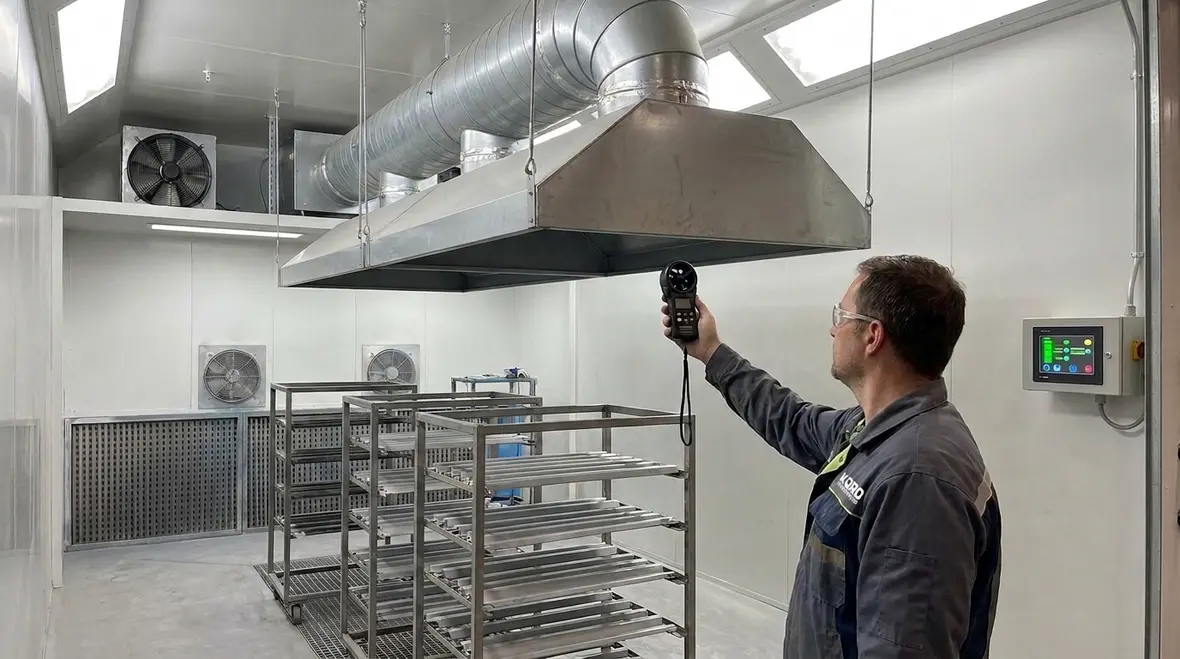
NFPA 33 Section 7.12: Ventilation for Drying Areas in Spray Operations
Quick Answer
NFPA 33 Section 7.12 requires drying areas in spray operations to be ventilated to control flammable and combustible solvent vapor accumulation. The standard focuses on maintaining safe air movement, proper exhaust design, and verification through inspection and ongoing maintenance. Compliance protects ignition control strategies and supports safe product processing.
What NFPA 33 Section 7.12 Requires for Drying Area Ventilation
NFPA 33 drying area ventilation spray operations governs ventilation performance during the post spray drying period, not only during spray application. The drying phase continues to release solvent vapors, creating a different vapor concentration profile than the spraying stage. Section 7.12 therefore centers on removing vapors effectively so ignition sources do not encounter flammable atmospheres.
In commercial facilities, this requirement commonly gets treated as “general exhaust,” but regulators and insurance partners expect a ventilation system that is engineered for the drying process, maintained for reliable performance, and inspected to verify control of vapor accumulation.
Why Drying Areas Need Dedicated Ventilation Control
Vapor generation continues after spraying stops
Even when spray stops, coatings continue to emit solvent vapors as evaporation occurs. Drying ovens, flash-off zones, and enclosed drying rooms can trap vapors if exhaust rates, ducting, and make up air are not aligned with the coating chemistry and drying conditions.
Air balance affects both flammability and worker safety
Ventilation performance depends on airflow patterns, not only fan capacity. Poor air distribution can create stagnant pockets where vapors accumulate. The result is a higher likelihood of flammable mixtures near ignition capable equipment, lighting, heaters, motors, or fans.
Common commercial compliance pressure points
- Exhaust exists, but airflow is insufficient during specific production schedules or temperature set points.
- Ducts and filters restrict airflow over time, especially in retail and light industrial facilities that do not plan service intervals.
- Make up air lags behind exhaust, causing negative pressure that disrupts airflow and reduces capture effectiveness.
- Coating formulation changes shift vapor generation rates without a ventilation reassessment.
How Ventilation Systems Typically Meet Section 7.12 Objectives
Section 7.12 does not rely on a single fan size or a one time design. Instead, it focuses on ventilation effectiveness during drying so vapor accumulation remains controlled. In practical terms, facilities usually implement engineered exhaust and controlled make up air, supported by instrumentation and maintenance.
Exhaust capture and removal
Exhaust systems should remove solvent vapors at or near the source. Proper hood or duct placement supports capture during high off gassing periods. Duct routing must avoid dead ends and minimize bends that increase resistance and reduce airflow.
Make up air to maintain safe flow paths
Exhaust without adequate make up air can cause turbulence and short circuiting, pulling air from unintended areas rather than removing vapors where they concentrate. Controlled make up air helps maintain predictable airflow patterns through the drying zone.
Interlocks and operating logic for real process control
Where dryers or enclosures operate intermittently, ventilation should interlock with drying operations or be otherwise controlled to ensure ventilation remains active during solvent release. Common failure mode: exhaust fans run only during spray, while drying periods continue with ventilation reduced or off.
Filtration and maintenance for sustained airflow
Filters, duct buildup, and fan degradation directly impact exhaust rates. Section 7.12 compliance depends on the ventilation system operating as intended at the time of inspection, which means service schedules, calibration practices, and documented performance checks matter.
Inspections, Testing, and Verification That Auditors Expect
Commercial facility owners often ask how to demonstrate that drying area ventilation remains effective. NFPA 33 compliance is strongest when verification is routine and tied to the drying operational profile.
For broader lifecycle support, facilities often pair this work with commercial fire suppression services so inspections, testing, and maintenance stay coordinated across related protection systems.
What facility teams typically document
- Current airflow measurements for exhaust and make up air, captured during representative drying operations.
- Fan status and control sequence proof, including interlocks and startup timing.
- Inspection records for ductwork integrity, damper operation, and obstructions.
- Filter condition and replacement history, plus evidence of airflow recovery after service.
- Maintenance logs showing corrective actions when performance trends drift.
Common failure points found during real world compliance reviews
- Damper stuck position or inconsistent blade travel causing reduced exhaust at the ceiling or door zone.
- Variable frequency drive settings that changed during upgrades, unintentionally reducing drying ventilation.
- Exhaust fans operating at a lower speed due to seasonal thermostat logic or energy saving mode.
- Thermal damage to duct linings or flexible connectors that alters flow resistance and capture efficiency.
To strengthen ongoing compliance posture, many facilities align drying area ventilation inspections with broader impairment prevention. For related fire protection planning, review Kord Fire Protection’s fire protection impairment management guide.
Design Considerations for Different Drying Setups
Enclosed drying rooms and ovens
Enclosed drying spaces require special attention to vapor management because vapors cannot disperse naturally. Designers should account for airflow distribution, exhaust removal paths, and make up air supply so vapors do not accumulate against walls, doors, or equipment housings.
Spot curing and localized drying stations
Localized drying stations often create “narrow capture” systems. If vapor release spreads beyond the intended capture zone, the ventilation may control only part of the hazard area. Maintenance teams should confirm that duct placement and hood coverage match the actual production footprint.
Batch processes and changing production schedules
Drying cycles vary by product and coating chemistry. Ventilation control logic should reflect the real schedule, including startup and shutdown sequencing so exhaust does not end prematurely or restart late.
Who Owns Compliance: Operations, Maintenance, and Fire Safety Engineering
Section 7.12 creates shared responsibility across operational control, mechanical maintenance, and fire protection engineering. Production teams control drying duration and process parameters. Maintenance teams keep exhaust and air distribution equipment within spec. Fire safety specialists confirm that ventilation performance supports the overall ignition control strategy.
Kord Fire Protection supports commercial facilities by providing practical compliance services that address the most common real world gaps. This includes reviewing ventilation performance documentation, coordinating test and inspection activities, and supporting corrective action plans when airflow trends or equipment conditions fall out of tolerance.
If your team is tightening recordkeeping at the same time, Kord’s article on fire safety system documentation for compliance fits naturally into that process.
Frequently Asked Questions
Next Steps
Review your drying area ventilation operating sequence, airflow performance documentation, and maintenance records against the expectations of NFPA 33 Section 7.12. If your system uses variable controls, filters, or interlocks, confirm performance during the actual drying cycle, not only during spray. Contact Kord Fire Protection to plan an inspection and maintenance focused on sustaining compliant drying area ventilation spray operations over time.

Join Our Newsletter!
Get the latest fire safety tips delivered straight to your inbox From our Newsletter.



