
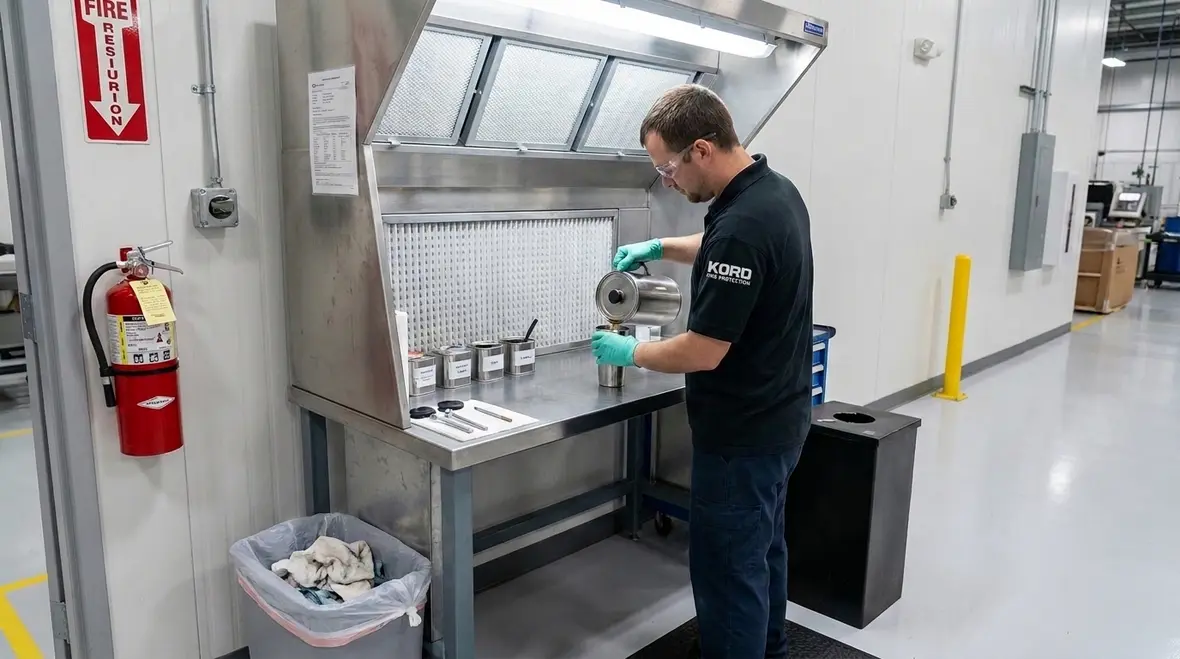
NFPA 33 Section 14.3: Limited Finishing Workstations Explained
Quick Answer: NFPA 33 Section 14.3 limits how finishing operations may be performed at “limited finishing workstations” to reduce ignition and fire growth risks. The requirements address ventilation, storage and use of flammable and combustible materials, and how facilities control ignition sources and housekeeping. Compliance depends on verifying operating limits and maintaining the workstation as installed.
What NFPA 33 Section 14.3 means in plain terms
NFPA 33 limited finishing workstation requirements define when a finishing area can be treated as “limited” rather than as a full-scale finishing space. The intent is straightforward: if the operation uses smaller quantities, limited work practices, and controlled exposure of flammable vapors, then the facility can apply a proportionate level of protection.
In real commercial and industrial settings, the practical challenge is not locating the workstation area on a floor plan. The challenge is proving that day to day operations stay within the “limited” boundaries, including how materials are staged, how quickly containers are closed, and how ventilation and ignition control systems perform over time.
For a broader look at how inspection, testing, and maintenance programs support code-compliant fire protection across commercial facilities, explore the full lifecycle of fire protection servicing.
Where Section 14.3 applies and what triggers the “limited” classification
Section 14.3 applies to finishing operations where the facility design and operating practices maintain limited quantities and controlled exposure. It typically covers applications such as touch up, small batch work, localized finishing, or limited duration operations where flammable and combustible materials are not released in the same way as larger spray booths or full finishing rooms.
Facilities often get tripped up by one of these assumptions:
- Assuming the label is enough. A workstation marked “limited” does not automatically meet NFPA 33 requirements unless the operating practices and hardware match the permitted approach.
- Overstaging materials. Keeping extra gallons, drums, or partially filled containers nearby can defeat the intent of limited exposure.
- Changing workflow. A process shift from short touch ups to regular production finishing increases vapor generation and invalidates prior compliance assumptions.
To avoid compliance drift, the facility should align training, written work instructions, and daily supervisory checks with the conditions that define a limited finishing workstation.
Key compliance areas in NFPA 33 limited finishing workstation requirements
1) Ventilation and capture performance
Ventilation is a central risk control for finishing operations. For limited finishing workstation designs, the ventilation arrangement must capture and remove flammable vapors and aerosols effectively so the workstation does not become a vapor accumulation zone.
Common operational failure points include:
- Blocked airflow paths. Overspray filters, duct obstructions, or poor seating of hoods can reduce capture performance.
- Changes to the workstation layout. Moving parts, racks, and carts can redirect airflow, creating dead zones where vapors accumulate.
- Fans running at the wrong duty. Maintenance issues or control system changes can reduce airflow below the required performance baseline.
Best practice is to treat ventilation verification as a program, not an annual event. Include filter inspection, duct checks, and performance verification in scheduled maintenance, and document results for inspection readiness.
2) Handling, storage, and container control
Limited finishing workstations rely on strict control of flammable and combustible materials. NFPA 33 expectations typically focus on limiting the amount of material present, preventing open containers, and managing waste and rags to prevent ignition sources from contacting vapors.
Field observations that frequently cause noncompliance include:
- Leaving lids off, propped, or stored in a way that permits evaporation and vapor release.
- Storing additional products and reducers “just in case” in the workstation zone.
- Allowing waste containers and rag bins to overflow or remain uncovered.
Facilities should implement a controlled staging routine. Material staging should occur immediately before use, containers should close promptly, and waste should move to designated containers on a schedule that matches production cycles.
3) Ignition source control and equipment selection
Finishing processes can generate flammable vapors. Even with ventilation, risk remains if ignition sources are not controlled. NFPA 33 addresses ignition control principles through equipment selection, grounding and bonding practices where applicable, and ensuring that the workstation does not create conditions where ignition can occur.
For commercial facilities, common gaps include:
- Using non-rated equipment near the workstation without validating suitability.
- Allowing tools, heaters, or portable devices to be used within the controlled zone without determining hazard classification implications.
- Ignoring static discharge risks during material transfer and handling.
Facilities should align the workstation hardware inventory with the finishing process chemicals, the work practices, and the ventilation design basis. Any change to products, application methods, or the workstation location should trigger a re-check of ignition source controls.
4) Housekeeping, overspray management, and waste control
Housekeeping affects both fire risk and ventilation effectiveness. Accumulated residue can become an ignition fuel load or obstruct airflow. Overspray and particulate matter also influence filter loading, which can reduce capture performance over time.
Operational controls typically include:
- Scheduled cleaning to remove overspray and residue from surfaces and from within the ventilation system where required.
- Proper disposal of wipes, rags, filters, and residue in approved containers.
- Tracking filter condition and cleaning intervals so the workstation remains within its intended performance range.
In practice, the compliance win comes from linking cleaning intervals to production, not to calendar dates alone.
Common compliance challenges in commercial facilities
NFPA 33 limited finishing workstation requirements are often applied in warehouses, retail service centers, and light industrial environments where space and budgets constrain dedicated finishing buildouts. The following challenges appear repeatedly during inspections and risk assessments:
- Process variability. Teams shift materials, change spray techniques, or increase turnaround time without updating compliance documentation.
- Partial workstation changes. Facilities retrofit shelving, add carts, or move exhaust hoods without validating airflow impacts.
- Maintenance ownership gaps. Ventilation components get serviced late or inconsistently because responsibilities are split between operations and facilities teams.
- Training drift. New employees follow informal practices that conflict with container closure, waste disposal, and staging limits.
These issues are solvable with a structured compliance program that includes written procedures, visual verification checklists, and documented inspections. Kord Fire Protection supports facilities by helping establish and sustain workstation compliance through practical inspection, testing, and maintenance support tailored to commercial operations.
If your facility needs a broader compliance roadmap around fire prevention and protection systems, consider reviewing the service resources available here: Kord Fire Protection.
Inspection readiness: documentation, testing, and maintenance
NFPA 33 compliance hinges on more than the workstation at the moment of an audit. Inspectors and insurers expect evidence that the workstation operates as designed and that risk controls remain effective.
What to maintain as evidence
- Ventilation maintenance records including filter changes, duct checks, and functional verification results.
- Work practice documentation covering staging, container closure, waste handling, and cleaning schedules.
- Training records for employees using the workstation, including what “limited” means in daily operations.
- Configuration control documentation showing that changes to layout, equipment, and product types are evaluated for impact.
How failures typically surface during reviews
Most workstation issues appear during walk-throughs and interviews. Investigators look for telltale signs such as surplus chemicals stored in the area, open containers, overflowing waste bins, or ventilation components that look ignored. Even if the system was initially installed correctly, risk controls can degrade without consistent maintenance and supervision.
A proactive compliance cadence reduces disruption. Kord Fire Protection can help facilities plan and execute the inspection and testing workflow so the workstation remains consistent with the intent of NFPA 33 limited finishing workstation requirements.
Frequently Asked Questions
Get your workstation compliance validated
NFPA 33 limited finishing workstation requirements work only when the equipment and day to day practices stay aligned. Kord Fire Protection can help your facility verify ventilation performance, maintenance documentation, and practical operating controls so your limited workstation remains inspection ready. Contact Kord Fire Protection to schedule a compliance review and build a maintenance plan that reflects how your operation actually runs.

Join Our Newsletter!
Get the latest fire safety tips delivered straight to your inbox From our Newsletter.



