
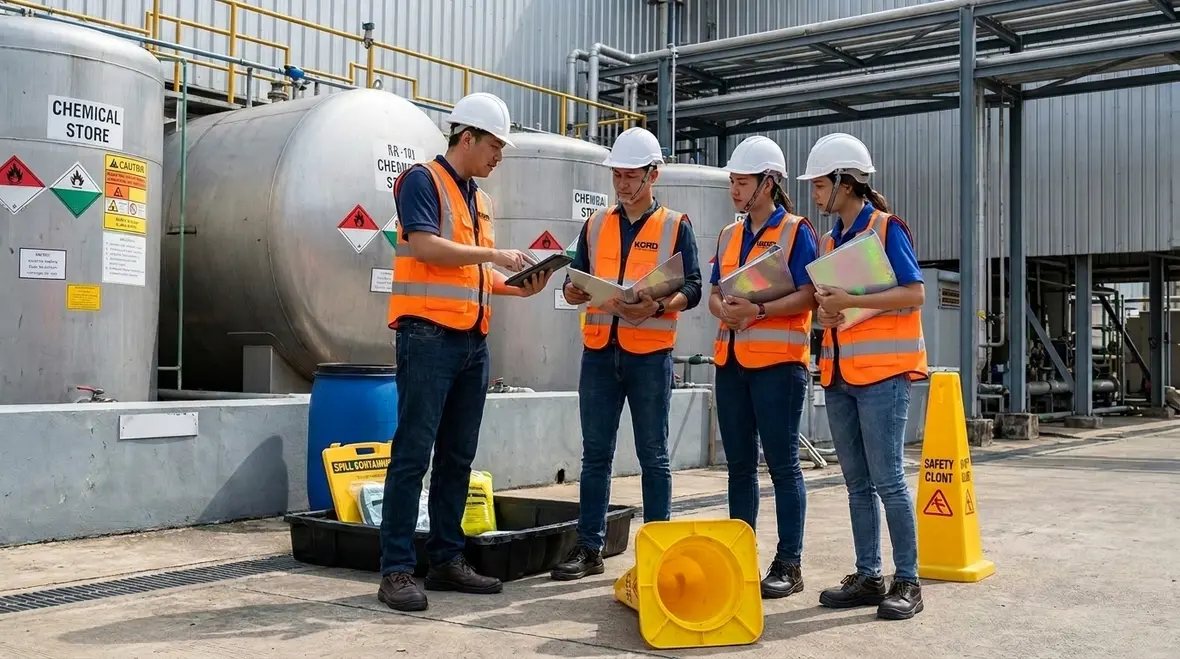
NFPA 30 Section 6.9: Emergency Planning and Training for Liquid Hazards
Quick Answer
NFPA 30 Section 6.9 requires commercial facilities handling liquid hazards to establish emergency plans and deliver role based training. It focuses on readiness before an incident, ongoing drills, and documented competency. Facilities must ensure procedures, alerting methods, and response actions align with liquid hazard risks.
NFPA 30 Section 6.9 emergency planning training liquids is one of the most operationally important sections in NFPA 30 for real world risk control. It turns written hazard information into practiced response capability for staff, contractors, and site leadership. This article explains what compliance looks like, what inspectors commonly probe, and how commercial facilities can build and maintain effective training and emergency readiness for flammable and combustible liquids.
For facilities strengthening special hazard response readiness, Kord Fire Protection also provides commercial fire suppression system services that support protection planning for higher risk environments.
What NFPA 30 Section 6.9 expects from emergency planning
NFPA 30 Section 6.9 focuses on emergency planning and training tied directly to liquid hazards on site. For many commercial facilities, the planning work fails not because the hazard exists, but because the response plan does not reflect how the facility actually operates. Plans must match layout, quantities, process controls, storage arrangements, and practical response limitations.
In practice, emergency planning typically covers:
- Incident scenarios linked to the facility’s liquid hazards, including release, fire exposure, container damage, and loss of containment.
- Clear roles and responsibilities for supervision, frontline response, and support functions.
- Specific procedures for alarm, evacuation or sheltering decisions, and emergency communications.
- Control actions intended to mitigate escalation, where appropriate and safe, such as isolating transfer operations or shutting down systems.
- Coordination steps for emergency services notification, access management, and site orientation for responders.
- Requirements for plan documentation, accessibility, and periodic review based on changes in hazards or operations.
Facilities that handle multiple liquid hazard categories must ensure the plan addresses the correct response expectations for each. Training and planning should be tied to hazard class, not generic fire response language.
How to structure emergency training for liquids so it works during an incident
Effective training under NFPA 30 Section 6.9 emergency planning training liquids should be role based and operationally specific. The goal is to reduce decision time and avoid the most common failure points: confusion about alarms, incorrect shutdown steps, and unsafe actions during release or fire conditions.
1) Build role based training tracks
Commercial sites often train everyone the same way, then discover that the plan assumes decisions by only a few people. Instead, segment training so each group understands its obligations.
- Command and supervision: Incident assessment, establishing control zones, deciding on evacuation or sheltering, and coordinating with emergency services.
- Frontline operators: How to recognize abnormal conditions, how to activate alarms, when to stop work and retreat, and what information to relay to responders.
- Maintenance and contractors: Permit requirements, isolation steps before hot work or intrusive tasks, and how to respond if a release occurs.
- Dispatch or security roles: Gate and access procedures, responder wayfinding, and documentation of response actions.
2) Train on “what you do first,” not just “what you should know”
Drills and training sessions should prioritize the first actions that keep people safe. For liquid hazards, early actions typically include verifying the alarm is activated, confirming the correct emergency notification route, and moving personnel to the planned safe location.
3) Use scenario based drills to expose gaps
Training should include scenarios tied to likely failure modes such as:
- A transfer hose leak during loading or unloading
- A container integrity failure or valve damage leading to spill spread
- Fire impingement on containers that triggers heat exposure concerns
- Overflow or release from a process step that can ignite or produce vapor hazards
Scenario based drills reveal operational friction points, including missing spill kits, unclear isolation steps, or staff uncertainty about when to evacuate versus attempt control. Those gaps require correction in training and plan documentation.
Common compliance challenges in commercial facilities (and how inspectors look)
NFPA 30 Section 6.9 emergency planning training liquids often gets criticized during audits because evidence of training and plan implementation is incomplete. Inspectors and risk reviewers frequently look for traceability from hazard inventory to plan content and from plan content to training records.
Challenge A: Training records that do not prove competency
Many sites can produce sign in sheets but cannot demonstrate that training covered the specific hazards on site or that staff understood the emergency actions. To strengthen compliance, training documentation should include:
- Training topic, date, and instructor or approved provider
- Attendees by role category
- Scenario type or learning objectives
- Assessment method, such as a drill performance review or documented competency check
Challenge B: Plans that do not match the site layout
A plan that works on paper but does not match real locations creates delays. For liquid hazards, delays often involve access routes, control equipment locations, and the identification of storage areas or transfer points.
Facilities should ensure emergency plans reference accurate site features and that drills validate those references.
Challenge C: Changes in liquids, quantities, or transfer methods not triggering plan updates
Commercial and industrial sites routinely change suppliers, product types, storage arrangements, or packaging. When hazards evolve, emergency response assumptions can become outdated. A strong change management practice triggers plan and training refreshes when hazards materially change.
Challenge D: Contractor gaps
Contractors often arrive with general knowledge but without site specific instructions. NFPA 30 Section 6.9 expectations should extend to contractor orientation and emergency training aligned with the liquid hazards they may encounter.
Operational procedures that tie training to equipment and readiness
Emergency planning and training must connect to how the facility uses equipment in an actual emergency. For liquid hazards, procedures often fail when staff cannot locate equipment quickly, do not know the intended use, or the equipment is out of service.
Alerting and communications
Training should confirm which alarm systems activate, what announcements say, and who communicates with occupants, supervisors, and emergency services. Facilities should test that communication pathways work, especially during high noise conditions or facility shutdown states.
Shut down and isolation decision steps
Where operations can be safely stopped, training must specify the controlled shutdown steps and the authority to initiate them. Staff must understand the difference between actions that reduce hazard and actions that increase danger, such as attempting to control a release without isolation capability.
Spill control and containment interface
Training should cover spill response boundaries, including what personnel are allowed to do before evacuation. Equipment readiness matters, such as spill kits, compatible absorbents, booms for appropriate scenarios, and containerization for waste.
Fire response interfaces
For liquid hazards, fire response can involve rapid decision making about evacuation, emergency service arrival, and exposure hazard assessment. Training must avoid assumptions that the first arriving personnel can control a liquid fire without the right conditions, equipment, and training.
How Kord Fire Protection supports ongoing compliance for liquid hazard emergencies
Commercial facilities often treat emergency planning as a one time document. In reality, NFPA 30 compliance depends on continuous verification that training stays aligned with site changes, equipment condition, and operational constraints. Kord Fire Protection supports this lifecycle approach with services that strengthen both readiness and defensibility.
For example, Kord Fire Protection can assist with:
- Gap identification between liquid hazard inventory and emergency plan content
- Training support aligned to roles, scenarios, and practical response steps
- Inspection and maintenance coordination that supports operational readiness of emergency related equipment
- Documentation practices that improve audit readiness and reduce uncertainty during reviews
For additional context on how NFPA 30 regulates flammable liquids and the operational expectations that feed into emergency planning, visit How NFPA 30 regulates flammable liquids.
You can also explore Kord Fire Protection’s NFPA 30 flammable and combustible liquids overview for broader context around storage, transfer, and protection strategy.
Frequently Asked Questions
Conclusion: act on gaps before an incident forces decisions
NFPA 30 Section 6.9 emergency planning training liquids is not satisfied by a binder or a generic fire drill. It requires role based training, scenario driven practice, and documented alignment with the actual liquid hazards on site. Kord Fire Protection helps commercial facilities keep plans current, validate readiness through practical verification, and strengthen audit defensibility. Contact Kord Fire Protection to review your emergency planning and training program and identify high impact compliance gaps.

Join Our Newsletter!
Get the latest fire safety tips delivered straight to your inbox From our Newsletter.



