
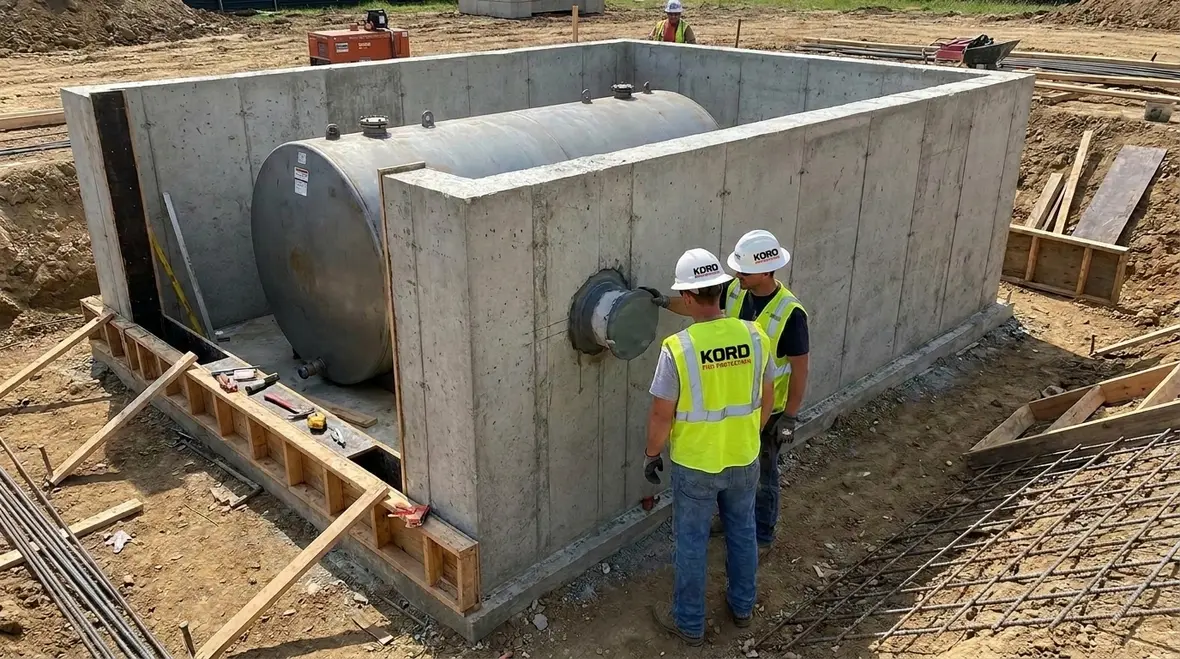
NFPA 30 Section 25.5: Constructing and Installing Tank Vaults
Quick Answer
NFPA 30 Section 25.5 tank vault construction installation requirements focus on containment, fire-resistance, venting and drainage control, and protected installation practices. Compliance depends on correct materials, proper openings and seals, and verified operational safeguards that limit vapor migration and liquid spread.
Why NFPA 30 Section 25.5 tank vault construction installation details matter
Tank vaults do more than “hold a tank.” They manage accident scenarios where flammable liquids may leak, generate vapors, and spread beyond the tank area. Section 25.5 sets expectations for how vaults get built, how they get installed, and how the design supports safe containment and fire protection objectives.
For commercial and industrial facilities, this section becomes a compliance risk point during construction, retrofits, and maintenance outages. For retail and warehouse properties, it becomes an operational risk point when staff assumptions about “secondary containment” do not align with actual vault function, inspection requirements, and emergency response needs.
To understand the broader regulatory logic behind these containment requirements, review how NFPA 30 regulates flammable liquids. That context helps teams apply Section 25.5 consistently across siting, storage, and release control measures.
If your facility is tightening its broader compliance program, it also helps to align tank vault verification with a structured inspection, testing, and maintenance approach so seals, drainage components, and related fire protection systems do not quietly drift out of spec.
What Section 25.5 expects during vault construction
NFPA 30 Section 25.5 directs the vault to be constructed in a way that supports safe confinement of flammable liquid releases and controls the pathway for vapors and ignition exposure. Practical compliance work typically starts with verifying the vault is built to the correct fire-resistance intent and that openings and penetrations do not compromise confinement.
1) Vault boundaries, fire resistance, and containment integrity
Construction quality directly impacts whether the vault can contain leaked liquid long enough to prevent spread and support emergency response. Teams should verify:
- Vault walls and floor systems meet the required fire-resistance and confinement design basis.
- Material selection supports long term performance where spills, cleaning agents, and condensate occur.
- Expansion joints, wall floor interfaces, and corners are built with compatible sealing methods that resist cracking and shrinkage.
2) Penetrations, openings, and sealing discipline
Most real world vault failures originate around openings: conduit entries, cable penetrations, piping sleeves, instrumentation interfaces, and access points. Construction and installation practices must maintain segregation between internal tank equipment spaces and the vault environment.
Compliance teams should require:
- Penetration seals that remain intact after installation, inspection, and maintenance access.
- Correct gasket and sleeve selection to avoid gaps during thermal cycling and vibration.
- Documentation of all penetrations and their sealing method for repeatable inspections.
3) Drainage and liquid management controls
Vault drainage design determines whether leaked product remains contained or migrates to adjacent areas. Poorly designed drainage routes can defeat the vault concept, especially where floor slopes, sumps, valves, and outlet piping do not behave as intended during a spill.
Installers typically must coordinate:
- How leaked liquid reaches a controlled collection point.
- How valves, shutoffs, or controlled drainage components prevent uncontrolled discharge.
- How operators verify system status after routine work or weather events.
Install the tank and vault as one protected system
NFPA 30 Section 25.5 tank vault construction installation emphasizes that the vault and the tank installation method work together. A vault built to spec can still fail if the tank foundation, anchoring, piping connections, or equipment interfaces introduce pathways for leakage and vapor migration.
1) Foundation, anchorage, and settlement control
Settlement and movement can stress vault walls, compromise seals, and create micro pathways for vapors. Commercial facilities should ensure:
- Tank supports and foundations align with design loads and maintain level conditions.
- Anchorage does not produce unintended stress concentrations at penetration areas.
- Contractors verify workmanship after curing and after any rework or re-tamping.
2) Piping, flanges, and connection interfaces
Connections can become high risk points during commissioning because they get adjusted, tightened, and rechecked. If the vault design includes pathways that assume a specific configuration, any deviation can undermine containment.
Install teams should standardize:
- Leak testing of piping and tank connections immediately after installation and after pressure changes.
- Correct application of seals and gaskets compatible with the stored flammable liquid.
- Controlled routing of vent, fill, and product lines so penetrations remain protected.
3) Venting and vapor control interfaces
Vapor management connects directly to safe ignition control. If vents discharge into locations that do not align with the design intent, vapors can accumulate near sources. That is why installation verification must include the vent terminal location, discharge routing, and confirmation that vapor outlets do not bypass protective barriers.
Common compliance gaps that show up during inspections
Even well planned tank vault construction installation projects can generate noncompliance findings. The following issues frequently appear during verification walks, commissioning reviews, and follow up maintenance checks.
1) Uncontrolled penetrations added after acceptance
Facilities often add cable trays, instrumentation, or additional sensors during operations. Without a controlled change process, penetrations get installed later without the original sealing standards.
- Result: vapor migration pathways and reduced containment reliability.
- Fix: maintain a penetration register and require sealed restoration inspections after each change.
2) Drainage devices not tested for functional response
Drainage and collection components can fail due to debris accumulation, mispositioned valves, or corrosion. Functional assurance matters because a vault can only prevent spread if leaked product gets captured and held as designed.
- Result: liquid migration outside the vault footprint.
- Fix: implement periodic functional verification and inspection of drainage components.
3) Seal degradation from cleaning cycles and service work
Routine cleaning and spill response methods can degrade seals over time. Maintenance can also re-open penetrations without reestablishing the original fire and vapor control.
- Result: compromised confinement and unplanned maintenance driven risk.
- Fix: use compatible cleaning agents and require re inspection after service entry.
How commercial facilities should verify ongoing performance
NFPA 30 tank vault requirements do not stop at construction closeout. Operational reliability depends on inspection, documentation, and disciplined maintenance. A practical approach includes scheduled checks and trigger based inspections for abnormal conditions.
Inspection program elements
- Visual condition checks: monitor wall, floor interfaces, seals, and penetration integrity for cracks, gaps, and damage.
- Drainage verification: confirm pathways remain clear and that controlled discharge functions as intended.
- Evidence control: record findings, photos, and corrective actions to support audit readiness.
- After event inspections: conduct targeted inspections after spills, maintenance entries, or structural work nearby.
Maintenance and repair best practices
Maintenance must treat the vault like a life safety and process containment asset. Repair work should restore performance, not just “patch the surface.” The repair method should be compatible with original materials and should reinstate sealing and fire-resistance intent.
Kord Fire Protection supports commercial operators with compliance focused testing, inspection documentation, and ongoing maintenance coordination. That partnership helps facilities close the gap between construction records and what actually remains compliant during routine operations. To see how that support fits into a broader service model, explore full fire protection services for inspection, maintenance, repairs, and deficiency correction.
Who benefits most from a compliant tank vault strategy
Section 25.5 outcomes matter across multiple facility types. The highest value comes from aligning vault construction installation practices with site operations, emergency response workflows, and maintenance capabilities.
- Industrial and manufacturing: higher spill frequency and frequent shutdown work increases penetration and drainage risk.
- Warehousing and logistics: consistent inspection routines prevent backlog driven seal and drainage degradation.
- Retail and commercial premises: clear documentation and staff training prevents “informal fixes” after minor damage.
- Engineering and facilities teams: standardized records support audits and reduce rework costs during future upgrades.
Frequently Asked Questions
Conclusion and call to action
NFPA 30 Section 25.5 tank vault construction installation should be treated as a system, not a one time project. Facilities that verify seals, drainage behavior, and interface integrity during construction and throughout operations reduce risk and audit exposure. Kord Fire Protection helps commercial operators plan compliance, perform practical inspection and testing, and maintain reliable documentation. Contact Kord Fire Protection to schedule a review of your tank vault installation and ongoing maintenance program.

Join Our Newsletter!
Get the latest fire safety tips delivered straight to your inbox From our Newsletter.



