
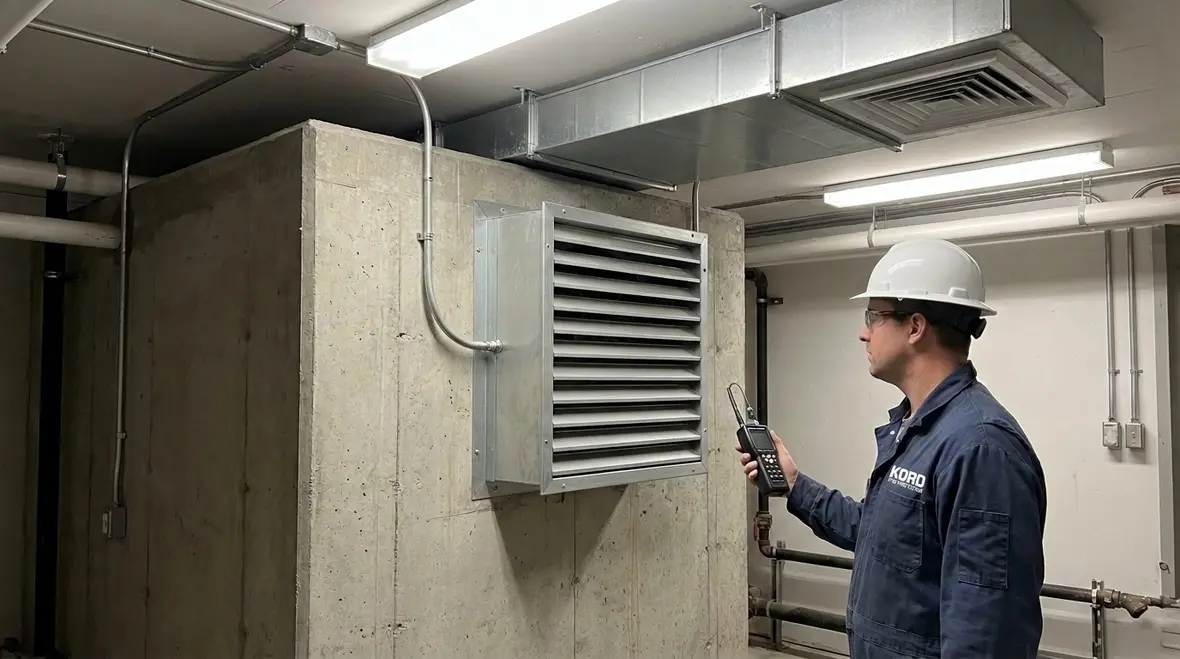
NFPA 30 Section 25.10: Ventilation Systems for Tank Vaults
Quick Answer: NFPA 30 Section 25.10 sets performance expectations for ventilation in tank vaults to control hazardous vapors, maintain safe conditions, and reduce ignition risk. Compliance depends on correct fan selection, ducting, air flow verification, and ongoing inspection and maintenance.
Why NFPA 30 Section 25.10 Matters for Tank Vault Safety
NFPA 30 Section 25.10 tank vault ventilation is designed to prevent flammable vapor accumulation within and around containment spaces that can develop explosive atmospheres. For commercial, industrial, and retail facilities, the operational risk is not theoretical. Tank vaults typically receive routine fill, transfer, and maintenance activity. Each event can release vapor, and even small leaks can shift the vault from “controlled” to “hazardous” if ventilation performance degrades.
Facilities usually fail compliance at the operational level: fans removed, dampers stuck, ductwork corroded, incorrect replacement parts, or airflow that no longer matches the original design. NFPA 30 Section 25.10 focuses on ensuring ventilation is adequate, maintainable, and verifiable, not simply installed once during commissioning.
If your team is reviewing broader system readiness at the same time, it helps to pair ventilation planning with fire protection services in Southern California so inspection timing, repairs, and compliance priorities stay coordinated naturally.
What NFPA 30 Section 25.10 Requires: Performance, Control, and Protection
Section 25.10 addresses how ventilation systems must manage vapor risk in tank vaults. While the exact requirements depend on tank type, configuration, and design basis, the compliance intent is consistent: ventilation must keep hazardous vapor concentrations below dangerous limits and prevent conditions that support ignition.
Ventilation must be capable and maintained
NFPA 30 Section 25.10 tank vault ventilation compliance depends on the system’s ability to deliver required air movement under normal and operational conditions. That includes proper duct routing, intact penetrations, and components that continue operating as intended over time.
Airflow integrity: Fans, dampers, and ductwork must remain functional and unblocked.
Air movement pathways: Supply and exhaust routes must prevent stagnant vapor pockets.
Reliable operation: Systems must perform during conditions that create vapor, not only during scheduled checks.
System design must consider hazardous vapor environments
Ventilation equipment in or serving a hazardous area must be suitable for the environment it will encounter. That includes selection of motors and electrical components appropriate to the potential atmosphere, and installation practices that preserve equipment integrity.
Operational Mechanics: How Tank Vault Ventilation Systems Typically Work
Understanding the mechanism helps facilities maintain compliance in day to day operations. A typical tank vault ventilation design uses one or more fans connected to ductwork that provides exhaust of vapors from the vault space to a safe location.
Key components that drive real-world performance
Fan and motor assembly: Air delivery depends on correct rotation, belt tension where applicable, and unobstructed inlet and discharge. Field replacement parts that differ from original specifications can degrade airflow.
Dampers and louvered inlets: Dampers must open and close as intended. Common failures include stuck blades from corrosion, paint buildup, or misalignment after maintenance.
Ductwork and fittings: Corrosion, crushed sections, or duct shrink wrap used improperly can change flow resistance. Even small leaks can reduce effective exhaust.
Exhaust discharge location: Discharge must remain safe and not reintroduce vapors into occupied areas or air intakes.
What “good” airflow looks like in practice
For compliance assurance, facilities need evidence that ventilation performance matches the design basis. That typically involves airflow checks using appropriate test methods, verifying damper position, and confirming that the system operates during expected vapor producing activities. When airflow cannot be verified, the system becomes an unproven control.
Common Compliance Failure Points (and Why They Matter)
Commercial environments rarely fail because of a single missing document. They fail because ventilation performance shifts after commissioning. The most frequent failure points align with maintenance reality, not design theory.
1) Blocked or restricted duct paths
Dust, debris, ice in colder regions, and construction contamination can restrict duct airflow. Vaults also accumulate residue from normal operations. Any restriction changes resistance and reduces fan effectiveness.
2) Damper malfunction
Dampers that do not move freely create a mismatch between expected and actual air movement. Crevice corrosion and actuator problems often go unnoticed until a higher risk event occurs.
3) Fan degradation and wrong replacements
Fans can lose performance due to bearing wear, impeller fouling, or incorrect speed. Replacing a fan with a similar but not equivalent unit can lead to insufficient ventilation, even if it runs.
4) Unverified performance after maintenance
Facilities sometimes treat ventilation inspections as visual checks only. A system can look intact while airflow capability has changed. NFPA 30 compliance depends on maintaining the ventilation control in a verified, functional state.
Inspection, Testing, and Maintenance: How to Stay Audit-Ready
Audit readiness requires a repeatable process. The most effective approach combines scheduled inspection, documented testing, and corrective actions tied to performance outcomes. Kord Fire Protection supports commercial facilities by aligning ventilation system checks with practical operational conditions and maintenance workflows.
Inspection activities that reduce downtime and risk
Component verification: Confirm fan operation, damper travel, and duct integrity using established procedures.
Physical condition assessment: Identify corrosion, loose fittings, and evidence of residue buildup inside air paths.
Controls and interlocks review: Verify the system responds as required to operating scenarios that create vapor.
Testing approach for documented performance
Testing should be planned around how the system actually operates during fill, transfer, and related work. Where the facility has multiple tank vaults or shared ducting, testing should confirm the correct airflow distribution or performance at each relevant section.
For broader context on how NFPA 30 regulates flammable liquids and associated hazards, see how NFPA 30 regulates flammable liquids. This helps teams connect ventilation controls to the overall flammable liquid management framework.
How to Plan for Upgrades Without Creating New Risks
Facilities often need to modernize ventilation equipment due to reliability, energy efficiency, or equipment obsolescence. Upgrades can introduce new hazards if the new system is not validated against the ventilation performance intent.
Upgrade planning checklist
Confirm design basis: Ensure the airflow capacity and control logic remain aligned with the original safety intent.
Preserve hazardous area suitability: Replacement motors, controls, and electrical components must match the required environmental classification.
Re-test after installation: Document performance verification before returning the vault to normal operations.
Update maintenance procedures: Train staff on the differences between old and new components, especially controls and damper operation.
Kord Fire Protection can assist with compliance focused planning, ensuring the upgrade does not interrupt the ventilation control effectiveness required by NFPA 30 Section 25.10 tank vault ventilation expectations.
Frequently Asked Questions
Conclusion and Call to Action
NFPA 30 Section 25.10 tank vault ventilation is a performance based safety control that depends on correct design, hazardous area suitability, and ongoing verification. If a facility cannot demonstrate airflow and functional integrity after maintenance, the risk rises fast during routine operations. Kord Fire Protection helps commercial teams stay audit ready with practical inspection, testing, and maintenance support. Contact Kord Fire Protection today to schedule a ventilation compliance review and performance verification for your tank vault systems.

Join Our Newsletter!
Get the latest fire safety tips delivered straight to your inbox From our Newsletter.



