
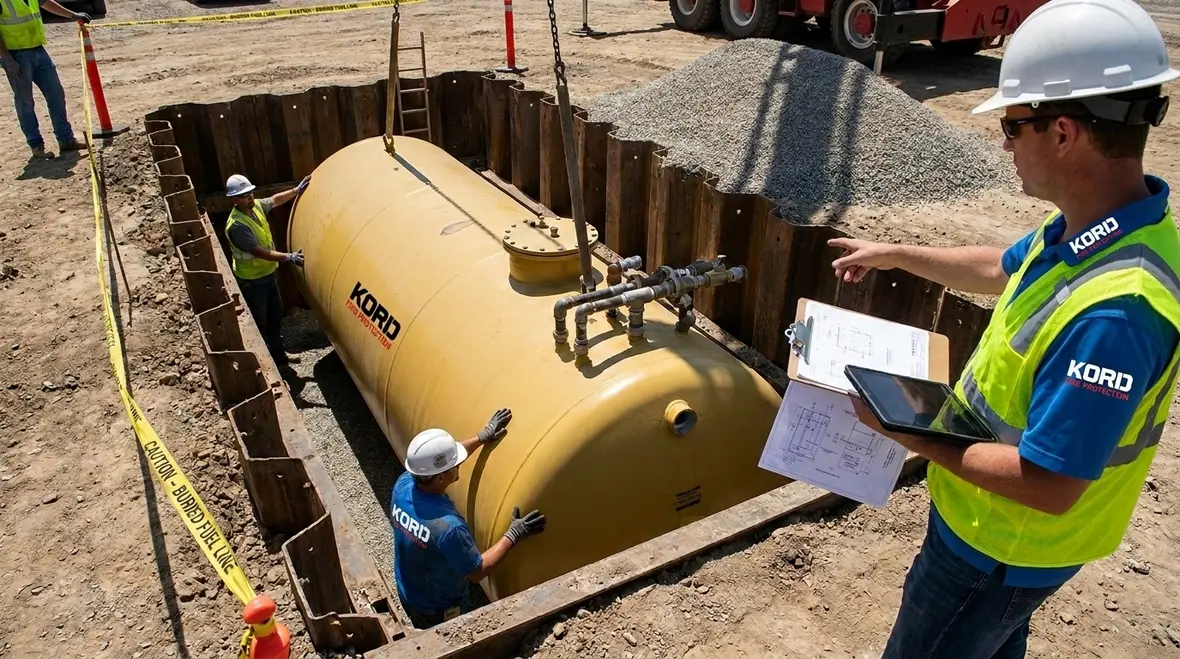
NFPA 30 Section 23.16: Following Installation Instructions for USTs
Quick Answer
NFPA 30 Section 23.16 requires owners and installers to follow the approved installation instructions for underground storage tanks (USTs). This obligation controls placement, support, fittings, piping, burial depth, leak testing interfaces, and commissioning steps. Proper instruction based installation supports fire safety, inspection readiness, and regulatory defensibility.
What Section 23.16 requires after the tank arrives on site
NFPA 30 Section 23.16 UST installation instructions focus on one outcome: the UST system must be installed exactly as specified in the approved documentation. For commercial, industrial, and retail facilities, the most common compliance breakdown happens after delivery, when contractors make “field adjustments” to deal with grade changes, utility conflicts, or scheduling pressure. Section 23.16 limits that flexibility by tying acceptance to the installation instructions that govern critical interfaces such as corrosion protection, closures, fittings, and testable connections.
To understand how NFPA 30 regulates flammable liquids across the life cycle, including installation and safety controls, refer to: how NFPA 30 regulates flammable liquids.
If your team is also tightening records for inspection readiness, it helps to review fire safety system documentation for compliance early, because the paperwork tends to get loud the moment an auditor walks in.
Why “follow the instructions” is treated as a safety control
NFPA 30 uses installation requirements as a fire risk barrier. When an underground tank or tank piping is installed outside its instruction set, multiple failure points can appear simultaneously:
- Corrosion protection can become incomplete where insulation, coatings, or cathodic protection interfaces do not match the design.
- Fittings and closures can lose sealing performance, increasing the likelihood of vapor or product migration.
- Test ports and leak detection components may not meet functional alignment, which can reduce detection capability during required testing.
- Improper burial depth or bedding can distort the tank shell or piping, stressing joints and causing early seal failure.
- Incorrect venting or interconnection details can affect pressure behavior and increase release severity.
In practice, inspectors evaluate whether the installed condition matches the instruction driven design envelope. That means facilities need proof, not just intent. An installation package that includes the approved instructions, material lists, and verification steps becomes a key compliance record.
How teams should execute NFPA 30 Section 23.16 UST installation instructions on site
Commercial projects often run on overlapping trades, which makes instruction control difficult. The safest approach uses a stepwise workflow that locks critical parameters before work proceeds.
1) Pre installation confirmation and instruction control
- Verify the exact tank model, piping configuration, and accessories match the approved instructions.
- Confirm compatibility between tank system components and the facility’s corrosion protection and leak detection strategy.
- Ensure drawings, product compatibility requirements, and test methodology align with the installation instructions.
Common commercial challenge: replacing a component because “it is equivalent.” If the replacement is not within the approved instruction set, Section 23.16 exposure increases.
2) Excavation, bedding, and tank placement checks
- Match burial depth, grading, and bedding specifications.
- Control settlement risks by using the bedding and backfill materials identified in the instructions.
- Confirm alignment of penetrations, manway components, and piping connections before final set.
Failure point to watch: tanks placed on uneven or inadequately prepared foundations. Even if the tank appears level, stress at penetrations and joints can create delayed leaks.
3) Piping interfaces, fittings, and closure requirements
- Install piping, unions, flexible connectors (if applicable), and fittings per the instruction driven torque and sealing methods.
- Verify that couplers, gaskets, boots, and connection hardware are compatible with the stored product.
- Confirm that closure methods and access points preserve the intended barrier integrity.
Field adjustment risk: reseating a connection using a “better sealant” outside the instruction list. In UST systems, seal compatibility directly affects long term performance.
4) Corrosion protection and leak detection compatibility
- Install coatings and cathodic protection components as specified, including any required test leads and inspection points.
- Maintain the required interfaces for monitoring, including test wells or access features.
- Perform interim checks before covering work to avoid hidden defects.
Corrosion protection interfaces often fail during cover up when teams proceed without verification that components are correctly seated and electrically configured. Documented checks help protect the facility during audits.
5) Commissioning, testing, and documentation
- Complete acceptance testing that matches the installation instructions and facility requirements.
- Record results for leak detection readiness, pressure or vacuum checks (if applicable), and sensor functionality.
- Maintain as built records tied to the installed configuration.
Inspection readiness matters in commercial operations. A facility with incomplete commissioning documentation can face repeat testing costs and operational downtime.
What inspectors look for later: the audit trail and the installed condition
Section 23.16 does not end at turnover. Inspectors expect the installed UST system to remain aligned with the instruction driven design during ongoing compliance activities. Facilities typically demonstrate alignment through:
- Installation package completeness: approved instructions, product datasheets, accessory lists, and site specific approvals.
- As built documentation: confirmation that actual components and configurations match the submitted design.
- Test records: leak detection performance documentation and evidence of required test intervals.
- Maintenance continuity: maintenance actions performed only with instruction compliant parts and procedures.
For commercial facilities, maintenance teams can become the weak link. Replaced components that are not specified in the original instructions can undermine both safety barriers and the facility’s test validity over time. A planned maintenance process should include instruction verification before any swap or adjustment.
Where compliance usually breaks during UST install projects
The following are recurring, practical failure points that drive risk and increase rework:
- Component substitutions: “Equivalent” accessories that alter sealing, monitoring interfaces, or corrosion protection performance.
- Cover up before verification: incomplete inspections of penetrations, corrosion components, and leak detection interfaces prior to backfill.
- Incorrect bedding or backfill: materials that do not support the tank and piping as required by the instructions.
- Sealant and gasket mismatches: non approved materials that degrade under stored product exposure.
- Uncontrolled field modifications: changes to fittings or routing that are not evaluated against the instruction set.
These failures create a pattern: the tank may appear functional at commissioning, but the system’s barrier integrity can deteriorate faster than expected. Instruction compliant installation helps prevent early loss of containment and supports effective monitoring.
How Kord Fire Protection supports instruction compliant UST safety
Commercial owners benefit from partnering with a team that understands how instruction compliance affects inspection outcomes and long term fire safety performance. Kord Fire Protection supports facilities with practical compliance deliverables that align installation intent with ongoing verification.
- Assistance with compliance documentation organization and review readiness for UST related safety expectations.
- Guidance that supports consistent maintenance planning and verification so instruction compliant configuration stays intact.
- Operational coordination for commercial sites where downtime and contractor access constraints require structured, auditable workflows.
When facilities treat NFPA 30 Section 23.16 UST installation instructions as a lifecycle requirement, they reduce rework, testing repeat cycles, and audit friction.
Frequently Asked Questions
Get installation ready for inspection, not just commissioning
Facilities should validate NFPA 30 Section 23.16 UST installation instructions before installation starts, verify critical interfaces before cover up, and keep as built and test records complete for later audit readiness. Kord Fire Protection can help commercial teams organize compliance evidence and plan maintenance so the installed condition stays instruction compliant. Contact Kord Fire Protection today to support your UST compliance program and reduce rework risk.

Join Our Newsletter!
Get the latest fire safety tips delivered straight to your inbox From our Newsletter.



