
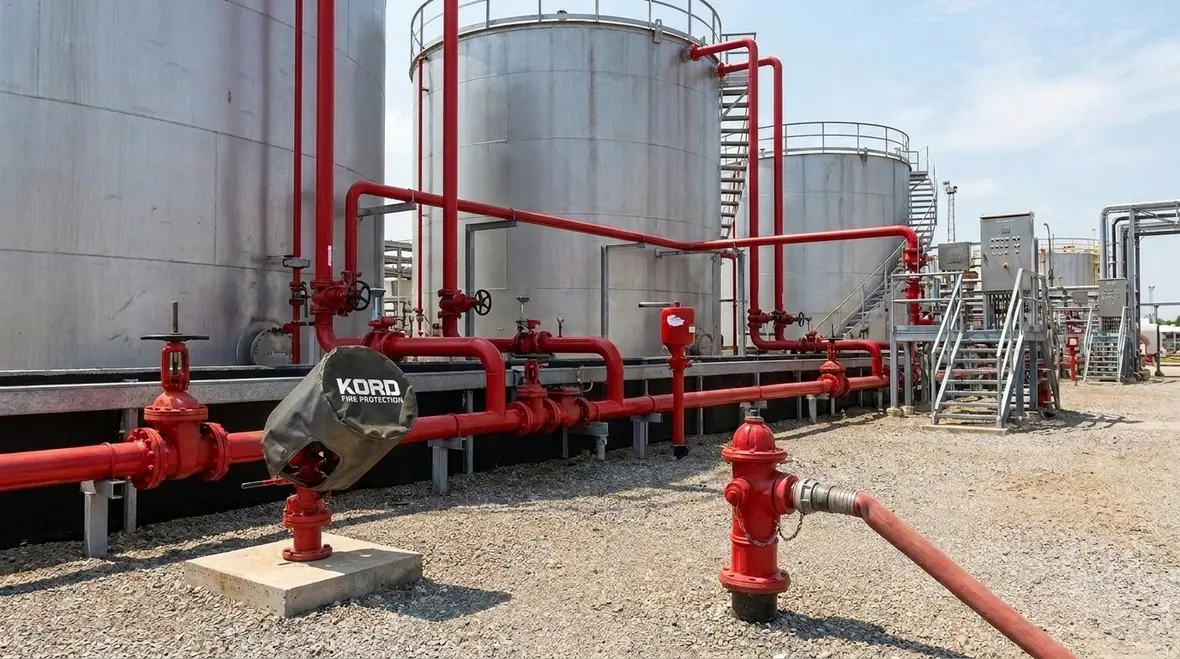
NFPA 30 Section 22.8: Fire Protection for Aboveground Tanks
Quick Answer
NFPA 30 Section 22.8 sets performance driven requirements to reduce fire risk and limit fire growth around aboveground tanks. It focuses on detection, suppression, remote control, protection of tank openings, and inspection and maintenance so systems remain reliable during abnormal conditions and emergencies.
Facilities managing tank hazards often benefit from a broader fire protection services plan that keeps inspections, testing, and corrective actions coordinated instead of scattered across multiple vendors.
Why NFPA 30 Section 22.8 matters for commercial tank farms
Commercial and industrial operators often underestimate how quickly an aboveground tank fire can escalate. Vapor release, wind driven flame spread, impingement on nearby equipment, and failure of exposed components can turn a localized incident into a facility wide event. NFPA 30 Section 22.8 fire protection aboveground tanks provides a structured baseline to prevent ignition escalation, protect critical exposures, and keep installed systems functional.
For retail fuel sites, distribution terminals, and manufacturing plants, compliance becomes a practical operations problem. Fire protection systems must work at the same time that maintenance, turnover, and production schedules increase variability. Facilities need clear inspection routines, documented testing, and a dependable service provider that understands NFPA 30 and the field realities of valves, pumps, nozzles, heat tracing, and control power.
What Section 22.8 typically requires on aboveground tanks
NFPA 30 Section 22.8 fire protection aboveground tanks generally addresses fire protective provisions tied to tank hazards and typical facility layout. While exact details can vary based on tank type, size, location, and the flammable liquid involved, the intent remains consistent: detect and control fires rapidly, protect the tank shell and appurtenances, and maintain a defendable response until emergency action is completed.
1) Protection strategy aligned with tank hazard conditions
Aboveground tanks present unique hazard geometry. Heat radiation from a burning surface can threaten adjacent equipment, piping, and tank manways. A compliant protection strategy evaluates likely fire scenarios, including early fire discovery, exposure to radiant heat, and the consequences of blocked or failed valves. Installations often combine fixed systems where appropriate and procedural controls for safe isolation and response.
2) Systems designed to protect openings and critical points
Many failures start at the weakest exposed points. Tank openings, vents, gauging connections, and fill or withdrawal interfaces can allow fire to grow if they are not adequately protected. Section 22.8 considerations frequently connect fire protection design to these interfaces, ensuring they remain covered or controllable during credible incidents.
3) Reliable actuation, controls, and operator interface
A protection system must actuate under alarm and emergency conditions with minimal ambiguity. Control components, power reliability, and fail safe behavior matter as much as the discharge hardware. Facilities need controls that support remote emergency response while preventing unauthorized or unsafe manual actions.
How systems work in the real world: mechanisms and failure points
Design compliance only succeeds if equipment functions as intended under plant conditions. NFPA 30 Section 22.8 fire protection aboveground tanks is commonly challenged by installation drift, corrosion, and deferred maintenance. Understanding how systems fail helps operators build effective inspection and acceptance programs.
Fixed suppression hardware and its common problems
- Clogging and blockage: Nozzles and strainers can clog from sediment, corrosion products, or construction debris. Even partial blockage reduces coverage and increases local heat damage.
- Incorrect hydraulics or distribution: Changes to pipe runs, minor slope errors, or unapproved fittings can disrupt flow and coverage patterns.
- Corrosion at exterior components: Exposed piping, valve bodies, and fittings degrade over time, impacting pressure integrity and response speed.
Detection and alarm reliability
- Drift in sensitivity: Detectors can become less responsive due to contamination, paint overspray, dust loading, or environmental changes.
- Alarm routing and supervision gaps: Misconfigured zones or missing supervision can delay response or cause nuisance alarms that lead to alarm fatigue.
Valves, actuation circuits, and isolation logic
- Sticking valves: Even when valves are exercised, sticky seals and debris can prevent full movement during an emergency.
- Incorrect or outdated isolation procedures: Maintenance actions may change valve positions or tags without updating procedures, creating a disconnect during an incident.
- Control power interruptions: Loss of power, degraded batteries, or poor terminations can prevent system activation at the exact time it is needed.
Operators strengthen compliance by treating inspections as a technical discipline, not a calendar task. Kord Fire Protection supports facilities with planned testing, verification of coverage performance assumptions, and maintenance workflows that keep systems stable between shutdowns and turnarounds.
Compliance in practice: inspections, testing, and documentation
NFPA 30 Section 22.8 fire protection aboveground tanks should be implemented with inspection and maintenance plans that match how the plant operates. A common compliance gap occurs when inspections do not reflect actual system interfaces, such as valves that are normally locked, remote reset logic, and seasonal changes in ambient conditions.
What to verify during routine service
- Coverage verification readiness: Ensure no physical obstructions exist around discharge patterns, and confirm that components match approved drawings.
- Condition of actuating equipment: Verify panel supervision, correct signal paths, and reliable device integrity.
- Valve position assurance: Confirm normal and emergency positions align with site procedures and are correctly tagged.
- Hydraulic and pneumatic health: Check for signs of water ingress, corrosion, pressure losses, and abnormal flow behavior.
- System labeling and instruction clarity: Maintain readable labels and operational instructions at control points and field locations.
Documentation that regulators and insurers expect
Facilities typically need traceable proof that testing occurred, results were within acceptance ranges, and any deficiencies were corrected. Strong documentation includes maintenance reports, device serial or tag references, and a record of corrective actions. This reduces turnaround risk and supports audits, incident reviews, and renewal cycles.
To strengthen how flammable liquid hazards integrate with fire protection planning, facility teams often cross reference NFPA 30 concepts with related regulatory interpretations and best practices. See how NFPA 30 regulates flammable liquids for practical context on how hazard controls connect across the standard.
Common compliance challenges for aboveground tanks
Even well operated facilities struggle with a few recurring issues. Addressing these challenges early prevents nonconformities and avoids operational downtime caused by emergency repairs.
Challenge 1: Design changes that outpace as built records
Piping reroutes, tank upgrades, new ladders, changed insulation, and revised outlet sizes can alter installation conditions without updating drawings or component lists. During inspection, this creates uncertainty about what was originally approved. Kord Fire Protection helps align field conditions with documentation so the compliance story remains consistent.
Challenge 2: Deferred maintenance on exterior and embedded components
Exterior pipework, valve wheels, and electrical terminations degrade. Embedded components may fail slowly due to corrosion or mechanical wear that does not show during day to day operations.
Challenge 3: Operational procedures are not synchronized to the system
When plant staff change shift, contractor work occurs, or isolation valves are moved for maintenance, procedures can become outdated. A compliant fire protection system cannot compensate for incorrect isolation logic or unclear response steps.
Challenge 4: Coordination between multiple trades and vendors
Fire protection systems involve electrical contractors, instrumentation teams, mechanical trades, and operations. A missed coordination detail can result in incompatible component interfaces or untested changes.
How Kord Fire Protection supports ongoing NFPA 30 Section 22.8 readiness
Commercial facilities need a service partner that treats tank fire protection as a living system. Kord Fire Protection delivers practical compliance support through scheduled testing, preventive maintenance, and targeted corrective actions that address field failure points before they become operational incidents.
Support commonly includes confirmation of system condition, verification of control readiness, and maintenance practices that help ensure equipment works during abnormal scenarios. This approach reduces the likelihood of inspection surprises and strengthens the facility’s ability to respond safely if a fire event occurs.
Frequently Asked Questions
Next steps
Audit your aboveground tank fire protection readiness against NFPA 30 Section 22.8 by verifying field alignment to approved design documents, then confirm detection, actuation, and suppression performance through a disciplined testing and maintenance plan. Contact Kord Fire Protection to schedule a compliance focused inspection and develop a service roadmap that keeps your systems reliable between audits, outages, and operational changes.

Join Our Newsletter!
Get the latest fire safety tips delivered straight to your inbox From our Newsletter.



