
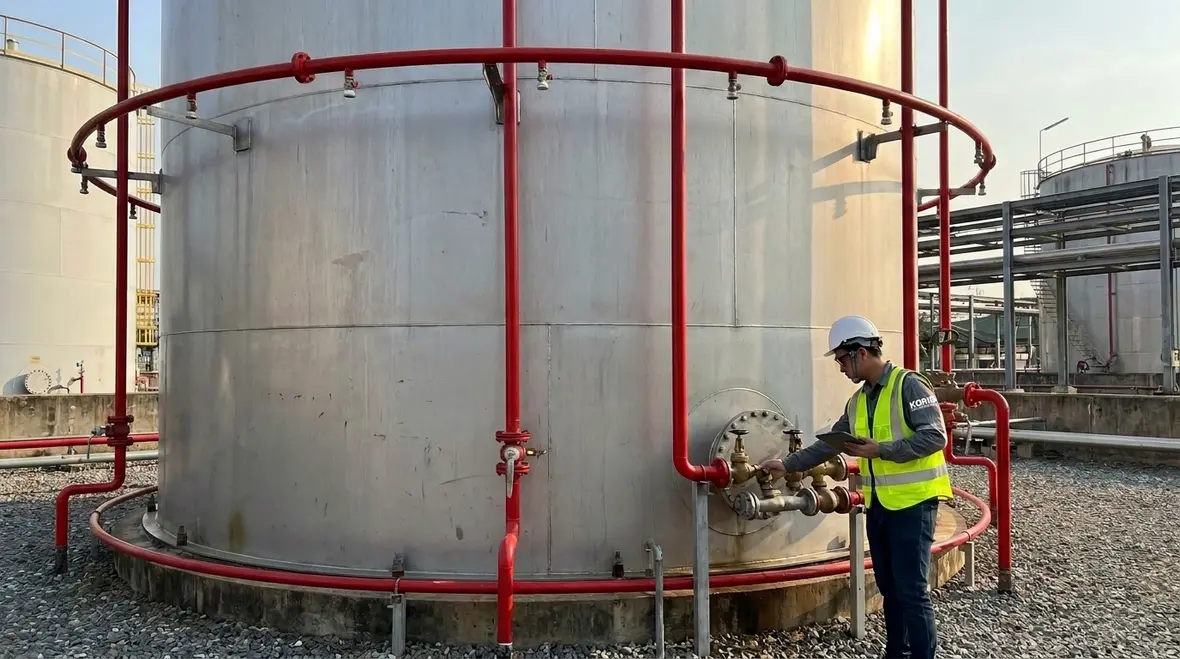
NFPA 30 Section 22.10: Additional Rules for Protected Tanks
Quick Answer: NFPA 30 Section 22.10 sets additional requirements for tanks that are protected by design features such as fireproofing, water spray, or automatic suppression. It focuses on how those protections perform in real fire conditions, including maintenance, inspection, and system reliability for protected aboveground tanks.
What NFPA 30 Section 22.10 protected aboveground tanks actually changes
NFPA 30 Section 22.10 adds practical rules when the facility protects an aboveground tank with an engineered fire protection measure. Instead of treating protection as a one time installation, the standard requires facilities to manage protection as an ongoing life safety function. That means defined inspection expectations, operational readiness, and controls that reduce the likelihood of protection impairment during normal facility use.
Because the protection systems can fail in predictable ways, compliance depends on how the tank, protection components, and detection and control equipment operate together. For an overview of how NFPA 30 regulates flammable liquids, see how NFPA 30 regulates flammable liquids. If your team is also reviewing broader inspection, testing, and maintenance support, fire protection services in Southern California fit naturally alongside protected tank compliance planning.
When the “protected” designation applies
Facilities typically fall into Section 22.10 triggers when a protected condition exists, such as when a tank uses fire resistant construction, insulation or fireproof coatings designed to maintain survivability, or active protection systems intended to limit heat exposure or control fire involvement. The intent remains consistent across protected designs: keep the tank within safe thermal conditions long enough for the scenario to be controlled.
From a commercial compliance standpoint, the main question operational teams must answer is this: “Does the protection stay effective during real facility conditions?” Common drivers include ongoing maintenance activities, accidental mechanical damage, corrosion of concealed components, obstructions around nozzles, and incorrect restoration after repairs.
Common protected tank configurations
Passive thermal protection: fireproofing, insulation, or coatings applied to withstand heat exposure and limit temperature rise.
Active cooling or protection: water spray systems intended to reduce radiant and convective heat transfer to the tank shell.
Integrated detection and control: systems that initiate protection based on heat, flame, or other detection methods as designed.
Key compliance requirements facilities must plan for
Section 22.10 focused requirements generally concentrate on three risk areas: ensuring the protected design stays functional, ensuring the system can be activated as intended, and ensuring components remain compatible with operating conditions. In real facilities, these areas become compliance gaps during renovations, contractor scope changes, or deferred maintenance cycles.
Operational readiness and activation reliability
Protected aboveground tanks depend on the time window between incident initiation and fire control actions. Compliance systems should be verified for activation reliability, including proper control logic, correct set points, and fail safe behavior. Technical teams should treat activation as a testable function, not a theoretical design feature.
Typical failure points include incorrect sequencing after panel upgrades, wrong detector mapping, impaired valves, stuck check valves, clogged nozzles, and software configuration drift in microprocessor based controllers. Facilities that operate multiple tanks often see cross zoning errors after expansions or label changes.
Inspection, testing, and maintenance expectations
Section 22.10 requirements effectively force facilities to implement a maintenance discipline tailored to protected tanks. That includes inspection of visible protective features, evaluation of active components for performance, and verification that repairs maintain the original protection intent.
In practice, “maintenance” must cover both the tank and the protection envelope. For passive systems, this means verifying coating integrity and continuity where damage commonly occurs, such as around access points, ladders, piping penetrations, and anchor locations. For active systems, it means checking water distribution, nozzle condition, pressure adequacy, and ensuring that isolation devices do not inadvertently prevent flow.
Protection impairment during normal operations
Operational activities can interfere with protected tank performance. Examples include:
Physical damage: forklifts, construction impacts, dropped tools, or scraping during maintenance.
Obstruction: debris accumulation, paint overspray, stored materials too close to discharge points, or blocked water spray patterns.
Environmental degradation: corrosion under insulation, UV degradation of coatings, and water ingress into junction areas.
Unauthorized modifications: routing piping or adding equipment that interferes with cooling coverage or thermal protection thickness.
These impairments may not be obvious during routine rounds, especially when protective components are partially concealed. Compliance programs should explicitly include walkthroughs that target potential impairment locations.
How to structure a compliance program for protected tanks
A successful Section 22.10 compliance approach aligns engineering intent with field execution. The facility should document protection design assumptions and then translate those assumptions into inspection checklists, test intervals, and maintenance work instructions. This reduces ambiguity for contractors and prevents drift during upgrades.
Develop a protection register and inspection checklist
Facilities benefit from a tank specific “protection register” that lists each protected element and its maintenance needs. A strong register includes:
Protection type (passive, active, or both) and coverage boundaries
Component identification numbers and locations
Critical performance attributes (for active systems, distribution and activation; for passive systems, integrity and continuity)
Known vulnerability points such as penetrations, supports, and access structures
This process supports repeatable compliance, especially for commercial, industrial, and retail sites where operational turnover and contractor rotation can increase variability.
Set work control requirements for repairs and changes
When a tank requires repair, the facility should control how the protection is restored. For passive systems, restoration quality must match original thickness, coverage, and adhesion characteristics. For active systems, repairs must restore leak integrity, valve positions, nozzle condition, and control logic.
Without controlled restoration, the tank may remain “protected” on paper but lose protection in reality. That gap becomes a critical findings theme during audits and insurance reviews.
Use incident based lessons to improve inspection focus
Facilities can strengthen compliance by learning from near misses and documented maintenance events. Common lessons include patterns of coating cracking near vibration sources, nozzle clogging after seasonal shut downs, and control panel alarms caused by incorrect component labeling.
By converting lessons into checklist updates and targeted inspection rounds, facilities reduce the probability of repeat failures.
Where teams commonly miss Section 22.10 protected tank requirements
Protected tank compliance failures usually originate from predictable gaps rather than misunderstanding the core intent. The most common issues include:
Deferred maintenance: inspection finds wear or damage but corrective actions slip until after the next compliance cycle.
Incomplete post repair verification: repairs restore the tank but do not verify protection performance or coverage continuity.
Inconsistent contractor scope: construction teams modify attachments or routing without assessing impact on protection components.
Accessibility problems: insulation or structures restrict inspection access, leading to superficial checks rather than integrity verification.
Control system drift: changes to zones, firmware, or wiring without validated testing of protected tank initiation.
Kord Fire Protection supports facilities by aligning fire safety testing, inspection discipline, and maintenance documentation to the operational realities of protected aboveground tanks. That includes verifying that protection systems remain capable of performing their intended function over time, not only at commissioning.
Partnering for ongoing protected tank compliance
Commercial and industrial facilities often face competing priorities: production continuity, frequent maintenance work, and multi discipline contractor activity. Those pressures increase the likelihood of protection impairment if the fire protection program does not include proactive verification and work control.
Kord Fire Protection helps teams manage NFPA 30 Section 22.10 protected aboveground tanks as a sustained safety capability. That means scheduled inspections, performance verification, and practical maintenance oversight that supports audit readiness and reduces operational risk.
Frequently Asked Questions
Ready to close your Section 22.10 gaps?
If your facility has protected aboveground tanks, a structured compliance review can identify where inspection focus, work control, or performance testing needs improvement. Contact Kord Fire Protection for an audit oriented approach that supports NFPA 30 Section 22.10 compliance through realistic maintenance and verification planning, documentation, and ongoing service.

Join Our Newsletter!
Get the latest fire safety tips delivered straight to your inbox From our Newsletter.



