
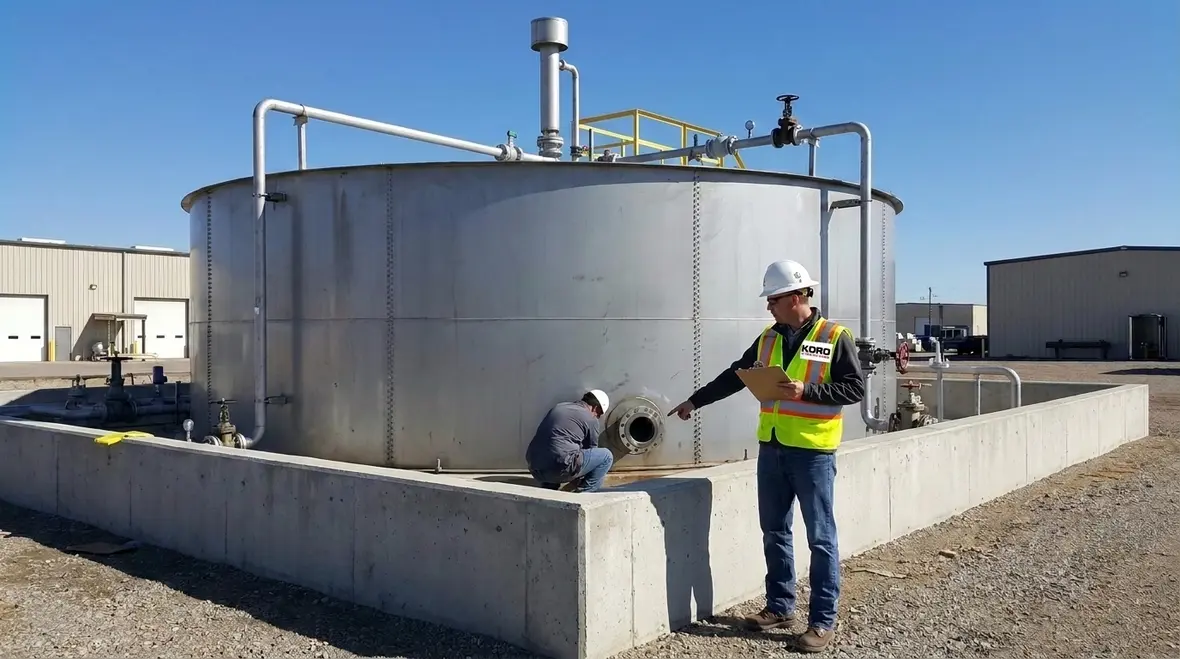
NFPA 30 Section 22.5: Installing Aboveground Storage Tanks (AST) Requirements
Quick Answer
N FPA 30 Section 22.5 AST installation requirements govern how commercial aboveground storage tanks are placed, protected, vented, supported, and connected to reduce fire and explosion risk. Compliance affects spacing, containment, corrosion control, and installation quality, all of which inspection teams verify during acceptance and ongoing maintenance.
What NFPA 30 Section 22.5 is trying to prevent
N FPA 30 Section 22.5 AST installation requirements focus on preventing predictable loss scenarios: releases from faulty piping or connections, improper venting, ignition sources introduced during installation, and inadequate containment or drainage. In commercial, industrial, and retail facilities, these installation risks compound quickly because tanks are often tied to pumps, dispensers, transfer hoses, and control systems that demand dependable mechanical and fire-safe performance.
For facilities managing flammable liquids, the installation phase becomes the highest leverage point for long term compliance. One incorrect support detail or a missed check valve configuration can create chronic vapor leakage, impeding safe operations and raising audit exposure.
Facilities often start by aligning engineering intent to code language. Then they validate field build quality with documented verification. For a broader view of how NFPA 30 regulates flammable liquids and related hazards, see how NFPA 30 regulates flammable liquids.
Where Section 22.5 fits in the AST compliance process
NFPA 30 organizes storage and handling requirements so that installation practices match the tank’s intended use, product characteristics, and operating environment. Within that framework, Section 22.5 addresses aboveground tank installation elements that directly influence containment, fire protection, and leak control.
Commercial compliance teams typically encounter three practical pressure points:
-
As built alignment: The installed configuration must match drawings, equipment listings, and site conditions that the design assumed.
-
Interface with fire protection systems: Tank configuration affects spill containment, drainage routing, and how other systems perform during emergency response.
-
Maintenance accessibility: Installation choices that block access for inspection, gauging, vent servicing, or drain maintenance create compliance drift over time.
Installation fundamentals: location, supports, and spill behavior
Installation success begins before the first connection. NFPA 30 Section 22.5 AST installation requirements require proper tank placement and mechanical readiness so that the tank remains stable and the facility can manage any spill or leak without creating uncontained fire spread.
1) Tank foundations and support integrity
Tanks rely on designed support and leveling to prevent stress on shell seams, nozzles, and internal components. Misalignment can lead to accelerated gasket wear, joint loosening at flanged connections, and abnormal strain at pipe interfaces. In commercial environments, these issues often emerge later as seepage at fittings, vapor odors, and inconsistent gauge readings.
2) Connection routing and mechanical protection
Tank piping and connected systems need routing that respects thermal movement, vibration risks, and impact exposure. Installation crews that run piping too rigidly or neglect flexible connections where needed can cause chronic stress on valves and fittings. Stress also undermines leak testing results by masking micro movement until the system reaches operating pressure and temperature.
3) Containment, drainage, and where fuel goes
Spill management is not theoretical during inspections. Inspectors verify how drainage and containment work under credible release conditions. Installation choices must support the containment strategy, including how product flows to drains or controlled areas and how ignition source exposure remains controlled.
For facilities with existing grades, basements, or structural penetrations, field verification becomes critical. Kord Fire Protection supports ongoing compliance by coordinating documentation, inspection readiness, and maintenance planning so that installation decisions hold up under real-world operations. Facilities dealing with broader suppression risks can also review fire suppression system services to connect tank area hazards with system level protection planning.
Venting, ignition control, and the details that trigger failures
Venting and emergency pressure relief behavior directly influence vapor concentration and potential release during upset conditions. NFPA 30 Section 22.5 AST installation requirements require that vent systems, relief components, and associated hardware perform as intended and remain free from installation defects.
Vent discharge routing and vapor management
Improper vent termination locations can pull vapors toward air intakes, building openings, or ignition sources. Common field errors include incorrect vent height, incorrect discharge angle, missing guards where required, and routing that conflicts with prevailing wind or site obstructions.
Fire exposure considerations during installation
AST installations also have to account for credible fire scenarios during construction and commissioning. If temporary heaters, cutting operations, or non rated electrical connections enter the work area without control, the risk profile changes. Installation procedures should control ignition sources and confirm that materials and wiring selections align with the hazardous location requirements tied to the stored product.
Common installation failure points inspectors look for
-
Missing or misinstalled fittings: Incorrect orientation, omitted gaskets, or wrong torque procedures can create persistent seepage.
-
Improper grounding or bonding: Electrostatic control failures increase the probability of ignition during transfer or vapor generation.
-
Incorrect valve selection or placement: Installation that does not match the design intent can prevent containment isolation when needed.
-
Inconsistent leak test documentation: Teams often perform tests but fail to keep installation traceability, leaving gaps during compliance review.
Commissioning and inspection readiness: the compliance proof pack
Even when the tank equipment itself is correct, NFPA 30 Section 22.5 AST installation requirements expect traceable verification that the assembly works. For commercial facilities, this means preparing a “proof pack” that connects drawings, equipment documentation, and field testing results.
Operational testing that holds up under scrutiny
Commissioning should validate that the tank system behaves as installed, including pressure or leak testing practices where applicable, correct operation of gauges and monitoring interfaces, and confirmation of vent and relief hardware placement. Testing methods must also reflect the installation state so that the results represent what will exist during normal operations.
Documentation that reduces audit and downtime risk
Inspections often slow down when teams cannot quickly show how the installation matches the design basis. Kord Fire Protection helps commercial and industrial operators reduce downtime by structuring documentation and inspection coordination around how facilities actually maintain and verify AST assets over time. Teams looking to tighten the paper trail can also review fire safety system documentation for compliance for a practical documentation perspective.
When fire protection compliance is managed as a recurring program rather than an episodic activity, organizations typically experience fewer installation correction events and less operational disruption during audits.
How maintenance protects the installation you paid for
NFPA 30 Section 22.5 AST installation requirements do not end at handoff. Installation quality must remain intact through maintenance cycles. The most common compliance drift occurs when mechanical components degrade, connections loosen, vent systems accumulate obstruction, and containment drainage pathways change due to site work.
Maintenance tasks linked to installation performance
-
Vent inspection and clearing: Confirm discharge paths remain unobstructed and hardware remains correctly positioned.
-
Leak detection and connection integrity checks: Monitor for seepage at joints, flanges, and instrumentation penetrations, especially after operational startups or changes.
-
Containment and drainage verification: Ensure drains route correctly and spill control features remain functional after landscaping, paving, or construction modifications.
-
Foundation and support monitoring: Watch for settlement, corrosion impacts, or stress signs that can transfer to nozzles and pipework.
Because commercial facilities routinely undergo renovations, equipment upgrades, and process changes, a maintenance plan must include “change management” checks that confirm the installation still matches code intent.
Why Kord Fire Protection supports AST compliance beyond installation
Commercial AST projects fail compliance for reasons that look technical but behave operationally: missing traceability, incomplete commissioning documentation, unclear responsibility for ongoing inspections, or poor readiness for recurring verification. Kord Fire Protection acts as a compliance partner that connects installation requirements to practical inspection and maintenance outcomes.
Facilities that plan early usually reduce corrective work after commissioning. Those outcomes protect safety, limit downtime, and strengthen audit confidence. For additional context on compliance drivers related to flammable liquids, review how NFPA 30 regulates flammable liquids.
Frequently Asked Questions
Next step: verify your AST installation now
If your facility is commissioning a new tank or modifying an existing one, validate compliance readiness before handover. Request a compliance review that maps NFPA 30 Section 22.5 AST installation requirements to your site layout, vent and connection details, and inspection documentation. Kord Fire Protection helps commercial, industrial, and retail operators confirm installation quality, strengthen audit confidence, and maintain safe performance through ongoing service.

Join Our Newsletter!
Get the latest fire safety tips delivered straight to your inbox From our Newsletter.



