
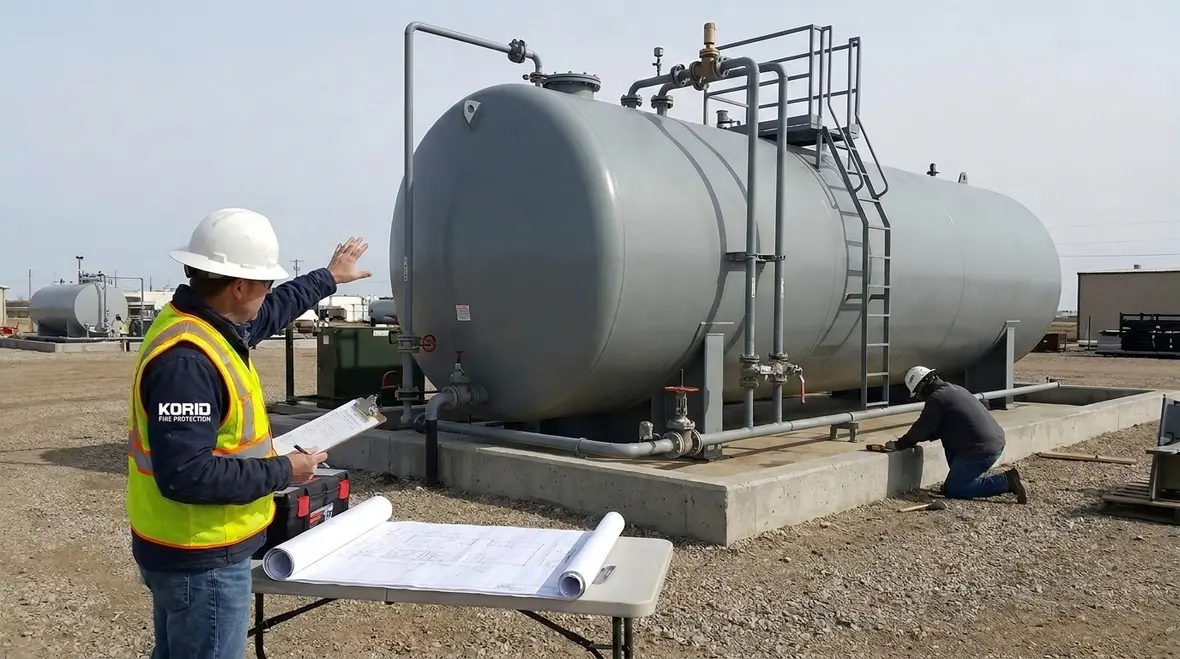
NFPA 30 Section 22.16: Following Installation Instructions for ASTs
Quick Answer
NFPA 30 Section 22.16 requires owners and installers of aboveground storage tanks (ASTs) to follow the installation instructions provided by the tank manufacturer and any applicable referenced standards. This ensures correct placement, piping connection, venting, foundation support, and commissioning controls for safe operation.
Why NFPA 30 Section 22.16 matters for commercial AST safety
Commercial, industrial, and retail facilities that store flammable liquids depend on predictable tank performance. NFPA 30 Section 22.16 AST installation instructions link the tank system to the conditions under which it was engineered. When installations deviate from the manufacturer’s directions, the safety features embedded in the tank design and its connected components can fail to function as intended.
In real-world projects, the compliance risk usually shows up after installation, during commissioning, leak testing, regulator calibration, or operational inspections. Section 22.16 is where the standard enforces that those details cannot be improvised. Facilities that manage AST compliance through disciplined documentation and field verification reduce both fire risk and downtime from corrective actions.
For broader context on flammable liquid compliance, review how NFPA 30 regulates flammable liquids. If your site work overlaps with suppression planning for commercial hazards, fire suppression systems is also a useful related reference.
What “following installation instructions” actually includes
NFPA 30 Section 22.16 AST installation instructions do not only cover where the tank sits on the site. They typically govern the full installation envelope, including:
-
Tank location and siting requirements, such as separation distances, access routes for inspection and maintenance, and compatibility with surrounding occupancy.
-
Foundation and support, including load distribution, leveling tolerances, anchoring requirements, and settlement allowances.
-
Connecting piping and appurtenances, covering alignment, material matching, routing, supports, and connection methods that preserve system integrity.
-
Venting and pressure control setup, ensuring that vents, conservation systems, and relief devices are installed to the engineered configuration.
-
Electrical and bonding components, including grounding and bonding arrangements where required for static control and equipment safety.
-
Commissioning verification, such as functional checks, calibration steps, and leak detection procedures that confirm the system is ready for service.
Because tanks and accessories can vary significantly by manufacturer and model, NFPA 30 Section 22.16 AST installation instructions work as the compliance bridge between engineered design intent and field execution.
Common compliance gaps during AST installation
Most installation nonconformities do not stem from ignoring safety fundamentals. They come from incomplete translation of the manufacturer’s instructions into site-ready work packages, procurement substitutions, or hurried commissioning windows.
1) Foundation, leveling, and anchorage shortcuts
Incorrect foundation preparation or skipping specified anchoring procedures can create stress points that affect seams, nozzles, and connected piping. Over time, thermal cycling and vibration can worsen alignment issues, increasing the likelihood of leaks at gaskets and flange joints. During inspection, these problems often appear as weeping, staining, or unexpected pressure drops.
2) Venting configuration and relief device placement errors
Venting and pressure control components must be installed to the engineered arrangement. Common failures include incorrect orientation, improper discharge routing, missing spacers or adapters, or vent paths that conflict with site obstructions. Even if the tank appears intact, vent and relief performance can be compromised, raising fire and explosion risk in abnormal conditions.
3) Piping routing and support deviations
Flammable liquid piping is sensitive to stress. Improper pipe supports, excessive hose length, or misaligned connections can pull loads into tank nozzles. This often leads to accelerated gasket aging and joint loosening. Installers frequently address symptoms later instead of correcting the root alignment and support design that NFPA 30 Section 22.16 AST installation instructions require.
4) Missing grounding, bonding, or incorrect electrical interfaces
Facilities that handle flammable liquids typically expect static control and bonding continuity. When installers do not match the manufacturer’s bonding points, materials, or conductor sizing, the system may not provide the intended electrostatic dissipation. Inspections may reveal intermittent continuity, corrosion at connection points, or wiring routed in ways that are not mechanically protected.
5) Incomplete documentation for commissioning and acceptance
Many compliance failures occur on paper. If a facility cannot demonstrate that installation steps followed the instructions, it struggles during audits, insurance reviews, or enforcement inspections. A robust acceptance package includes installation checklists, calibration records, test reports, and an as-built drawing set that matches the executed configuration.
Field verification: how to prove compliance with NFPA 30 Section 22.16
To comply confidently with NFPA 30 Section 22.16 AST installation instructions, facilities typically need more than a contractor closeout folder. They need verification controls that confirm the tank system was installed as engineered.
Pre startup checks that reduce risk
-
Site walkdown against the tank-specific instructions, verifying foundation condition, clearance, and access paths.
-
Mechanical integrity checks, including alignment of piping, confirmation of torque and gasket selection where applicable, and validation of support spacing.
-
Venting and relief inspection, confirming correct installation of vent routing, discharge locations, and the absence of obstructions.
-
Electrical continuity and bonding verification, including inspection for corrosion, secure terminations, and correct bonding paths.
Commissioning evidence that withstands scrutiny
A strong commissioning package aligns operational tests with the installation instructions. Typical evidence includes leak test results, calibration records for level or control components, functional tests of alarms and interlocks where installed, and documentation of any deviations with recorded approvals.
For deeper context on how NFPA 30 regulates flammable liquid hazards, facilities can reference this guidance: how NFPA 30 regulates flammable liquids. It supports risk-based decisions that pair installation compliance with operational hazard management.
Maintenance and inspection: keeping the installation correct over time
Following installation instructions at turnover does not end compliance. Over the tank lifecycle, changes in valves, couplings, seals, grounding conductors, and vent obstructions can recreate installation nonconformities. NFPA 30 expectations typically intersect with ongoing inspection and maintenance programs that confirm safety systems remain installed and effective.
Commercial facilities also face operational pressures that drive small work orders. Each work order can unintentionally alter the configuration that NFPA 30 Section 22.16 AST installation instructions established. Effective maintenance programs therefore include:
-
Controlled change management for piping modifications, vent alterations, and accessory replacements.
-
Inspection schedules aligned to the risk profile of the flammable liquid system and site conditions.
-
Document control to preserve as-built accuracy, manufacturer references, and test history.
-
Condition-based checks for corrosion, gasket seepage, grounding continuity drift, and physical damage to vent or relief components.
Kord Fire Protection supports facilities with compliance-focused testing, maintenance planning, and documentation practices designed for ongoing audits and operational readiness. For Australian facilities and commercial sites, Kord Fire Protection information is available at https://kordfire.com.au.
Frequently Asked Questions
Next step: verify your AST installation package
Facilities should compare the executed AST work against the manufacturer’s installation instructions and then validate that commissioning evidence matches the required configuration. Kord Fire Protection can help commercial teams build a defensible compliance file, plan ongoing inspection and maintenance, and reduce corrective work after turnover. Contact Kord Fire Protection via kordfire.com.au to review your AST documentation and inspection readiness.

Join Our Newsletter!
Get the latest fire safety tips delivered straight to your inbox From our Newsletter.



