
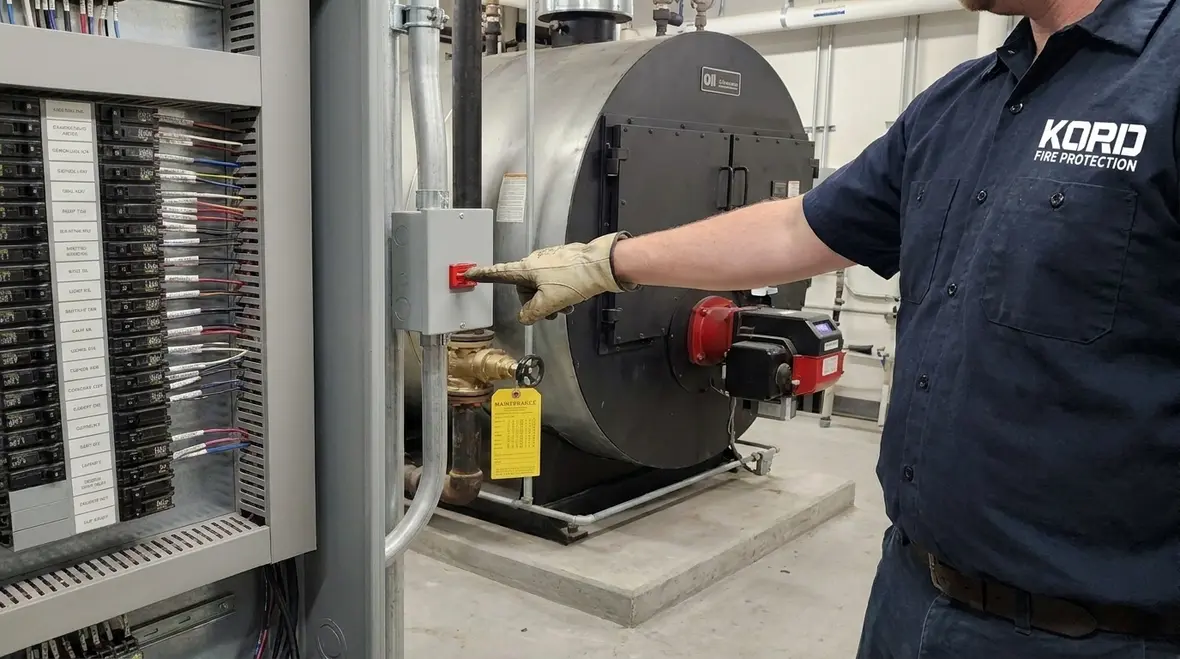
NFPA 31 Section 4.4: Electrical Service Requirements for Oil Equipment
Quick Answer: NFPA 31 Section 4.4 sets the electrical service expectations for oil burning equipment, focusing on safe supply, correct circuiting, and reliable controls. It also drives inspection readiness by requiring systems to function as intended and be maintained to prevent shock, fire, or operational failures.
For facilities tightening up inspection workflows, it also helps to connect this review with broader fire protection services in Southern California so electrical checks, documentation, and corrective actions do not end up living in separate worlds.
What Section 4.4 actually demands for NFPA 31 electrical services oil burning equipment
NFPA 31 Section 4.4 addresses the electrical service interface to oil burning equipment so the burner, controls, and associated safety devices operate safely and consistently. In practice, this means the facility must provide suitable power characteristics, proper wiring and disconnecting arrangements, and equipment access for inspection and service. For commercial sites, these requirements matter because day to day operational continuity depends on burner safety control reliability.
Because electrical service details often sit between trades and contractors, compliance problems commonly show up during commissioning, maintenance walkdowns, or after nuisance shutdowns. Using a structured approach helps teams align burner controls, wiring integrity, and power supply documentation to NFPA 31 expectations.
Where electrical service requirements show up on real job sites
1) Burner control voltage and reliability
Oil burners rely on control components that must receive stable and correctly wired power. Section 4.4 expectations typically translate into providing an electrical service that matches the equipment requirements and supports safe operation through start, run, and shutdown sequences. If power quality, circuit capacity, or wiring termination quality is inadequate, control components can misread flame status, fail to prove safety sequences, or drop out during ignition.
Common field issues include loose terminals, undersized conductors, or incorrectly landed control wiring after service work. These failures often surface as lockouts or intermittent ignition problems that are difficult to diagnose without documenting the electrical service setup and control sequence timing.
2) Proper circuiting and disconnecting for service
Oil equipment must remain serviceable and safe to isolate. Electrical service arrangements should support safe de energization for inspection, cleaning, component replacement, and troubleshooting. This includes ensuring that disconnecting means are accessible, clearly identified, and installed in a manner that aligns with equipment service needs.
Commercial facilities also benefit from consistent lockout and tagging practices. When disconnecting points are hard to access, poorly labeled, or shared across equipment with unclear boundaries, technicians face elevated risk during maintenance and higher downtime when fault isolation becomes slow.
3) Continuity to controls, limit circuits, and flame safety
Oil burner safety control sequences depend on electrical continuity and correct wiring pathways. While Section 4.4 is not a full burner control logic document, it influences the reliability of limit circuits, ignition control operation, and flame sensing circuits. Any service arrangement that introduces wiring defects, improper grounding continuity, or mismatched circuit protection increases the probability of safety device misoperation.
In practice, even when the burner “starts,” electrical faults can prevent proper limit checks, delay ignition, or disrupt flame sensing stabilization. These conditions may trigger nuisance shutdowns that appear like operational issues but originate in the electrical service interface.
Operational compliance challenges in commercial facilities
Commissioning documentation gaps
Many facilities can operate for months, then fail an inspection because documentation is missing. Electrical service compliance is easier to defend when the facility holds installation records that show equipment nameplate values, circuit details, and service disconnect configuration. Without this, teams may struggle to verify that the electrical service supports NFPA 31 electrical services oil burning equipment requirements as installed.
Commercial operators should treat commissioning outputs as living records, updated after any burner replacement, control panel change, or wiring modifications.
Afterhours maintenance and “temporary fixes”
Routine oil equipment maintenance sometimes includes quick swaps of components, temporary wiring changes, or bypasses that are not captured in official records. These actions can compromise the intended electrical service configuration. Later, when an inspection occurs, the facility may be unable to prove that electrical service arrangements remain compliant.
Kord Fire Protection supports commercial maintenance programs by aligning inspection and servicing activity with compliance evidence needs, including checklists tied to practical NFPA 31 expectations for ongoing readiness.
Interference from adjacent electrical work
Retail and industrial sites frequently expand infrastructure, relocate panels, or add loads. If electrical service routes are modified without confirming burner control circuit integrity, the risk of damaged insulation, poor terminations, or unintended routing changes rises. Even small electrical changes can alter control behavior, particularly when wiring is reworked near control cabinets.
Inspection and maintenance: how teams should verify electrical service readiness
To remain inspection ready, facilities should treat NFPA 31 electrical services oil burning equipment as a maintained system, not a one time installation task. Verification should focus on the parts that routinely drift from original condition.
What to check during routine service
Service disconnect condition and identification: Confirm disconnects are accessible, labeled to the equipment served, and fit for safe lockout.
Wiring integrity at the burner control interface: Inspect terminations for looseness, corrosion, or evidence of heat damage.
Grounding continuity and bonding: Verify grounding pathways remain intact after any panel or junction modifications.
Protection devices coordination: Confirm fusing or circuit protection is consistent with equipment requirements and not replaced with mismatched ratings.
Control cabinet physical readiness: Ensure covers, strain reliefs, and cable routing prevent strain or abrasion that can degrade over time.
What commonly fails and causes repeat callbacks
Repeat failures often involve electrical service interface weaknesses rather than burner mechanics. Expect a higher frequency of problems when installations lack clear separation of burner circuits from general loads, when service access is poor, or when multiple contractors touch the same control enclosure over time.
Kord Fire Protection encourages facilities to implement a maintenance workflow that captures electrical observations and ties them to service records. This reduces the likelihood of unresolved defects carrying forward into the next service cycle.
Practical compliance guidance for oil burner installation and ongoing service
For teams planning or upgrading oil burner systems, alignment between installation details and service practices is essential. A practical reference point is available through Kord Fire Protection’s guide, which focuses on installation realities and how teams can prevent common compliance gaps:
NFPA 31: A practical guide to oil burning equipment installation
For commercial operators, integrating electrical service review into the same workflow as burner commissioning improves outcome consistency. It also supports safer maintenance cycles, because technicians can isolate and troubleshoot equipment with confidence when conditions change.
For additional service support resources in Australia, visit https://kordfire.com.au/ and for electrical support considerations through a qualified partner, explore Kord Electric as part of your broader compliance and maintenance planning.
Frequently Asked Questions
Next step: schedule an NFPA 31 electrical service readiness review
If your facility operates oil burning equipment, use a structured electrical service readiness review to reduce inspection risk and avoid repeat burner lockouts. Kord Fire Protection can help validate electrical isolation arrangements, check control interface wiring integrity, and support documentation you can confidently present. Contact Kord Fire Protection today to plan a compliance focused inspection and maintenance program tailored to your commercial site requirements.

Join Our Newsletter!
Get the latest fire safety tips delivered straight to your inbox From our Newsletter.



