
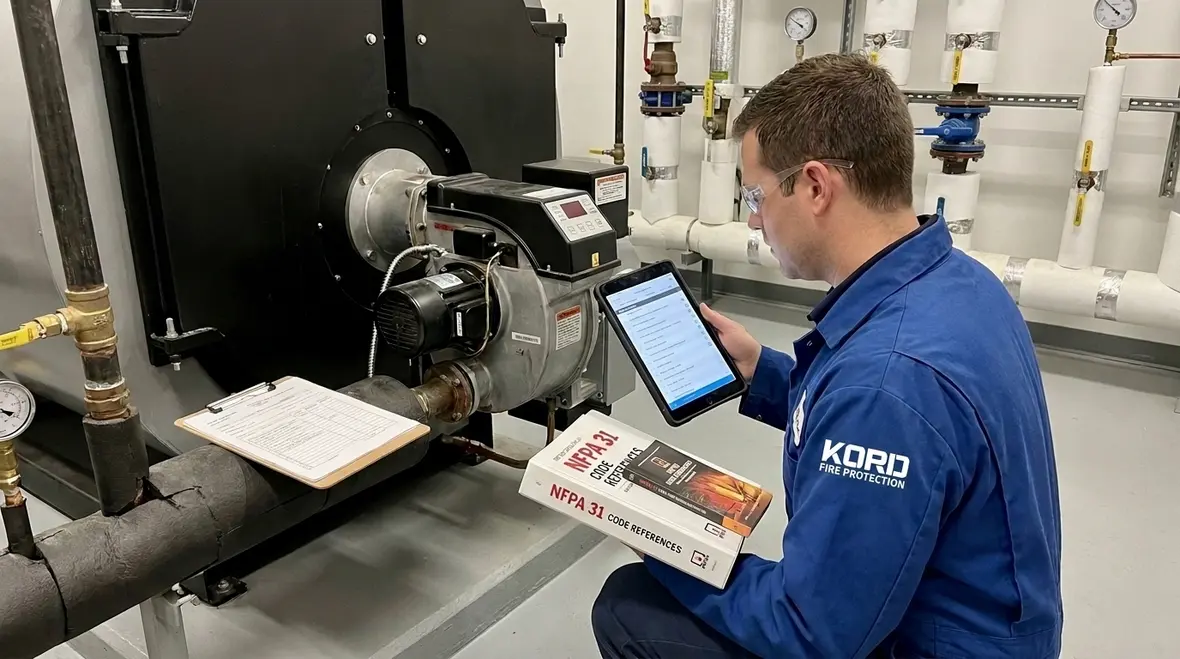
NFPA 31 Section 2.3: Non-NFPA References Inside the Oil Burner Code
Quick Answer
NFPA 31 Section 2.3 clarifies how the oil burner code treats non-NFPA documents cited within the standard. It explains which external references apply, how updates are handled, and why facilities must maintain document control for inspections, commissioning, and ongoing maintenance.
If your team is tightening documentation around inspections and maintenance, it also helps to review broader fire protection services in Southern California so compliance work, service scheduling, and corrective actions stay aligned across the building.
Why Section 2.3 Matters for Commercial Compliance
NFPA 31 governs the installation, maintenance, and safe operation of oil burning equipment. In day-to-day compliance, the real challenge often appears in the details: inspections, service records, and commissioning reports that rely on referenced technical requirements. NFPA 31 Section 2.3 addresses that reality by defining how NFPA 31 non NFPA referenced documents are used within the code framework.
For commercial facilities, retail stores, and industrial plants, this section becomes a practical control point. When auditors and AHJs review documentation, they frequently look for evidence that the referenced standard was followed as part of design decisions, installation practices, or inspection and maintenance procedures. If document control is weak, even a correctly installed burner system can face compliance delays.
What NFPA 31 Section 2.3 Typically Requires You to Verify
Section 2.3 establishes that NFPA 31 may incorporate requirements by reference to documents produced by organizations outside NFPA. The critical compliance work is not just knowing the external document exists. Facilities must ensure the installation and maintenance actions align with the version of the referenced content that NFPA 31 recognizes.
In practice, compliance teams need to confirm three items for each external reference that appears in NFPA 31:
-
Applicability: The referenced standard applies to a specific system component, condition, or operating requirement, not the entire facility.
-
Version control: The requirement may be tied to a specific edition or referenced language that carries forward the intent of the standard at the time of publication.
-
Demonstrable evidence: The facility can show inspection results, commissioning test outcomes, and maintenance procedures that reflect the referenced requirement.
When these three items align, audits become faster and maintenance planning becomes more predictable, especially for multi site operations and contract maintenance environments.
How External References Affect Burner Installation and Commissioning
Non-NFPA references inside the oil burner code often impact the “how” of installation. Even when NFPA 31 does not describe a method in full procedural detail, a referenced external document may define engineering criteria, safety practices, acceptance testing, or maintenance intervals.
Common process areas where referenced documents show up
-
Fuel oil piping and supports: External criteria may influence pressure testing practices, corrosion and support expectations, and installation tolerances.
-
Burner set up and combustion performance: References can shape test methods, setup documentation, and performance targets for stable combustion and safe exhaust conditions.
-
Ventilation and combustion air: Outside references often support assumptions about air supply, draft conditions, and safe clearance concepts.
-
Electrical interlocks and safety controls: External content can influence the functional verification approach during startup and service.
-
Inspection and maintenance mechanics: Non-NFPA references may define cleaning practices, component inspection triggers, and acceptable condition thresholds.
Operationally, commissioning teams must translate these requirements into repeatable checklists. For example, if the external reference specifies a test method, the maintenance plan should include that method as a documented step and define what “pass” looks like. Without this translation, crews may perform “similar” checks that fail to satisfy the specific acceptance criteria used during compliance review.
What Failure Looks Like in Real Facility Audits
Non-NFPA references inside the oil burner code can create gaps when organizations treat them as optional background reading. Several recurring failure points appear during inspections and insurance reviews.
1) Missing document trail
Facilities sometimes cannot prove which edition of an external standard was used. This becomes critical when an external reference includes procedural acceptance criteria rather than general safety intent. The fix is not only to update procedures, but also to update the commissioning and maintenance documentation that ties actions to the correct referenced content.
2) “Installed to NFPA 31” without method alignment
Even if the installation complies with the intent of NFPA 31, crews can still fall short if the referenced method requires a specific test approach or minimum inspection scope. Auditors often treat referenced procedures as mandatory where NFPA 31 directs compliance through incorporation by reference.
3) Maintenance drift over time
Maintenance schedules can drift due to staffing changes, contractor turnover, or parts availability. When drift occurs, combustion checks and safety control verification may stop matching the referenced method. A facility then accumulates operational risk and documentation risk at the same time.
4) Inadequate cross training
Commercial facilities often use multiple vendors for service, yet each vendor may interpret referenced documents differently. Without a controlled compliance package, different contractors may apply different practices for the same system component.
Kord Fire Protection helps facilities address these risks with practical compliance workflows that support inspection readiness, repeatable maintenance actions, and audit friendly documentation. For a broader installation and maintenance approach that supports NFPA 31 expectations, see NFPA 31 practical guide to oil burning equipment installation.
Building an Internal Compliance System for NFPA 31 Non-NFPA References
Section 2.3 works best when a facility treats referenced documents as controlled compliance inputs. A robust internal system does not require bureaucracy. It requires clarity, ownership, and repeatability.
Recommended compliance controls
-
Reference register: Maintain a table of each NFPA 31 reference to non NFPA referenced documents, mapped to the relevant equipment section, asset ID, and inspection category.
-
Edition lock: Record the edition version used for the installation or last major service event, aligned to NFPA 31’s direction.
-
Procedure mapping: Convert external procedures into internal checklists for commissioning and periodic maintenance.
-
Evidence package: Standardize what the technician must attach to the service report, such as combustion test outcomes, safety control verification notes, and adjustment confirmations.
-
Contractor alignment: Require contractors to follow the facility’s mapped procedures and provide service results in the same evidence format.
This system supports common commercial operating constraints. Retail sites need minimal downtime. Industrial sites need predictable shutdown windows. In both cases, documented compliance reduces the chance that a service call turns into a delayed rectification effort triggered by missing or misapplied referenced requirements.
For facilities that manage multiple sites, Kord Fire Protection can help standardize the maintenance documentation and inspection approach so every location can demonstrate consistent compliance behavior tied back to the referenced requirements.
Frequently Asked Questions
Next Step: Get Your Oil Burner Compliance Package Audit Ready
If your facility operates oil burning equipment, strengthen document control for non-NFPA references now. Kord Fire Protection can help you build a repeatable inspection and maintenance evidence package aligned with NFPA 31 expectations, reduce audit delays, and support safe ongoing operation. Contact Kord Fire Protection via our NFPA 31 installation guidance to start a compliance review workflow.

Join Our Newsletter!
Get the latest fire safety tips delivered straight to your inbox From our Newsletter.



