
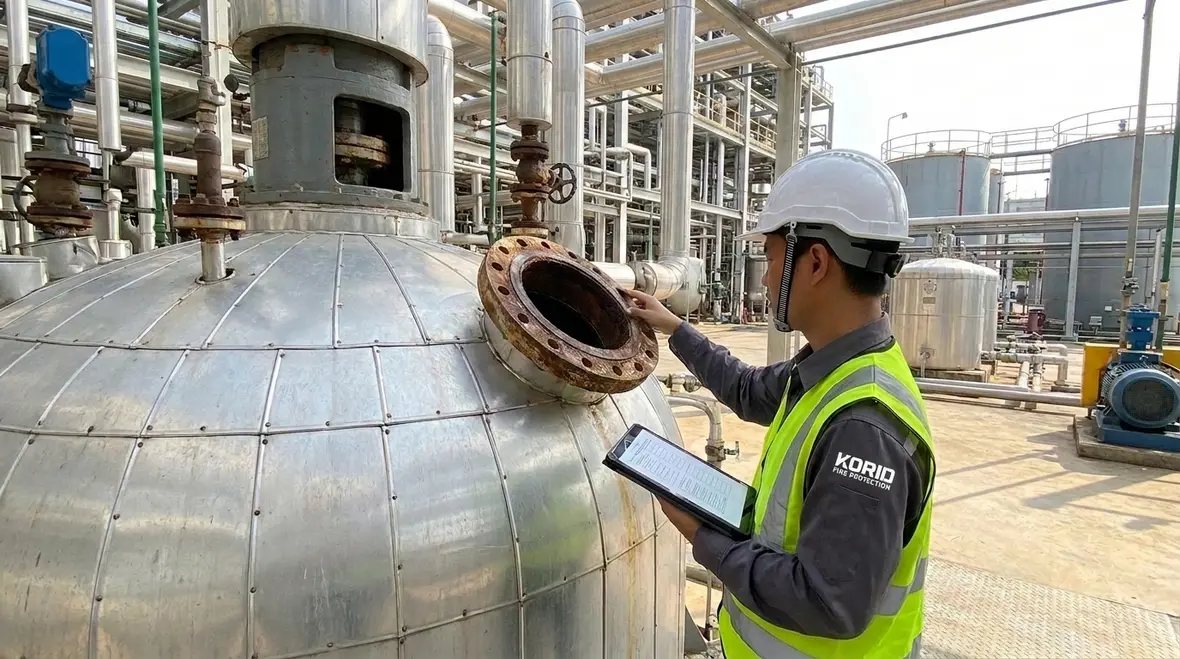
NFPA 30 Section 17.16: Process Equipment and Vessel Requirements
Quick Answer
NFPA 30 Section 17.16 sets design, installation, protection, and maintenance expectations for process equipment and vessels handling flammable liquids. It focuses on keeping ignition sources controlled, preventing leaks and failures, and ensuring inspection and documentation support ongoing safe operation in commercial and industrial settings.
Facilities that also need broader fire suppression system services often get better results when equipment protection, inspections, and maintenance records are managed together instead of in separate silos.
Why Section 17.16 matters for flammable liquid operations
Commercial facilities rarely fail at a single point. They fail through small weaknesses that accumulate: degraded gaskets, corrosion under insulation, loose connections, blocked vents, or inadequate spill controls. NFPA 30 Section 17.16 process equipment vessels address those vulnerabilities by requiring equipment and vessel controls that support safe containment, limit leak severity, and maintain protection systems over time.
In day to day operations, the practical challenge is that compliance must survive real operating conditions. Temperature cycling, maintenance turnover, contractor changes, and winterization practices all affect how vessels and connected piping perform. Section 17.16 therefore ties expectations to inspection readiness, maintainable protection features, and a focus on how equipment behaves as conditions change.
Scope check: what Section 17.16 targets
NFPA 30 Section 17.16 process equipment vessels generally applies to equipment that handles or contains flammable liquids as part of a processing system. That includes vessels and vessel related components such as closures, fittings, relief arrangements, vents, level controls, and the hardware that helps keep leaks from becoming ignition and fire scenarios.
Facility owners and safety managers typically misinterpret the scope in one of three ways:
-
Assuming “tank only” compliance. They overlook nozzles, manways, gauge connections, drains, venting, and valve assemblies.
-
Limiting reviews to installation drawings. They ignore current field conditions, recent modifications, and maintenance history.
-
Failing to align inspection intervals. They rely on manufacturer guidance alone instead of building a compliant inspection program that matches the site risk profile.
Core compliance requirements for process equipment and vessel integrity
Section 17.16 expectations center on preventing release, controlling ignition sources, and ensuring equipment remains suitable for service. In practice, the following control categories determine whether a facility can demonstrate compliance during audits and during insurer or regulatory scrutiny.
1) Vessel condition, material suitability, and corrosion control
Vessels and connected components must remain in a safe condition for flammable liquid service. Corrosion and material degradation are common failure drivers, especially where condensation, chemical exposure, or water ingress occurs. Commercial facilities frequently face corrosion under insulation, at flange joints, around grounding points, and on the underside of supports.
Operational best practice includes:
-
Documented corrosion monitoring and inspection findings tied to the specific vessel area and environment.
-
Maintenance records showing timely replacement of corroded fittings and compromised gaskets.
-
Field verification that insulation removal and inspection are performed where risk is highest.
2) Closures, gaskets, and leak prevention
Leaks do not only happen during failures. They also occur during normal opening and closing, during vibration, and as temperature swings cause expansion and contraction. Closures and flanges require controlled installation and ongoing verification.
Frequent real world issues include:
-
Incorrect gasket selection during repairs or using unsuitable materials for the specific liquid and temperature range.
-
Loose flange bolts after maintenance turnover or incomplete torque procedures.
-
Drain valves left partially open, blocked by debris, or non responsive due to maintenance practices.
Kord Fire Protection supports commercial sites by coordinating inspection planning, maintenance readiness checks, and evidence packages that align with how compliance is typically assessed during inspections and internal audits.
3) Relief, venting, and connected hardware management
Relief and vent arrangements manage abnormal conditions such as thermal expansion and blocked flow scenarios. When these features do not function as intended, pressure control and release pathways become unpredictable.
Common failure points include blocked vents, improvised discharge routing, missing caps, and vent terminations that collect water or debris. For many retail and industrial operations, the issue is not that the vent exists. The issue is that it changes over time due to maintenance modifications, contamination, or poor housekeeping.
4) Ignition control around vessels and process connections
Even when vessels remain sound, ignition control remains critical. NFPA 30 Section 17.16 process equipment vessels works in the broader framework of controlling ignition sources around flammable liquid systems. Facilities must verify that electrical equipment, bonding and grounding practices, and hot work controls remain effective.
Operational evidence that reduces compliance risk includes:
-
Records showing electrical classification and equipment selection where required by the hazard environment.
-
Bonding and grounding inspections after maintenance or component replacement.
-
Hot work permits that explicitly address nearby vessel and piping hazards, including vapor considerations.
5) Inspection, testing, and maintenance documentation
Section 17.16 emphasizes that safety features and equipment reliability must be maintained, not only installed. This requirement creates a major compliance burden for facilities that lack structured inspection schedules or cannot demonstrate continuity of maintenance controls.
To reduce audit and operational risk, facilities should ensure that inspection programs include:
-
Defined inspection intervals tied to risk, operating severity, and change history.
-
Clear acceptance criteria for repair and replacement actions.
-
Traceable documentation for field changes, including contractors and maintenance work scopes.
If a facility relies on ad hoc checks, nonconformances usually surface during peak audit periods, emergency maintenance, or insurer reviews. Kord Fire Protection works with commercial teams to build practical compliance routines that match operational realities.
Common compliance pitfalls in commercial, industrial, and retail environments
NFPA 30 Section 17.16 process equipment vessels is frequently challenged where facilities treat compliance as a one time task. The following pitfalls appear repeatedly across commercial, industrial, and retail operations handling flammable liquids.
-
Maintenance deferral until failure. Small seepage or minor corrosion often escalates into major leakage, vapor accumulation, and extended downtime.
-
Insulation masking damage. Corrosion under insulation is difficult to detect without planned inspections and access procedures.
-
Inconsistent torque and gasket practices. Repairs performed by different contractors without standard procedures lead to recurring leaks.
-
Vent and drain routing changes. Temporary modifications become permanent, creating blockage or improper discharge.
-
Weak documentation control. Evidence gaps prevent a facility from proving that the vessel and connected systems remain safe for ongoing service.
For additional context on how NFPA 30 regulates flammable liquids and how these expectations integrate with facility fire risk controls, review how NFPA 30 regulates flammable liquids.
How Kord Fire Protection supports ongoing Section 17.16 readiness
Compliance performance depends on sustained maintenance and inspection quality. Kord Fire Protection helps facilities move from “we installed it” to “we can prove it stays safe.” That includes practical support for inspections, documentation readiness, and operational alignment across maintenance and safety teams.
Typical support activities include:
-
Reviewing process equipment and vessel protection considerations for field conditions and change history.
-
Helping establish inspection and maintenance evidence that supports NFPA 30 requirements during audits and internal reviews.
-
Coordinating fire safety system considerations that interact with vessel risk, such as ignition control pathways and operational procedures.
Commercial facilities benefit most when fire safety and maintenance teams operate from the same compliance playbook, with inspection tasks scheduled to avoid last minute production disruptions.
Frequently Asked Questions
Take action now
If process equipment and vessel safety controls are not backed by consistent inspection, maintenance, and documentation, compliance risk increases quickly. Kord Fire Protection helps commercial teams verify ongoing readiness aligned with NFPA 30 expectations. Contact Kord Fire Protection to schedule a compliance-focused review and build a practical maintenance and inspection plan for your NFPA 30 Section 17.16 process equipment vessels program.

Join Our Newsletter!
Get the latest fire safety tips delivered straight to your inbox From our Newsletter.



