
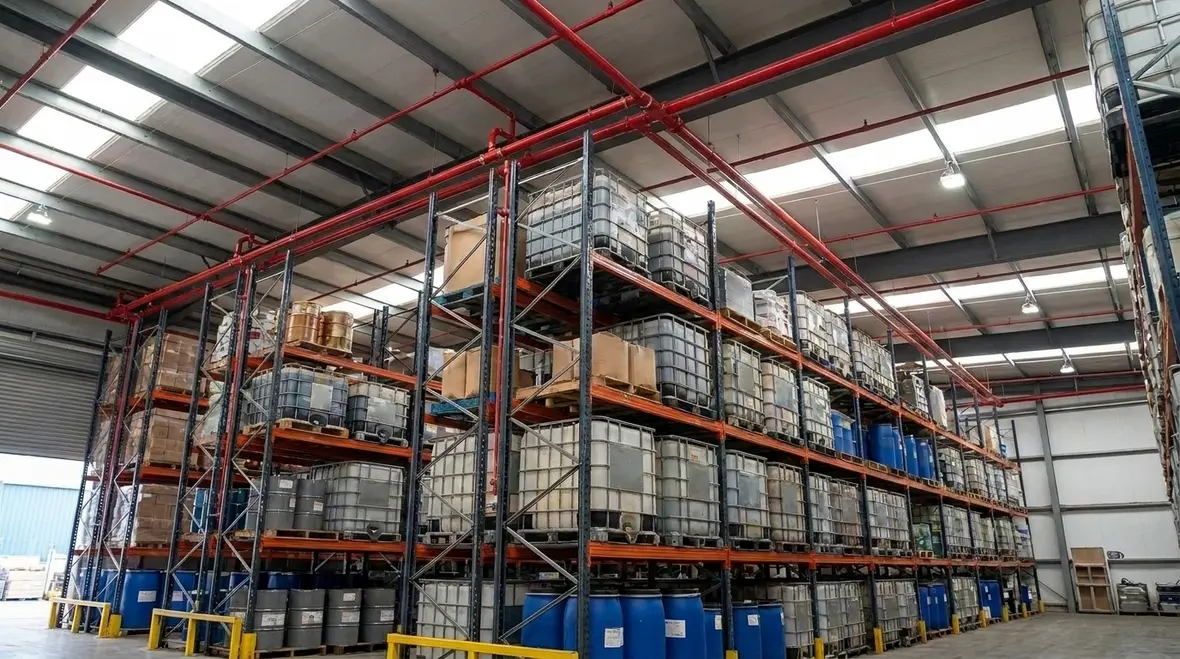
NFPA 30 Section 12.11: Fire Protection in Liquid Storage Warehouses
Quick Answer
NFPA 30 Section 12.11 sets the minimum fire protection expectations for liquid storage warehouse operations. It focuses on hazard control, fire detection and alarm performance, suppression effectiveness, and ongoing readiness through inspections, testing, and maintenance. Facilities must align systems to the stored liquids and warehouse layout.
What NFPA 30 Section 12.11 requires for fire protection in warehouses
NFPA 30 Section 12.11 fire protection warehouses treat a warehouse as an engineered fire risk environment, not a generic building. Compliance depends on the actual liquid hazards present, including flammability, quantity, storage arrangement, ventilation conditions, and ignition potential from equipment and operations. The section drives facilities to implement fire protection measures that remain effective over time, not only during initial installation.
Practical interpretation matters because many warehouses operate with changing stock keeping units, seasonal order spikes, and evolving rack configurations. Those changes can quietly alter fire dynamics, obstruction levels, and access to protected equipment. Good compliance therefore couples system design with disciplined operational controls, documented maintenance, and recurring functional testing.
Facilities that need a stronger maintenance backbone can also explore proactive maintenance for fire pump system reliability to see how recurring service planning supports dependable water supply performance in demanding warehouse environments.
For additional context on how NFPA 30 regulates flammable liquids and drives hazard focused controls, see how NFPA 30 regulates flammable liquids.
Key compliance focus areas in Section 12.11 for liquid storage
Section 12.11 commonly affects how a warehouse protects against ignition sources, controls fire growth, and ensures suppression systems function as intended. While exact requirements vary based on the warehouse design and liquid hazards, successful compliance programs follow a consistent set of technical principles.
1) Hazard classification and storage scenario matching
Fire protection starts with correct classification. Warehouses often store mixed liquid categories, including flammable liquids, combustible liquids, and products with specific temperature or vapor behavior. The facility must ensure that fire protection provisions match the credible scenarios, such as liquid spills, vapor release, blocked egress due to fire, and rapid fire impingement on adjacent storage bays.
Common failure point: systems selected for one liquid hazard profile remain in service while the warehouse later changes products or concentration. When the hazard changes, the performance assumptions for detection placement, suppression coverage, and water supply capacity can become outdated.
2) Detection and alarm performance tied to operational risks
Fire detection and alarm components in liquid storage warehouses must support timely warning and safe evacuation, while also enabling prompt suppression initiation when the design relies on it. Detection placement and device type must account for air movement, vapor stratification, and obstructions typical of racked storage.
Common failure point: dust, coatings, and normal warehouse residues accumulate on detection optics and housings. In some systems, this reduces sensitivity and delays alarm. In others, it creates nuisance alarms that lead operators to reduce responsiveness or override alerts.
3) Suppression and control concepts built for the liquid hazard
Suppression strategies must consider how the stored liquids burn and behave. In liquid storage warehouse scenarios, suppression often aims to control flame spread, cool involved materials, and reduce the ability of the fire to propagate through the storage arrangement. System components must be sized and arranged to achieve designed coverage and discharge characteristics.
Common failure point: blocked nozzles, valve issues, damaged piping sections, or improper maintenance that alters flow. Even minor deviations can affect discharge patterns and the time to water or agent delivery.
4) Water supply, pressure reliability, and dependable system supervision
Many warehouse fire protection schemes rely on water supply reliability, including pumps, tanks, mains, and pressure control devices. System supervision and control must maintain readiness, including verifying valve positions, supervisory signaling, and correct operation of pump and control logic.
Common failure point: “it was working last month” assumptions. Seasonal pump rotation, minor electrical faults, or intermittent pressure issues can degrade performance long before a full inspection identifies the problem.
How warehouses should operate inspection, testing, and maintenance under Section 12.11
Section 12.11 expectations extend beyond installation. Commercial facilities must keep systems ready for action through scheduled inspection and testing, with documented evidence that systems can meet their performance goals when required.
Inspection readiness: the day to day checks that prevent surprises
Operational inspection should confirm that protected spaces remain accessible and uncompromised. In practice, inspection focuses on:
- Clearance around detection devices and suppression outlets to prevent obstruction
- Integrity of piping supports, sleeves, and hangers
- Valve position verification for tamper seals and supervision indicators
- Correct labeling of zones, liquids, and hazard controls
- Condition of electrical control panels, power supplies, and battery backups
Common failure point: temporary storage during peak demand blocks discharge coverage paths or places combustibles too close to detection and alarm components.
Testing discipline: functional verification of real performance
Testing programs should verify that each system component triggers correctly and operates within design time frames. Functional testing typically includes alarms, initiating device verification, control panel operation, and confirmation of suppression operational states. Where systems incorporate pumps, tanks, or manifold logic, technicians must confirm that the system meets required flow and pressure assumptions.
Commercial reality: many warehouses face operational constraints that reduce testing windows. A credible testing plan coordinates with logistics teams so that shutdowns and access limitations do not compromise the integrity of the fire protection features.
Maintenance and component longevity in harsh warehouse environments
Liquid storage warehouses expose fire systems to elevated grime, vibration from traffic movement, humidity, and temperature swings. Those conditions accelerate wear on valves, actuators, floats, and seals. Maintenance should follow component manufacturer requirements while also aligning with NFPA expectations for ongoing readiness.
Kord Fire Protection supports facilities with service planning that addresses these real operating conditions, including inspection intervals, targeted remediation, and documentation suitable for audits and insurer reviews.
Common failure points in NFPA 30 Section 12.11 fire protection warehouses
Field experience shows that deficiencies often fall into recurring categories. Addressing these issues proactively reduces the chance of performance failures during actual emergencies.
Obstruction and coverage loss during operational changes
Warehouses commonly adjust rack spacing, staging areas, and material placement. Even if the warehouse intends to remain compliant, obstruction can reduce detection effectiveness and interfere with suppression discharge patterns. When storage density rises, the clearance needed for fire system function can be unintentionally removed.
Nuisance alarms and reduced credibility of warnings
Detection systems may generate frequent nuisance alarms due to environmental conditions or dirty devices. When staff become desensitized, response times degrade and emergency escalation can become inconsistent. Maintenance that returns devices to correct sensitivity and calibration helps maintain warning credibility.
Valve supervision issues and impaired water or agent delivery
Supervisory circuits can report trouble states due to faulty switches, wiring issues, or incorrect valve positions after maintenance work. In worst cases, valves can remain closed or partially obstructed. Facilities must ensure that post maintenance verification restores the system to its required supervised state.
Documentation gaps and incomplete maintenance records
Auditors and regulators increasingly expect clear traceability. Maintenance records should identify what was tested, what results were obtained, what corrective actions occurred, and when follow up verification took place. Missing documentation often delays compliance sign off even when the hardware is functioning.
Design and retrofit considerations for commercial, industrial, and retail facilities
Warehouses vary widely in building age, layout complexity, and operational tempo. Section 12.11 compliance often becomes a coordination project across fire engineering, operations, and facilities management.
Retrofit sequencing that protects ongoing operations
Retrofits must manage disruption to receiving, dispatch, and storage activities. Effective programs stage work to minimize time that detection or suppression circuits are out of service. They also ensure that any temporary measures do not introduce new hazard vulnerabilities.
System labeling, zoning, and emergency access
Commercial warehouses benefit when zoning is clear and access routes remain usable during an incident. Labels for protected areas, control locations, and shutdown points support faster response. Emergency services also rely on consistent layouts, signposting, and functional interfaces.
Integrating service plans with warehouse change management
When a facility changes stored products, updates packaging types, or expands inventory density, it should evaluate whether detection and suppression assumptions still hold. A documented change management process closes the gap between operational reality and fire protection design intent.
Kord Fire Protection operates as a compliance partner for ongoing testing and maintenance, helping customers sustain readiness through recurring service cycles and targeted corrective actions.
Frequently Asked Questions
Get Section 12.11-ready with a maintenance and compliance plan
NFPA 30 Section 12.11 fire protection warehouses require more than installation paperwork. Kord Fire Protection helps commercial sites sustain compliance through disciplined inspection, functional testing, and corrective maintenance. Arrange an assessment to confirm system readiness, identify common failure points, and build a service schedule aligned to your warehouse hazards, operating schedule, and audit expectations.

Join Our Newsletter!
Get the latest fire safety tips delivered straight to your inbox From our Newsletter.



