
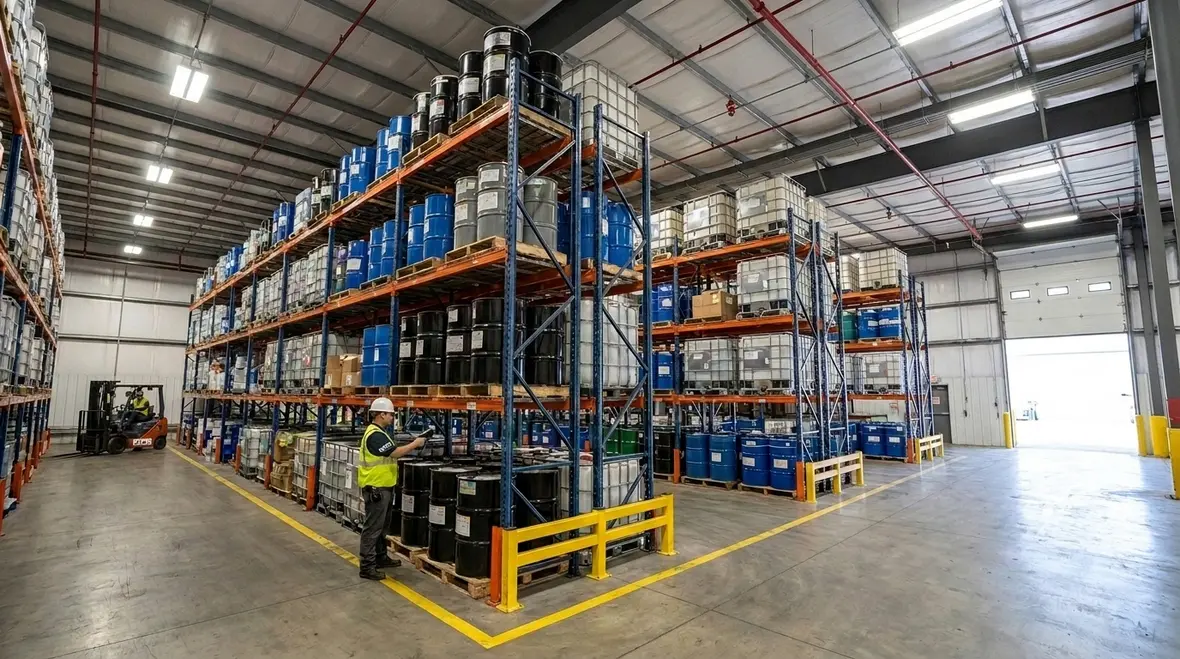
NFPA 30 Section 12.7: MAQs and Maximum Storage Heights in Warehouses
Quick Answer: NFPA 30 Section 12.7 sets rules for calculating MAQs and limits on how high commodities containing flammable liquids can be stored in warehouses. The MAQ drives the design and safety limits for storage arrangements, protecting separation, fire control, and emergency response.
What NFPA 30 Section 12.7 warehouse MAQs storage heights really control
Commercial warehouse compliance often fails at the same point: facilities know they must follow NFPA 30, but they treat MAQ calculations as a paperwork exercise instead of an operational control. NFPA 30 Section 12.7 warehouse MAQs storage heights connect your inventory quantities, packaging, storage configuration, and protection features to enforceable limits. When these elements drift over time, storage height becomes the first visible compliance gap, and it can cascade into permitting delays, inspection findings, and costly rework of racking or containment.
For flammable liquid governance beyond the warehouse context, readers should also review how the standard regulates flammable liquids throughout facilities: how NFPA 30 regulates flammable liquids. If your team is also tightening broader storage rules and hazard boundaries, Kord Fire Protection’s article on control areas and how they set storage limits fits naturally with this warehouse discussion.
How MAQs drive maximum storage heights in real warehouses
In NFPA 30, MAQ meaning Maximum Allowable Quantity is the threshold quantity that determines what storage level and protection approach the facility must use. Section 12.7 warehouse MAQs storage heights are not isolated numbers. They function as a decision engine that links:
- Which flammable liquids are present, and how they are classified.
- The form of storage such as drums, totes, IBCs, or containers in cartons.
- The physical layout and whether the storage area acts as a single storage space or is separated into distinct hazard areas.
- Whether a storage design is allowed to exceed basic limits only when the facility provides required controls and safeguards.
Practically, an inspection team verifies that maximum quantities and arrangements match the permitted hazard basis. If the maximum allowable quantity is not respected, the permitted maximum storage height may not be valid even if the racks look correct.
How warehouses should calculate MAQs step by step
A defensible MAQ calculation is procedural. It must account for inventory accuracy, container configuration, and how the storage is actually staged and accessed. Commercial facilities typically get these wrong in one of three ways: incorrect product classification, inventory underestimation, or failure to align the written hazard basis with what the warehouse team does daily.
1) Confirm product identities and classifications
MAQ calculations start with the SDS and product documentation, but they should end with confirmed hazard classification. Warehouses often store multiple brands with similar descriptions. The safety team must verify the exact flammable liquid properties that govern MAQ logic, and they must update the basis whenever products change, superseded SDS versions occur, or relabeling happens.
2) Verify container type, capacity, and stacking arrangement
NFPA 30 Section 12.7 warehouse MAQs storage heights depend on how material occupies space. Container type affects how many containers fit per level, how containment behaves, and how quickly a release can involve adjacent items. A common failure point is when storage height is measured by rack levels instead of measured commodity height with the actual container and dunnage configuration.
3) Map inventory totals to the storage area boundary
Warehouse layout matters. The MAQ basis can change if the same rack bay is treated differently under the fire separation and hazard area boundaries. Facilities should reconcile rack layout drawings against the as built condition, including any “temporary” segregation that becomes permanent.
4) Apply the standard’s maximum height logic to the calculated quantity
Once the maximum allowable quantity is established, the facility must ensure its storage height and storage density remain within the limits established by Section 12.7 warehouse MAQs storage heights. This must remain true for both planned conditions and operational realities such as receiving pallets staged nearby and end of aisle overstock.
Where inspections find noncompliance: height, arrangements, and control gaps
Even with a correct initial engineering basis, warehouses drift. NFPA 30 compliance becomes fragile when height controls rely only on signage or when the racking system allows easy exceedance without active monitoring.
Common failure points
- Overstated MAQ justification: inventory limits in documents do not match actual stock turns, seasonal staging, or contract logistics.
- Rack level misinterpretation: staff use rack height levels instead of the permitted maximum commodity height definition.
- Missing or altered storage features: changes to containment, pallets, dunnage, or liners alter how fire and spill control performs.
- Blocked egress or access clearance: higher stacks reduce service access to sprinklers, detectors, valves, and control panels.
- Protection system impairments: temporary impairments during maintenance can invalidate the hazard basis if not managed under a documented process.
Operational controls that reduce risk
High reliability compliance requires administrative and physical controls working together:
- Written storage height limits tied to product families and specific rack locations.
- Receiving and staging SOPs that prevent “holding patterns” that exceed the MAQ basis.
- Clear inspection points for supervisors that verify both the quantity and the actual storage height.
- Change management so any product substitution triggers an updated hazard assessment and height review.
Commercial and industrial facilities benefit when fire protection services support ongoing verification, not just initial compliance. Kord Fire Protection can assist by aligning documentation with warehouse operations and by supporting testing and maintenance activities that help keep protection systems and controls functional over time.
How protection features interact with Section 12.7 decisions
Maximum storage heights in warehouses do not operate in a vacuum. When flammable liquid storage is increased or arranged differently, the warehouse often needs design features that address fire control and spill management. Inspections may evaluate whether the protection approach is maintained and whether the hazard basis remains consistent.
Typical system and interface areas to verify
- Automatic detection and alarm: confirm coverage and ensure storage height does not interfere with field of view or smoke movement assumptions.
- Sprinkler arrangement and water supply reliability: confirm that storage does not obstruct sprinkler discharge patterns and that impairment records are managed.
- Fire department access and internal pathways: confirm that higher stacks preserve access for response and internal control operations.
- Containment and spill control: verify that containment capacity and drainage remain suitable as inventory quantities and storage arrangements change.
Facilities that coordinate these interfaces early usually avoid late design corrections. When they do not, warehouses often discover that compliance requires more than lowering stacks, such as revising rack layouts, updating hazard documentation, or adjusting protection system assumptions. For teams reviewing broader protection strategy in demanding facilities, Kord Fire Protection’s layered fire protection system for flammable liquids offers useful supporting context.
Are warehouses in retail, industrial, and commercial contexts treated the same?
The intent of NFPA 30 applies across commercial use cases, but warehouse realities vary. Retail distribution centers can experience more frequent SKU swaps. Industrial sites can have contractor staging practices. Commercial logistics operations can have variable inbound timing that affects daily quantities.
NFPA 30 Section 12.7 warehouse MAQs storage heights considerations become more complex when:
- Inventory turnover creates short term peak quantities that exceed the “average” used in older documentation.
- Contractors store materials in “unused” rack bays, unintentionally extending the hazard area.
- Merchandising or promotional staging increases local storage height near receiving docks.
The best approach involves harmonizing warehouse management systems with fire safety requirements, ensuring that MAQ and maximum height controls reflect the facility’s actual operating pattern.
Frequently Asked Questions
Get warehouse storage compliance aligned before the next inspection
Facilities should treat NFPA 30 Section 12.7 warehouse MAQs storage heights as an ongoing control, not a one time calculation. Kord Fire Protection can help validate your hazard basis against real warehouse conditions, support testing and maintenance verification, and strengthen documentation so operations and compliance stay aligned. Contact Kord Fire Protection to review your current storage height limits, MAQ basis, and inspection readiness.

Join Our Newsletter!
Get the latest fire safety tips delivered straight to your inbox From our Newsletter.



