
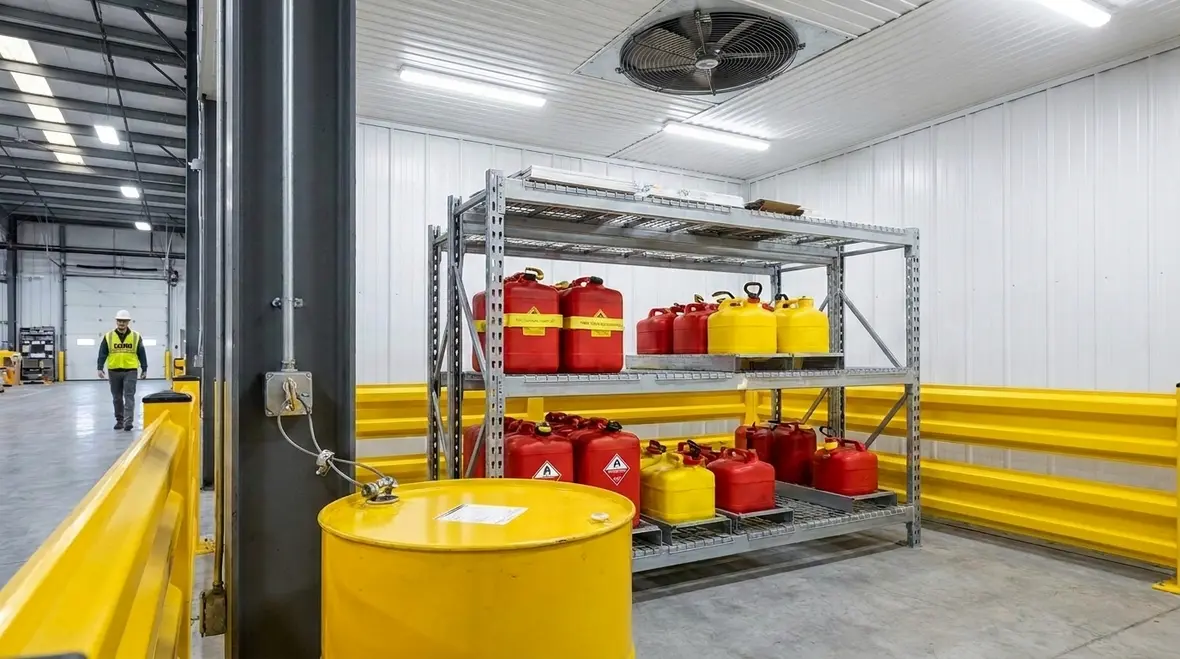
NFPA 30 Section 12.16: Explosion Control in Warehouses
Quick Answer
NFPA 30 Section 12.16 sets requirements to control explosion hazards in warehouse environments where flammable and combustible liquids are stored, handled, or transferred. The standard drives design, operational controls, and maintenance of ignition source management, ventilation concepts, and protective safeguards.
What NFPA 30 Section 12.16 explosion control warehouses expect from facility owners
In practical terms, NFPA 30 Section 12.16 focuses on reducing the likelihood that a flammable vapor air mixture forms and ensuring that, if conditions become hazardous, explosion consequences are controlled. For compliance teams, the challenge rarely sits in the “headline” requirement. It sits in day to day implementation: equipment condition, inspection discipline, and documentable maintenance that matches the actual operating reality of the warehouse.
The core concept behind NFPA 30 Section 12.16 explosion control warehouses is risk reduction through a layered approach. Facilities must control ignition sources, manage hazardous atmospheres, and verify that protective measures remain functional over time. This includes both fixed systems and the human processes that determine how safely materials move through storage and handling areas.
Facilities reviewing broader warehouse hazard planning often also look at warehouse foam fire suppression for flammable liquid safety to connect storage, handling, and suppression strategy more naturally. To understand how NFPA 30 regulates flammable liquids more broadly, refer to how NFPA 30 regulates flammable liquids.
Start with the hazard basis: liquids, quantities, and warehouse operations
NFPA 30 Section 12.16 applies to explosion control planning connected to flammable liquid hazards in warehouse settings. Compliance begins with establishing what is present and how it is used. A robust hazard basis typically includes:
- Inventory mapping by product, container type, and storage location.
- Operational flow mapping for transfer, pumping, decanting, dispensing, and loading activities.
- Verification of container integrity expectations, including lids, seals, and transfer hose condition.
- Assessment of ventilation adequacy where vapor accumulation can occur.
- Identification of credible ignition sources and where they can arise during routine work.
Warehouse reality matters. A compliant design that assumes “low activity” can fail when seasonal volume spikes increase transfer frequency. Similarly, a warehouse can meet initial installation requirements but fall out of compliance when maintenance lapses allow damaged fittings, faulty grounding, or blocked vents to persist.
What “explosion control” means in the field: prevention, protection, and verification
1) Ignition source control that matches the operating environment
Most explosion incidents in industrial and commercial warehouses trace back to ignition source introduction. NFPA 30 Section 12.16 drives facilities to control sources in both normal and foreseeable abnormal conditions. Typical ignition control mechanisms include:
- Electrical equipment selection suitable for the environment, including proper classification assumptions.
- Grounding and bonding practices for containers, transfer lines, and dispensing points to reduce static discharge ignition risk.
- Hot work management and written procedures for cutting, grinding, and temporary equipment deployment.
- Control of mechanical sources such as friction, impact, and motor or belt maintenance failures.
Common failure point: grounding points degrade, paint or residue isolates bonding surfaces, and hoses get replaced without confirming conductive continuity. Compliance requires not just presence, but verification.
2) Vapor control and ventilation concepts that prevent hazardous accumulation
Warehouses often treat ventilation as a “set and forget” infrastructure item. Under NFPA 30 Section 12.16, ventilation intent must be maintained so that hazardous vapor accumulation does not occur in locations where ignition might still arise. This includes ensuring:
- Exhaust systems remain unobstructed and perform at design intent.
- Fans and dampers function correctly, including belt condition and motor performance where applicable.
- Make up air arrangements avoid creating stagnant pockets that trap vapors.
- Changes to racking layouts, partitions, or storage methods do not undermine airflow patterns.
Common failure point: minor modifications made during retail or commercial fit outs, such as added shelving or signage, block airflow paths. Inspections and change management must treat these as ignition and vapor risk drivers.
3) Protective safeguards where conditions cannot be fully prevented
Where flammable vapor conditions may still arise, protective safeguards reduce consequences. Facilities commonly implement engineered protections such as venting, suppression, or other explosion mitigation concepts tailored to the hazard and system layout. The key compliance expectation is that the safeguarding equipment remains:
- Correctly configured for the scenario it was installed for.
- Supported by inspection, testing, and maintenance documentation.
- Integrated with procedures so that system isolation or impairment does not occur without authorization.
Common failure point: safeguard systems sit operationally “offline” due to nuisance faults, blocked detection ports, or incorrect reset procedures after maintenance. The standard emphasis on ongoing control means these patterns cannot become routine.
How compliance stays real: inspection, testing, and maintenance discipline
NFPA 30 Section 12.16 requirements create an ongoing obligation. Commercial and industrial operators do not pass compliance by installation alone. They pass by proving that the controls work when needed. A practical compliance program should define:
- Inspection frequencies tied to operating intensity and product volatility.
- Testing methods for ventilation performance, grounding integrity, and equipment condition.
- Acceptance criteria, including pass fail thresholds and corrective action timelines.
- Impairment control procedures for any equipment that could affect explosion protection.
- Training and accountability for warehouse staff and contractors conducting transfers.
Maintenance records that inspectors expect
Many facilities maintain invoices but lack the technical detail that demonstrates reliability. Strong documentation includes calibration records where applicable, functional test results, and visual evidence of component condition. For warehouse operations, records should reflect:
- Verification of seals, fittings, valves, and transfer hardware integrity.
- Maintenance outcomes for detection and safeguarding systems.
- Ventilation inspection results, including obstruction checks and fan operational checks.
- Grounding and bonding verification results, including resistance or continuity measures where the system supports it.
Operational procedures that prevent “process drift”
Explosion control measures often fail because procedures drift. Examples include:
- Using extension cords or temporary power solutions without confirming suitability.
- Changing transfer method or hose type without updating bonding assumptions.
- Allowing contractors to perform hot work without coordinated permits and monitoring.
- Leaving containers unsealed longer than the procedure allows.
A compliance program that links operational changes to hazard review prevents these drift patterns from undermining NFPA 30 Section 12.16 explosion control warehouses commitments.
Where warehouses commonly fall short and how to correct it fast
Commercial facilities, industrial warehouses, and retail distribution centers face recurring obstacles. The most common are not lack of equipment, but mismatches between design intent and operational behavior.
Challenge: “Temporary” storage and transfer locations
Temporary staging becomes permanent. When pallets, drums, totes, or intermediate containers are moved to locations not included in the original risk controls, vapor accumulation and ignition exposure can increase. Correction requires zoning controls, updated procedures, and inspection checks for newly used areas.
Challenge: Damaged transfer hardware and compromised seals
Hoses, couplings, gaskets, and valves degrade. Even small leaks can generate vapor clouds at transfer height, where ignition sources like motors and electrical enclosures exist. Correction requires a defined inspection routine, prompt replacement criteria, and verification that replacement items meet conductive and compatibility expectations.
Challenge: Ventilation performance not verified after maintenance
Filters clog, fans wear, dampers misalign, and ductwork accumulates residue. Correction requires functional checks after any maintenance work and a feedback loop that captures recurring partial failures.
Challenge: Contractors and shift handovers
Shift work can increase the probability that critical steps get skipped, especially around bonding confirmation and hot work controls. Correction includes contractor briefing requirements, permit integration, and handover checklists aligned to explosion control objectives.
Why ongoing service matters: keeping explosion control systems inspection ready
Explosion control in warehouses depends on long term reliability, not one time compliance. Kord Fire Protection supports commercial, industrial, and retail operators by coordinating practical inspection, testing, and maintenance aligned with the compliance intent behind NFPA 30 Section 12.16. This includes helping facilities maintain documented evidence that ignition controls, ventilation concepts, and explosion protection measures remain functional and properly configured.
When warehouses update product lines, alter storage layouts, or increase transfer volumes, Kord Fire Protection helps owners and compliance teams reassess how those changes affect hazard control. That keeps NFPA 30 Section 12.16 explosion control warehouses commitments aligned with operational reality, reducing downtime risk and improving audit defensibility.
Frequently Asked Questions
Next step: audit your warehouse explosion controls now
If your warehouse handles flammable or combustible liquids, treat NFPA 30 Section 12.16 as a living compliance obligation. Conduct a hazard based review of ignition controls, ventilation effectiveness, and protective safeguard readiness, then confirm documentation and maintenance schedules match your current operations. Engage Kord Fire Protection to plan inspection and testing activities that keep your controls effective, defensible, and ready for audits. Contact Kord Fire Protection today to schedule a compliance check.

Join Our Newsletter!
Get the latest fire safety tips delivered straight to your inbox From our Newsletter.



