
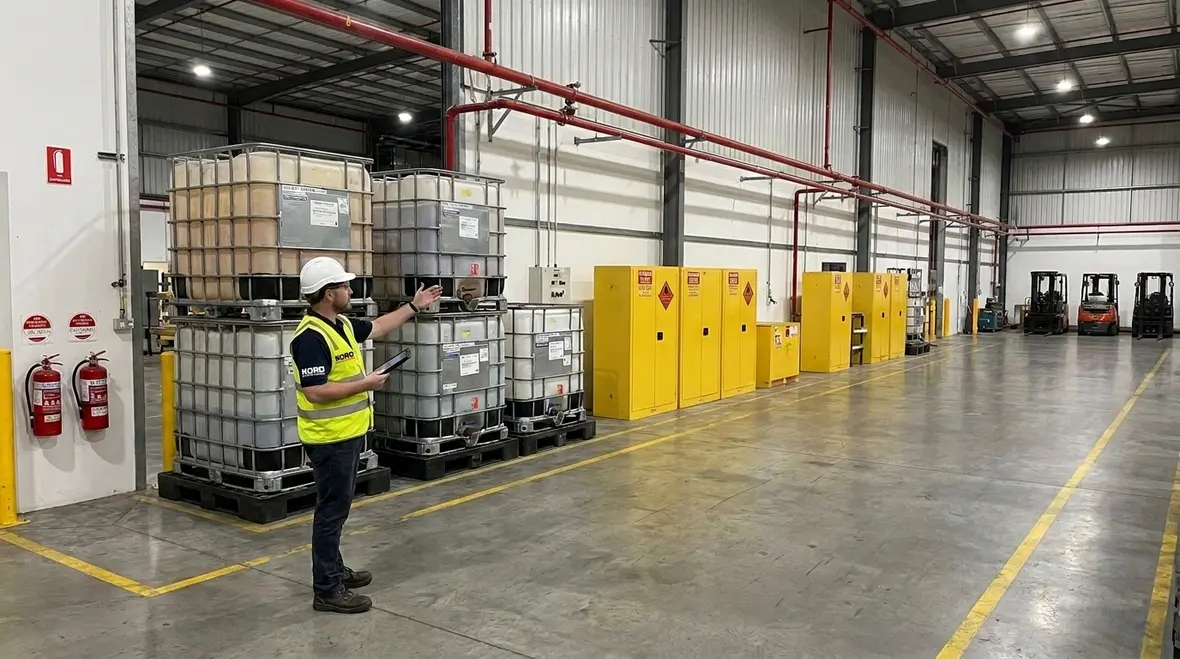
NFPA 30 Section 11.2: Applicability of Industrial Storage Rules
Quick Answer
NFPA 30 Section 11.2 applicability industrial storage determines when the standard’s industrial storage provisions apply to specific occupancies, storage arrangements, and quantities of flammable and combustible liquids. It drives the required construction features, separation, container controls, and inspection readiness, helping facilities avoid hazardous assumptions during design and retrofits.
Why Section 11.2 matters during design, expansion, and inspections
Facilities that store flammable or combustible liquids often treat NFPA 30 compliance as a one time design checkbox. NFPA 30 Section 11.2 applicability industrial storage corrects that mindset. It sets the boundary for which “industrial storage rules” govern the arrangement, operation, and protection of stored liquids based on the site’s storage conditions and how the liquids are managed.
In day to day commercial operations, Section 11.2 frequently becomes the difference between a compliant storage area and a near miss that fails inspection. It influences engineering assumptions, permits equipment placement decisions, and shapes maintenance requirements that affect fire department access, ignition source control, and containment performance.
If your team is also reviewing broader protection support, fire suppression system services can help connect storage risk with inspection, testing, maintenance, and upgrade planning in a way that fits real operations.
What Section 11.2 typically determines (and how inspectors read it)
NFPA 30 is structured so that general rules are supplemented by occupancy and storage specific provisions. Section 11.2 identifies when the “industrial storage” framework applies rather than other chapters or more limited rule sets. Inspectors usually focus on three practical questions:
- Is the storage classified as industrial storage under the criteria in Section 11.2? This can hinge on how products are stored, handled, and accessed.
- Do the stored commodities and quantities trigger industrial storage expectations? Quantity thresholds and physical arrangement affect the required controls.
- Is the storage configured in a way that aligns with the rules that follow Section 11.2? Ignition control, separation, and protection systems must match the applicable rule set.
Operationally, compliance teams should treat Section 11.2 applicability industrial storage as a “routing step” that determines the rest of the compliance pathway: the storage building, the location of containers, the bunding or containment expectations, and the inspection and impairment management plan.
Common scenarios that trigger industrial storage controls
1) Mixed use facilities that add tanks, drums, totes, or bulk containers
Retail and light industrial sites often expand with additional storage for solvents, coatings, fuels, or cleaning chemicals. The moment the site adds bulk containers or increases quantities, Section 11.2 applicability industrial storage may require a shift from “general handling” assumptions to “industrial storage” requirements.
Common failure points include:
- Containers placed without adequate separation from ignition sources or adjacent combustible hazards.
- Containment systems that do not match the quantity and type of storage.
- Fire protection impairments during maintenance that are not tracked or restored within required time windows.
2) Warehouse storage with high turnover and frequent staging
Even when products arrive in smaller container sizes, the operational pattern can make the storage behave like industrial storage. High turnover, staging practices, and frequent forklift movement change the risk profile and can increase heat, impact, and spill exposure.
Facilities should verify:
- Storage control practices that limit uncontrolled accumulation.
- Housekeeping standards that maintain clear access to extinguishing equipment and egress paths.
- Compatibility of container types with the specific liquids stored.
3) Upgrades that change container configuration or layout
Rearranging pallets, adding cabinet storage, or modifying tank placement can shift which NFPA 30 sections apply. A “minor layout change” often becomes a major compliance issue when it changes separation distances, containment performance, or access routes.
Kord Fire Protection typically supports facilities by mapping the new configuration to the applicable rule set, then aligning inspection checklists and impairment controls to the revised layout.
How to operationalize Section 11.2 so compliance stays real
Section 11.2 applicability industrial storage cannot be handled only at the document level. It must become an operational program that keeps storage protected under real-world conditions.
Inspection readiness: what teams should verify and document
Industrial storage compliance requires more than visual checks. Effective programs typically include:
- Container condition verification: lids, bungs, valves, hoses, and seals maintained to prevent weeping and vapor release.
- Secondary containment performance checks: bunds and sumps maintained to support capture of spills and drips.
- Separation and access verification: walkways and clearance maintained so firefighting and evacuation routes remain usable.
- Ignition source control: hot work permits and equipment management synchronized with the storage hazard.
Protection systems and failure points during maintenance
Industrial storage often depends on multiple layers of safety. During planned work, these layers fail most often through impairment, not absence of equipment.
Common failure points include:
- Fire detection, suppression, or monitoring systems disabled without documented authorization and restoration tracking.
- Containment systems altered during housekeeping or spill response without returning them to baseline configuration.
- Emergency equipment obstructed by staging, especially during receiving hours.
Kord Fire Protection can help commercial, industrial, and retail sites by coordinating compliance support that includes testing, inspection documentation, and maintenance alignment so systems remain reliable between inspections.
Training and work control aligned to the applicable rule set
Personnel should understand what changed when Section 11.2 applicability industrial storage applies. Training should tie procedures to measurable expectations such as how containers must be arranged, how spills are contained and reported, and how hot work permits prevent ignition events around storage.
Where Section 11.2 fits with broader NFPA 30 flammable liquid compliance
Section 11.2 applicability industrial storage functions as a decision gateway within NFPA 30’s flammable liquid approach. Storage arrangements must also align with broader requirements that govern flammable liquid behavior, protection concepts, and operational controls.
For facilities building a comprehensive compliance basis, Kord Fire Protection recommends reviewing how NFPA 30 regulates flammable liquids, including the practical connections between storage design and operational risk. See: how NFPA 30 regulates flammable liquids.
Integrating this knowledge with Section 11.2 helps ensure storage requirements and protection strategies do not conflict when a site expands, changes container types, or introduces new products.
Implementation checklist for commercial and industrial teams
Use this checklist to translate Section 11.2 applicability industrial storage into an actionable compliance workflow:
- Confirm applicability: Determine whether the storage arrangement meets the criteria that place the area under industrial storage rules.
- Map hazards to controls: Verify container types, quantities, and layout align with the applicable storage provisions.
- Validate containment and separation: Confirm bunding, access, and clearance meet the industrial storage expectations.
- Set inspection intervals: Define inspection frequencies and acceptance criteria for containers, containment, and access conditions.
- Control impairments: Implement a restoration process for any fire protection equipment that requires maintenance.
- Maintain documentation: Keep records that demonstrate consistent compliance between scheduled inspections.
Commercial owners and operators benefit when these steps are supported by a specialist service partner. Kord Fire Protection supports ongoing compliance through practical inspection, testing, and maintenance coordination designed for operational continuity.
Frequently Asked Questions
Next step: confirm applicability before you get stuck in remediation
Section 11.2 applicability industrial storage sets the foundation for the rest of your NFPA 30 compliance obligations. Kord Fire Protection can review your storage setup, identify the applicable rule pathway, and align inspections, testing, and maintenance to keep your facility inspection ready. Contact Kord Fire Protection at kordfire.com.au to schedule a compliance-focused assessment and build a maintenance program that survives real operations and recurring audits.

Join Our Newsletter!
Get the latest fire safety tips delivered straight to your inbox From our Newsletter.



