
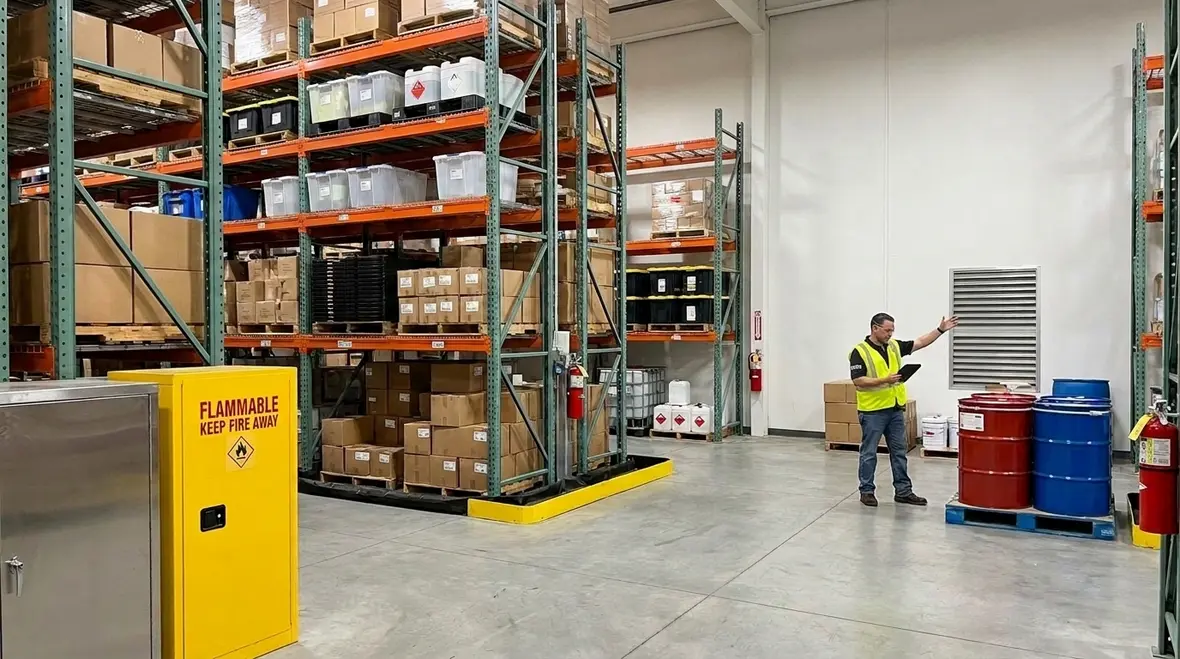
NFPA 30 Section 10.16: Explosion Control in Mercantile Storage
Quick Answer: NFPA 30 Section 10.16 sets the framework for reducing the likelihood and impact of explosions in mercantile storage. It centers on hazard identification, ignition control, protection strategy selection, and ongoing inspection and maintenance to keep controls effective.
Facilities reviewing these controls often also benefit from broader guidance on NFPA 30 flammable and combustible liquids requirements, especially when storage practices, ventilation conditions, and ignition risks all start overlapping like they are trying to win an argument together.
What NFPA 30 Section 10.16 is trying to prevent in retail and mercantile storage
In mercantile storage, ignition sources and flammable or combustible liquid vapors can align quickly. NFPA 30 Section 10.16 explosion control mercantile focuses on preventing an ignition event from escalating into an explosion, and on limiting consequences if a release occurs. For commercial and retail sites, the challenge is not only designing controls but sustaining them through day to day operations, changes in storage layout, and equipment wear.
These requirements typically interact with facility practices such as receiving and handling procedures, ventilation performance, container integrity, electrical classification, and the reliability of monitoring or protection systems. The most common compliance failures come from drift over time: missing inspections, deteriorated seals, incorrect storage configurations, and unmanaged ignition sources.
Hazard first: how facilities must scope mercantile explosion risk
Effective explosion control starts with a site specific hazard assessment aligned with NFPA 30 principles for flammable and combustible liquids. For mercantile storage, the scope should include:
- Inventory and volatility: Identify which liquids are present, their class or hazard characteristics, and how storage conditions affect vapor generation.
- Release pathways: Evaluate where spills, drips, leaks, and container failures can occur, including transfer points, shelving, pallets, and secondary containment areas.
- Air movement and confinement: Confirm how vapors can accumulate. Poor ventilation or partially closed enclosures can create hazardous vapor concentrations.
- Ignition sources: Assess open flames, hot work practices, motor and switching devices, static discharge potential, portable equipment, and even poor housekeeping.
For many retail facilities, the hazard map changes more often than the fire prevention plan. Seasonal product changes, expanded stock, and temporary displays can move the risk profile without updating controls. Kord Fire Protection supports clients by aligning inspection planning with current operational conditions and documented storage practices, not only the original design intent.
Explosion control strategies: practical measures that work on real commercial sites
NFPA 30 Section 10.16 explosion control mercantile is implemented through a combination of ignition control, vapor control, and protection features sized to the facility’s hazard profile. In practice, commercial facilities usually rely on several layers rather than a single solution.
1) Ignition control and electrical safety
Ignition control begins with eliminating or managing ignition sources around storage and handling. Common controls include:
- Use of listed equipment and appropriate electrical classification where required by the hazardous location determination.
- Control of portable ignition sources, including disciplined hot work permits and supervision of contractors.
- Static discharge management during dispensing, transferring, or filling operations.
- Maintenance of motors, switches, and fixtures to prevent overheating or damage that can create a new ignition pathway.
Failure points typically include missing periodic checks of equipment condition, unauthorized temporary power arrangements, and changes to lighting or receptacles that were not evaluated for suitability.
2) Vapor and release management
When vapors can accumulate, the risk rises significantly. Vapor control and release management commonly include:
- Secondary containment sized and maintained to capture drips and leaks.
- Ventilation performance verification, including confirming that exhaust or air movement is not blocked by shelving, storage expansion, or modified ductwork.
- Good container condition, including closure integrity, gasket condition, and appropriate storage orientation.
Many operational failures stem from minor issues that accumulate. Worn seals, damaged drum bungs, and mis-stacked cases reduce containment effectiveness and increase vapor release opportunities.
3) Detection, suppression, or protection features where required
Some mercantile environments require additional protection features to limit consequences. Where systems are installed, their effectiveness depends on:
- Correct placement and coverage so detectors or activation devices operate as intended.
- Setpoints and calibration that match current operations and product types.
- Alarming and response procedures that trained staff can execute consistently.
Kord Fire Protection helps clients keep these systems aligned with evolving inventory and maintenance realities, including documentation of tests, response readiness, and corrective actions after findings.
Inspection and maintenance: where compliance succeeds or fails
Explosion control in mercantile storage is not a one time design task. NFPA 30 Section 10.16 explosion control mercantile is sustained through a consistent inspection and maintenance regime that includes both equipment and operational discipline. Typical inspection and maintenance focus areas include:
- Container integrity: closures, valves, caps, drums, totes, and labels that remain intact and correctly stored.
- Secondary containment condition: cracks, corrosion, overflow paths, and whether containment remains free of obstructions.
- Ventilation and airflow paths: blocked louvers, modified arrangements, failed fans, or damaged ducting.
- Electrical and ignition prevention devices: damage, missing covers, proper operation of disconnects, and verification of equipment suitability.
- Any installed detection or protection systems: calibration, testing records, component replacement schedules, and functional checks.
A common failure point involves documentation gaps. Facilities may perform maintenance but fail to document it in a way that supports audit readiness. Another frequent issue is inspection drift, where the inspection scope focuses on visible items and misses process changes that elevate risk.
For a deeper compliance view on how NFPA 30 regulates flammable liquids in commercial settings, review how NFPA 30 regulates flammable liquids.
Operational controls: training, permits, and day to day discipline
Commercial facilities reduce explosion risk most effectively when operational controls match the actual workflow. NFPA 30 Section 10.16 explosion control mercantile expectations are strengthened by procedures that prevent ignition and control releases during routine and non routine tasks.
Staff training and competency
Training should cover:
- Safe receiving and storage placement, including correct spacing and containment practices.
- Transfer and dispensing procedures, including static control methods.
- Spill response coordination that avoids creating ignition risks during cleanup.
Hot work and contractor management
Hot work control is frequently the decisive factor in mercantile explosion outcomes. Facilities should ensure:
- Hot work permits explicitly address storage adjacency and vapor risk.
- Contractors comply with facility ignition controls, including equipment restrictions and supervision.
- Post hot work verification confirms safe conditions before returning to normal operations.
Change management
Storage layout changes, product substitutions, and seasonal promotions commonly alter hazard profiles. A robust change management process verifies that ventilation, storage arrangement, and ignition controls remain appropriate after updates.
Common compliance pitfalls in mercantile storage audits
Audits often uncover similar root causes. Identifying them early reduces downtime and improves confidence with regulators and insurers.
- Missing or outdated hazard documentation: hazard scope does not reflect current products and quantities.
- Ignition controls not aligned to current equipment: added lighting, refrigeration, or power tools introduce new ignition pathways.
- Ventilation obstructions: shelving, pallets, packaging, or temporary displays block airflow.
- Containment degradation: corrosion, damage, or overflow conditions that reduce effectiveness.
- Inspections without corrective follow up: identified deficiencies are not resolved or tracked to closure.
Kord Fire Protection positions itself as a practical partner for commercial compliance, with support across inspection planning, testing verification, corrective action tracking, and maintenance readiness for ongoing operations across retail, industrial, and mixed use facilities. This ongoing support helps ensure NFPA 30 controls remain functional, not just documented.
For additional support resources relevant to the broader NFPA 30 framework, clients often reference NFPA 30 flammable liquid requirements when updating site procedures and maintenance planning.
Frequently Asked Questions
Conclusion and next step
Explosion control in mercantile storage requires more than a checklist. It demands hazard scoping, layered controls, and disciplined inspection and maintenance that reflect how the site operates today. Kord Fire Protection can help commercial and retail facilities verify compliance readiness for NFPA 30 Section 10.16, close corrective actions, and keep controls reliable through maintenance and change management. Schedule an assessment to establish a practical, defensible compliance program.

Join Our Newsletter!
Get the latest fire safety tips delivered straight to your inbox From our Newsletter.



