
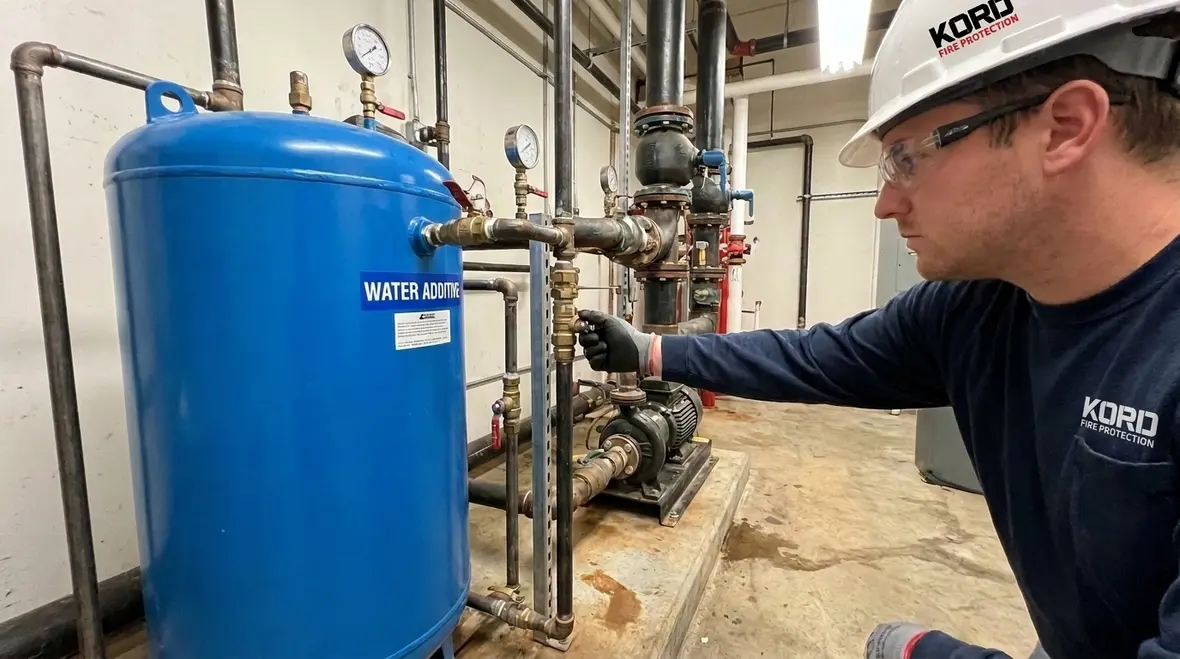
NFPA 18A Section 12.3: Designing Water Additive Applications for Class B 2D Fires
Quick Answer: NFPA 18A Section 12.3 sets engineering and operational requirements for selecting, designing, and applying water additives to suppress Class B 2D fuel fires. Effective designs control discharge rate, agent proportioning, system compatibility, and verified performance through commissioning and maintenance.
Facilities working through water additive system decisions often pair this kind of hazard-specific design review with broader fire suppression system support so proportioning, discharge hardware, and long-term service planning all stay aligned from the beginning.
What NFPA 18A Section 12.3 Requires for Class B 2D Water Additives
NFPA 18A class B 2D fire application design focuses on how water additives integrate into water based systems to achieve reliable suppression and mitigation for specific “2D” fire scenarios. Section 12.3 emphasizes that additive performance is not automatic. The design must ensure correct additive chemistry, correct proportioning, correct water supply conditions, and correct distribution so the additive reaches the fire in the intended concentration and pattern.
In commercial environments, noncompliance usually shows up during commissioning, maintenance intervals, or after operational changes such as water supply modifications, pump upgrades, or vendor replacement of proportioning components. A compliant water additive application design accounts for those realities from the beginning.
Start With the Hazard Analysis: Fuel Classes, Scenario, and System Intent
A defensible NFPA 18A class B 2D fire application design begins with the same core questions regardless of facility type. What is burning, how it burns, where ignition and escalation occur, and what the water based system must accomplish during the early suppression window.
Key design inputs typically include
- Fuel category and expected fire behavior for the Class B 2D scenario
- Location constraints that affect nozzle choice, spacing, and discharge pattern
- Water supply characteristics such as pressure stability, flow availability, and temperature
- Additive compatibility with water quality and system materials
- Performance goals for knockdown, cooling, and preventing re ignition
Commercial facilities often treat “water supply” as a static utility, but it can vary between daytime operations, seasonal temperature shifts, or demand surges from normal process loads. Those variations influence additive concentration and distribution consistency.
How Water Additives Are Designed Into the System: Proportioning and Compatibility
Section 12.3 level designs require that the additive concentration delivered to the discharge matches the intended formulation. That means the system must proportion correctly under real operating conditions, not just under ideal test conditions.
Proportioning mechanisms that must perform
- Closed loop or metered proportioning that controls additive injection based on water flow
- Positive displacement or controlled injection where design calculations require stable dosing
- Check valves and backflow prevention to prevent additive migration into the water line
- Calibration and verification methods to confirm dosing accuracy before and after service
In the field, proportioning failure modes are common and often overlooked. They include suction line air intrusion, clogged strainers that reduce injection flow, worn metering components, and calibration drift after maintenance. Even when the system is mechanically intact, a small dosing error can shift the suppression capability below the design intent.
Compatibility requirements
Additives must remain chemically effective and physically stable in the water supply. Compatibility issues show up as precipitation, filter loading, corrosion, seal degradation, or unexpected changes in discharge behavior. Facilities should treat water additives like a system component that requires documented material compatibility and periodic verification, not like a consumable that “just goes in.”
For additional code and guideline context that supports consistent design and compliance decisions, commercial teams often reference resources like NFPA codes and guidelines solutions for fire protection and life safety to align engineering intent with practical implementation and ongoing compliance.
Distribution Design: Nozzles, Coverage, and Delivered Concentration
Water additive suppression depends on distribution as much as proportioning. An NFPA 18A class B 2D fire application design must ensure that the nozzle layout and discharge characteristics produce the intended coverage and application profile for the hazard.
Common design elements affecting delivery
- Nozzle selection matched to droplet or spray characteristics required by the additive application method
- Hydraulic design ensuring adequate pressure at the nozzle and consistent flow balance
- Discharge duration assumptions tied to suppression objectives and system operating logic
- Obstruction considerations where racks, walls, ductwork, or process equipment can block application
Operational realities frequently create discrepancies between the as designed drawing and what exists during turnover or after remodeling. For example, a new mezzanine, added equipment, or moved storage can alter effective spray delivery. A compliant design treats those changes as configuration management events requiring documentation review and, when needed, field verification.
Performance verification during commissioning
Commissioning should verify that delivered additive concentration and flow rates remain within the design tolerances while the system performs under expected supply pressures. Commissioning that only checks that the system “sprays” does not confirm that the additive application design works as intended for Class B 2D scenarios.
Inspection, Testing, and Maintenance: Where Compliance Breaks Most Often
Section 12.3 driven systems require ongoing assurance that the additive application continues to meet design intent. Maintenance quality impacts both performance and reliability during the first minutes of an incident, when decisions and actions matter most.
Inspection and test focus areas
- Proportioning verification including calibration checks and functional checks of injection components
- Filter and strainer condition to prevent flow starvation or additive under dosing
- Reservoir condition and additive age consistent with manufacturer and design requirements
- Check valve performance and backflow prevention integrity
- Hydraulic stability ensuring pump performance and pressure control remain consistent
Commercial, industrial, and retail facilities commonly experience maintenance gaps when ownership changes, when contractors rotate, or when management focuses only on annual life safety inspections rather than system specific water additive performance verification. Additive systems require specialized attention because component drift can be gradual and not obvious during routine visual checks.
Kord Fire Protection supports ongoing compliance through documentation driven service, system specific testing coordination, and maintenance planning aligned with NFPA based expectations. This helps facilities reduce performance risk after equipment changes and keeps inspection outcomes defensible during audits. For teams building a stronger service routine, Kord’s inspection, testing, and maintenance approach offers useful context on keeping protection systems from turning into expensive ceiling jewelry.
Common Failure Points and How to Prevent Them
Failures in water additive suppression systems usually fall into a few recurring categories. Identifying these early improves long term reliability and reduces costly rework.
Typical failure points
- Incorrect additive concentration due to calibration drift, suction issues, or water flow measurement errors
- Water quality incompatibility that affects additive stability, filtration, or corrosion control
- Distribution mismatch from nozzle replacement without equivalent performance verification
- Partial obstruction after storage and layout changes
- Documentation gaps where as built information does not match commissioning test results
Preventive controls that work in real operations
- Lock additive dosing parameters to verified commissioning data and require change control for any component replacement
- Implement a scheduled filter management approach based on observed pressure differentials
- Train facility maintenance staff on what constitutes a “system affecting change” such as pump swaps or water supply modifications
- Maintain complete test records that link configuration, concentration verification, and acceptance outcomes
Frequently Asked Questions
Call to Action
Designing and maintaining a compliant NFPA 18A class B 2D fire application design requires more than equipment installation. It requires proportioning accuracy, distribution verification, and disciplined maintenance with traceable documentation. Kord Fire Protection helps commercial facilities validate commissioning results, manage ongoing inspection and testing, and protect performance after operational changes. Contact Kord Fire Protection to review your system design basis, maintenance plan, and compliance documentation before your next audit or service cycle.

Join Our Newsletter!
Get the latest fire safety tips delivered straight to your inbox From our Newsletter.



