
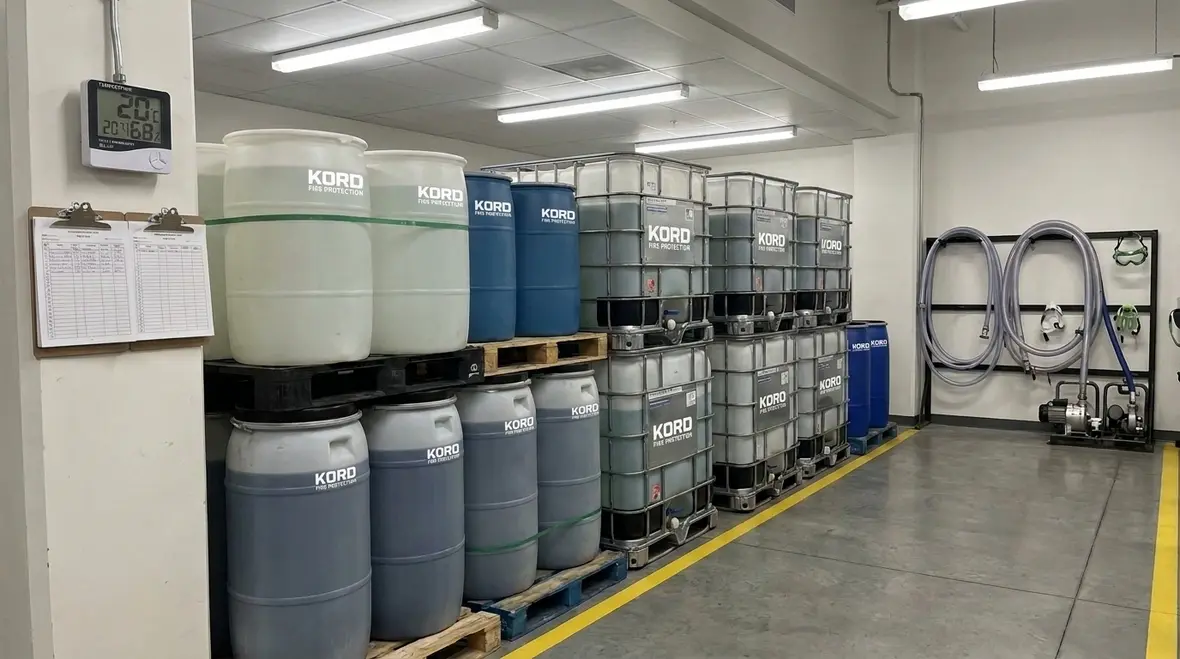
NFPA 18 Section 9.2: Storage Requirements for Wetting Agents
Quick Answer: NFPA 18 section 9.2 focuses on how facilities store wetting agents so they remain effective, safe, and compatible with fire protection equipment. Proper NFPA 18 section 9.2 wetting agent storage temperature and handling controls prevent degradation, contamination, and unreliable application during fire suppression operations.
For facilities aligning wetting agent storage with broader suppression upkeep, it helps to review related Australian fire sprinkler services so storage, inspection, and system readiness are not treated like distant cousins who only meet at audits.
What NFPA 18 section 9.2 is trying to prevent
Wetting agents support suppression effectiveness by improving water performance on Class A combustibles and certain fire scenarios. In practice, the biggest compliance risk comes from storing these agents in conditions that allow quality drift, contamination, or packaging damage. NFPA 18 section 9.2 wetting agent storage temperature and handling requirements aim to keep the product within acceptable performance limits and ensure readiness when systems or portable equipment require it.
Commercial facilities often discover noncompliance during internal audits, insurer reviews, or maintenance inspections. Typical drivers include temperature excursions in unconditioned storage rooms, missed tank rotation schedules, incorrect labeling, and poor segregation from incompatible chemicals.
NFPA 18 section 9.2 wetting agent storage temperature: what to control operationally
Facilities must manage storage temperature so wetting agent concentrates or solutions do not degrade before use. While the exact temperature limits depend on the specific wetting agent formulation, NFPA 18 section 9.2 wetting agent storage temperature and handling expectations generally require that stored material remains within the manufacturer’s specified range and that the storage environment prevents conditions that can change chemical performance.
Temperature excursion is not just a nuisance
Even brief exposure to out of range temperatures can lead to:
- Loss of wetting effectiveness, reducing suppression performance.
- Separation or stratification of components, causing uneven concentration.
- Corrosion or accelerated deterioration of tanks, drums, fittings, and gaskets.
- Inconsistent dilution outcomes when maintenance staff prepare solutions.
Practical compliance controls that stand up to audits
Strong facilities implement measurable controls rather than relying on “good storage practice.” Common high value actions include:
- Dedicated storage areas with temperature monitoring and documented checks.
- Written maximum exposure and response procedures when a reading goes out of range.
- Use of manufacturer data sheets to define acceptable limits and test triggers.
- Routine inspection of storage containers for bulging, swelling, leaks, and degraded seals.
Handling requirements: keeping concentration, cleanliness, and compatibility intact
NFPA 18 section 9.2 wetting agent storage temperature and handling requirements extend beyond temperature control. Handling procedures protect product uniformity and prevent contamination that can change viscosity, surfactant action, and system performance.
How contamination happens in real facilities
Most contamination events occur during maintenance and replenishment activities, not during normal “stand still” storage. Common failure points include:
- Using unclean transfer hoses or portable pumps previously used with incompatible chemicals.
- Allowing water quality mismatch during dilution, especially with hard water or incorrect ratios.
- Cross connecting drums or intermediate totes between different agents or strengths.
- Forgetting to verify labels, batch numbers, and last prep dates.
Operational handling practices that reduce risk
Commercial and industrial sites typically improve compliance outcomes by standardizing the workflow:
- Color coded labeling and segregation by concentration and application purpose.
- Batch records that show date received, date opened, dilution ratio, and preparer identity.
- Closed transfer practices where feasible to limit exposure and airborne contamination.
- Defined flushing and change out steps for pumps, strainers, and lines used in transfer.
- Compatibility checks with container materials, gaskets, and common maintenance chemicals.
For facilities aligning broader wetting agent programs with sprinkler and water based systems, Kord Fire Protection’s overview content supports the practical link between code expectations and daily maintenance routines. See: NFPA 18 overview and wetting agents guidance.
Equipment integration: where wetting agents fail most often
Even when stored material appears fine, the integration points can still fail. NFPA 18 section 9.2 wetting agent storage temperature and handling requirements are best treated as a system of controls that connect storage to application.
Common integration and maintenance points
- Transfer pumps and suction lines: check for worn seals, clogged strainers, and air ingestion risks that create concentration variability.
- Mixing and dilution vessels: verify ratios and mixing time so surfactant distribution remains uniform.
- Metering hardware: ensure calibration for volumetric controls used to measure concentrates and dilution water.
- Filters and strainers: inspect for debris and chemical residue that reduces flow or changes application patterns.
Inspection and verification that matter
Facilities typically meet NFPA 18 expectations more consistently when inspections are documented at the point of use, not only at storage. Effective programs include:
- Periodic verification of container integrity and secondary containment where required.
- Review of preparation logs against expected service intervals and storage time limits.
- Condition checks of application components, including lines, fittings, and strainers.
- Maintenance of testing tools used to verify concentration or solution characteristics.
When facilities need dependable fire water and delivery equipment support, fire pump maintenance planning often overlaps with wetting agent systems. For reference on pump ecosystem considerations, see: EN 12845 fire pump maintenance guide for buildings.
Commercial facility compliance challenges (and how to address them)
Retail, logistics, industrial processing, and office campuses frequently struggle with wetting agent compliance because storage and maintenance responsibilities sit across multiple teams. A robust compliance approach makes ownership clear and standardizes records.
Where teams commonly fall behind
- Unconditioned rooms: heat spikes in summer or cold snaps in winter drive temperature excursions.
- Inconsistent receiving checks: batches are sometimes accepted without verification of labels, SDS, or manufacturer data.
- Tool sharing: maintenance teams reuse hoses and containers without formal decontamination steps.
- Weak change control: mixing ratios change without updated documentation or training.
How service partners help keep audits clean
Kord Fire Protection supports ongoing compliance through inspection planning, record review, and maintenance coordination, helping commercial sites manage wetting agent readiness as part of their broader life safety obligations. For additional context on routine sprinkler service workflows that often interface with wetting agent handling procedures, visit: Australian fire sprinkler services.
Frequently Asked Questions
Conclusion and call to action
NFPA 18 section 9.2 wetting agent storage temperature and handling requirements protect suppression effectiveness by controlling storage conditions, contamination risk, and how solutions get prepared and delivered. To keep your program audit ready, implement temperature monitoring, enforce standardized handling and labeling, and verify application equipment condition on a schedule. Engage Kord Fire Protection to review your current storage and maintenance workflow, identify gaps, and maintain ongoing compliance through documented inspection and service support.

Join Our Newsletter!
Get the latest fire safety tips delivered straight to your inbox From our Newsletter.



