
NFPA 18 Section 7.3: Class B Fire Extinguishment Test Method Step-by-Step
Quick Answer: The NFPA 18 section 7.3 class B fire extinguishment test method walks test designers through preparation, fuel fire generation, agent discharge, and verification criteria. Facilities must follow consistent test setups, document conditions, and maintain equipment reliability to support defensible compliance outcomes.
If you are reviewing how field readiness connects to ongoing system care, it also helps to understand commercial fire sprinkler services, since qualification assumptions only stay useful when the installed system is maintained like it actually plans to show up on test day.
What NFPA 18 section 7.3 class B fire extinguishment test method is trying to prove
Commercial and industrial environments rely on extinguishing systems that perform predictably when combustible liquids and flammable hazards present risk. The NFPA 18 section 7.3 class B fire extinguishment test method establishes a structured way to confirm an agent, delivery system, and operating procedure can extinguish a Class B fire under defined conditions. The core intent is repeatability: the test setup must reflect controlled, measurable performance rather than “best effort” demonstrations.
For facility managers, the practical takeaway is that compliance does not stop at buying equipment. It includes ensuring components, maintenance, and operator procedures support the same performance assumptions used during qualification.
Step 1: Confirm test scope, hazards, and acceptance criteria before any ignition
Before an ignition source exists, qualified personnel should validate every element of the test plan against the governing requirements. This step typically includes documenting the intended hazard classification, the Class B fuel type, and the nominal conditions used to model fire severity.
Key compliance checks
- Agent and application method alignment: Ensure the test agent and delivery configuration match what the facility will actually install or maintain.
- Instrumentation readiness: Prepare monitoring equipment for measurements required by the test protocol, including timers, observation points, and any required environmental parameters.
- Repeatability controls: Standardize procedures for fuel placement, pre-burn time, and discharge timing so results remain defensible.
Common commercial failure point: facilities sometimes treat qualification as a one time event. Over time, changes to hardware, nozzles, piping layouts, valves, controls, or even fuel handling practices can create a gap between “tested” and “installed and maintained.”
Step 2: Prepare the test system and verify mechanical readiness
The discharge system must match the test intent in configuration and performance. This includes verifying the agent supply, controls, flow paths, and actuation methods. Technicians should verify that the system responds as designed, within documented tolerances.
Operational preparation elements
- Agent supply condition: Confirm correct agent quantity, concentration, and readiness. If the system relies on wetting agents, verify compatibility and correct formulation management practices. For broader context on wetting agent performance drivers, see NFPA 18 overview of wetting agents.
- Valve and actuator integrity: Check that valves move freely, set positions are correct, and actuation mechanisms operate consistently.
- Nozzle and piping condition: Inspect for blockage, corrosion, misalignment, or installation deviations that can alter discharge pattern and effective application rate.
- Control system logic and sequencing: Validate interlocks, release sequences, and any timing logic that can influence when discharge starts relative to ignition.
Where commercial facilities struggle most often is not the test day steps, but long term degradation. Storage conditions, maintenance practices, and component wear can reduce reliability even when the system still appears functional at a superficial level.
Step 3: Establish the fuel fire scenario and start the controlled burn
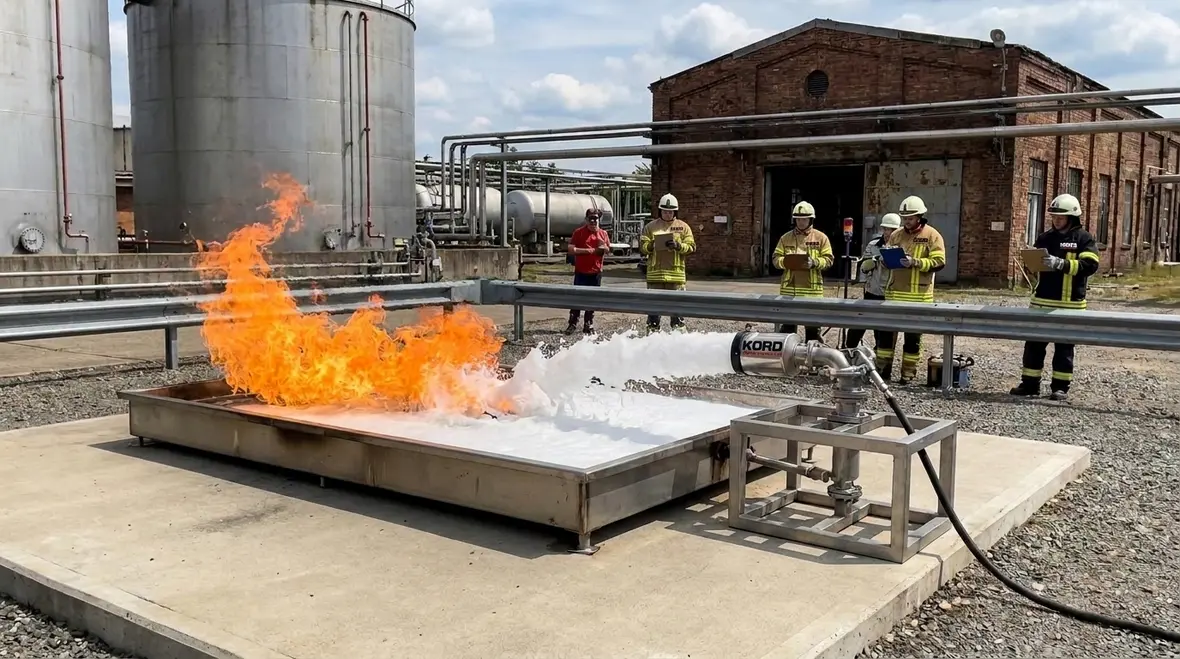
To test Class B extinguishment performance, the procedure creates a defined liquid fuel fire scenario. The test team prepares the fuel pan or apparatus, applies the fuel type and quantity required by the protocol, and ignites under controlled conditions.
Why this step matters
The extinguishment challenge depends on fire size, fuel characteristics, and burn progression. If the fire severity varies from test to test due to inconsistent loading, ignition behavior, or pre burn duration, then extinguishment outcomes become hard to compare.
Common setup variances that skew results
- Fuel contamination or incorrect fuel grade.
- Uneven fuel level or inconsistent pan placement.
- Variations in pre burn time that change heat release rate and vapor generation.
- Environmental influences such as airflow and temperature that alter flame behavior.
Facilities conducting recurring internal verifications should maintain procedures that prevent drift in how the fire scenario is established. Documented controls help ensure later tests remain comparable to original qualification data.
Step 4: Execute agent discharge using the exact operating sequence
Once the fire reaches the protocol defined stage, the system discharges the extinguishing agent in the manner specified. The discharge sequence must align with the control logic and physical design, including start timing, pressure or flow requirements, and distribution characteristics.
What technicians must observe during discharge
- Initiation timing: Confirm discharge starts at the correct point relative to ignition and burn progression.
- Agent delivery performance: Watch for signs of incomplete discharge, uneven distribution, or unexpected delays.
- Pattern and coverage: Ensure the delivery pattern supports extinguishment rather than creating ineffective jetting or bypass flow.
- Operational stability: Verify that the system does not exhibit abnormal pressure transients or control faults.
Commercial reliability is often constrained by delivery hardware, not just the agent. For example, pump performance and system pressure consistency can affect flow rate and coverage. Where pump reliability and system design details matter, teams should leverage proven engineering guidance from resources such as NFPA 25 fire pump testing requirements guidance.
In practice, Kord Fire Protection supports facilities by aligning installed systems with test assumptions and by planning maintenance that protects discharge reliability between tests. This reduces the risk that a system performs well on paper but underperforms during an actual verification event.
Step 5: Verify extinguishment, prevent re ignition, and document results
After discharge, the procedure requires verification against defined criteria. The test team confirms extinguishment, monitors for re ignition or continuing combustion, and records outcomes with sufficient detail for traceability.
Verification and documentation requirements
- Extinguishment confirmation: Document clear evidence that flames are out and combustion subsides according to the protocol.
- Re ignition monitoring: Observe for any re ignition during the specified post discharge monitoring window.
- Condition notes: Record any anomalies such as delayed discharge, unexpected agent distribution, or partial coverage indicators.
- Repeat test logic: Follow protocol expectations for whether the test must be repeated and under what conditions.
For commercial, industrial, and retail facilities, the most valuable output is not only a “pass or fail” result. It is a record that demonstrates the system maintained performance assumptions. That documentation supports risk management decisions, audit readiness, and reliable maintenance planning.
Step 6: Close out with maintenance actions that protect next test performance
Immediately after the test, teams should treat findings as maintenance inputs. Even when extinguishment is achieved, the data can indicate wear, drift, or distribution issues that will worsen if not corrected.
Maintenance actions to consider
- Component inspection: Inspect valves, hoses, nozzles, strainers, and sensors for damage or contamination.
- Control and release systems check: Confirm correct actuation and verify no fault codes or timing anomalies exist.
- Agent handling and formulation verification: For systems involving wetting agents, confirm compatibility and correct formulation control practices. Refer to NFPA 18 overview of wetting agents for helpful background on what influences performance.
- System integration review: Confirm that operational interfaces with fire detection, alarms, and manual controls remain aligned.
Kord Fire Protection provides commercial fire sprinkler and water based system expertise, including service models that help facilities maintain compliance through testing and ongoing technical oversight. For Australia based sprinkler service context, visit Australian fire sprinkler services.
Frequently Asked Questions
Call to action
Plan your next verification as a performance management exercise, not a paperwork exercise. Engage a qualified fire protection partner to confirm that your installed Class B extinguishment hardware, agent handling practices, and maintenance controls remain aligned with the NFPA 18 section 7.3 class B fire extinguishment test method assumptions. Kord Fire Protection can help you reduce test day surprises, protect operational reliability, and maintain defensible compliance documentation.

Join Our Newsletter!
Get the latest fire safety tips delivered straight to your inbox From our Newsletter.



