
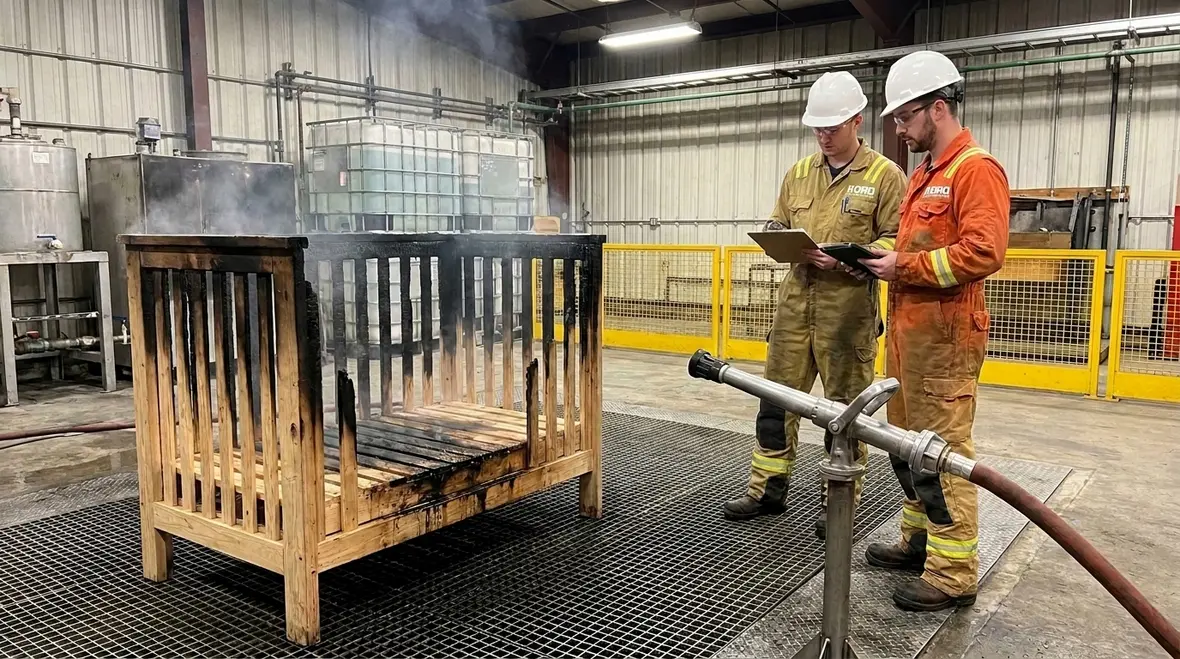
NFPA 18 Section 6.2: Wood Crib Fire Test for Wetting Agent Effectiveness
Quick Answer
NFPA 18 section 6.2 specifies a wood crib fire test that evaluates whether a wetting agent delivers the intended wetting performance under realistic conditions. The test focuses on fire suppression and control, not just chemical mixture approval. Ongoing maintenance, verification, and documentation protect compliance.
If your facility’s suppression strategy also depends on pressure and water delivery staying reliable under real demand, it helps to understand how fire pumps support sprinkler systems before wetting agent performance is judged in the field.
What the NFPA 18 section 6.2 wood crib fire test wetting agent is designed to confirm
NFPA 18 section 6.2 wood crib fire test wetting agent requirements exist to verify that wetting agents actually improve fire control when water alone is insufficient. In commercial and industrial settings, this matters because wetting agents are not “set and forget” products. System piping, concentrate storage, proportioning devices, water quality, and operational procedures can all reduce real-world effectiveness over time.
Practically, the test acts as a performance check for the entire wetting agent delivery pathway: concentrate handling, proportioning accuracy, discharge application, and the interaction between the agent and the burning fuel surface.
Where NFPA 18 wetting agent effectiveness testing fits in commercial fire protection
Wetting agent systems commonly support hazards where rapid wetting and penetration are critical, including areas with Class A combustible materials, surface burning fuels, and scenarios that require improved water contact. Facilities typically include commercial warehouses, manufacturing operations, retail stockrooms, and logistics hubs with high fuel loads and limited tolerance for fire spread.
From a compliance perspective, many organizations focus first on documentation, then on water flow tests, and only later on agent effectiveness. NFPA 18 section 6.2 drives attention back to performance because a system can pass basic hydrostatic and flow checks while still failing due to ineffective wetting delivery.
For a broader background on why wetting agents are used and what operational controls matter, see: NFPA 18 overview: wetting agents.
How the wood crib test is performed and what “effective” looks like
Test objective and acceptance logic
The wood crib fire test evaluates whether the wetting agent concentration and application method produce the intended improvement in fire suppression and control. In plain terms, the wetting agent should help water overcome surface tension limitations and increase wetting of the burning or partially ignited fuel mass.
Evaluators typically look for outcomes that indicate improved suppression and reduced sustained involvement of the fuel. The test is intended to be repeatable and representative of the system’s discharge characteristics.
Key operational factors that determine results
In the field, performance often hinges on a few controllable variables:
- Proportioning accuracy: The wetting agent concentration must remain within the system design limits. Even small deviations can reduce wetting performance.
- Delivery reliability: The agent must reach the nozzle and discharge point without being lost due to improper piping configuration, check valve behavior, or concentration segregation.
- Water supply characteristics: Water chemistry, temperature, and hardness can affect how the wetting agent performs and can change concentration behavior.
- Application method: Discharge pattern and contact with the crib influence outcomes. Improper nozzle selection or altered spray patterns can invalidate conclusions.
- System configuration changes: Modifications to piping, valves, or spray hardware can change how agent mixes with water before discharge.
Common failure points during wetting agent effectiveness tests
Commercial facilities frequently encounter repeatability problems due to:
- Concentrate contamination or degradation: Stock rotation failures, prolonged storage outside recommended temperature ranges, and contamination from improper handling.
- Incorrect mixing verification: Teams verify “tank level” but not the actual proportioning rate and outlet concentration under test conditions.
- Undetected air entrainment or flow regime issues: Air pockets and unstable flow can reduce effective mixing and change discharge characteristics.
- Blocked strainers or partially closed valves: These issues can shift flow balance and change how much concentrate actually reaches the discharge.
Compliance readiness: documentation, calibration, and test scheduling
What compliance teams should maintain
To support ongoing compliance, facilities should maintain complete records that connect wetting agent handling to test outcomes. A strong compliance file typically includes:
- Wetting agent product identification and batch or lot records
- Proportioner configuration details and calibration records
- Concentrate storage logs, including dates, condition checks, and transfer procedures
- Water supply parameters used for proportioning verification
- Test reports tied to the current system configuration
- Corrective action reports and evidence of re verification when changes occur
Calibration and verification that prevent false pass or false fail
The biggest compliance risk is treating the test as a one time event. A wetting agent can pass a wood crib fire test after a fresh fill, then fail months later due to drift in proportioning rate or changes in piping hydraulics.
In practice, calibration must be verified against actual discharge conditions, not only based on equipment manuals. Proportioners and related components should be inspected for wear and maintained so that agent concentration delivered to the nozzle matches the test assumptions.
For systems adjacent to foam and water based delivery, pump selection and performance verification also influence effective suppression. The broader technical community discusses pump considerations at: firepumps.org.
Operational training and maintenance challenges in real facilities
Why training directly affects test outcomes
Even when engineering drawings are correct, operational execution can change wetting agent performance. Facility technicians must understand the correct sequence for:
- Concentrate handling and transfer without introducing contamination
- Starting and stabilizing flows prior to discharge events
- Verifying proportioning operation and capturing required field parameters
- Documenting system configuration and any temporary adjustments
When technicians treat wetting agent systems like standard water systems, they can miss subtle failure conditions such as concentration drift, improper valve alignment, or mixing instability.
Maintenance activities that reduce drift risk
- Strainer cleaning and inspection to avoid flow restriction effects
- Valve cycling and inspection for sticking or misalignment
- Proportioner functional checks and condition monitoring
- Periodic verification of concentration delivery under controlled conditions
- Controlled concentrate replacement and stock rotation
For organizations planning or managing sprinkler and wetting agent related services, Kord Fire Protection provides practical support through ongoing inspection, testing, and system service delivery. See: Australian fire sprinkler services.
Choosing a test and maintenance partner for NFPA 18 compliance
NFPA 18 section 6.2 wood crib fire test wetting agent compliance is performance based, and performance depends on how the system is maintained between tests. Many facilities reduce risk by using a single accountable service partner who understands wetting agent control from storage and proportioning through discharge and verification.
Kord Fire Protection positions wetting agent systems as a managed life cycle. That includes readiness planning, evidence based maintenance, and re verification after any changes that can impact concentration delivery or application performance.
Frequently Asked Questions
Conclusion and call to action
NFPA 18 section 6.2 wood crib fire test wetting agent compliance protects facilities by verifying that wetting agent performance is real and repeatable. To avoid drift between tests, facilities should maintain accurate proportioning, control concentrate handling, and document configuration and results. Kord Fire Protection can support your inspection, testing, and maintenance program so your wetting agent systems stay aligned with NFPA 18 performance expectations. Contact Kord Fire Protection to plan your next verification and compliance pathway.

Join Our Newsletter!
Get the latest fire safety tips delivered straight to your inbox From our Newsletter.



