
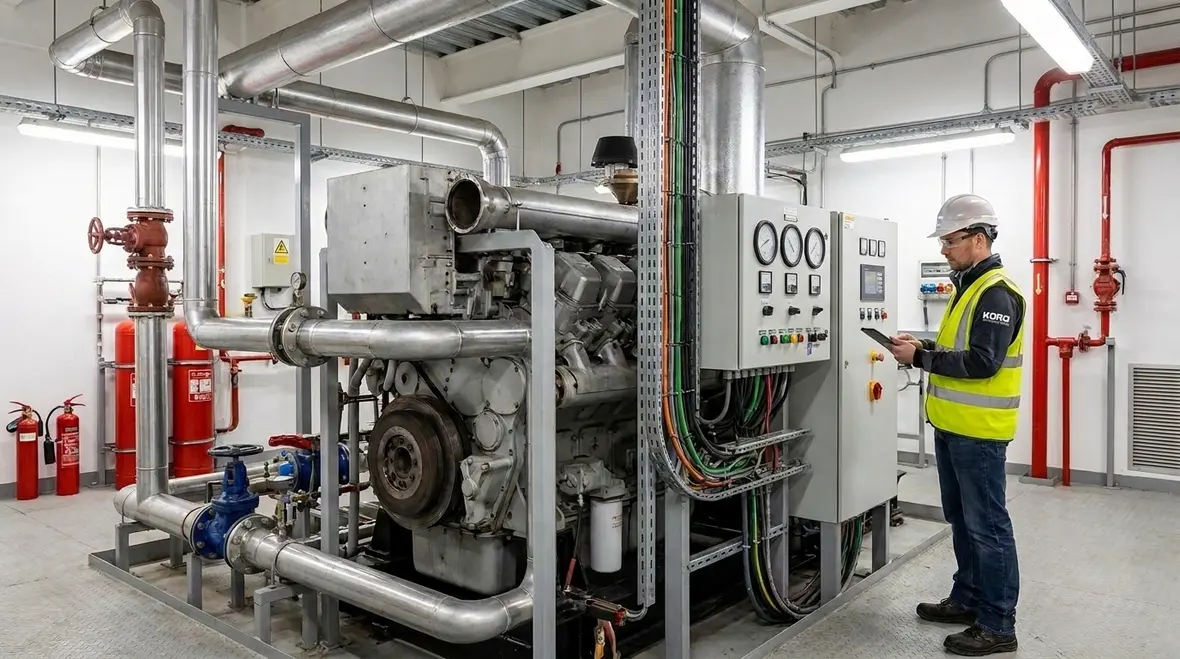
NFPA 37 Section 1.5 Equivalency: Alternative Compliance for Stationary Engines
Quick Answer: NFPA 37 Section 1.5 allows facilities to meet safety objectives using an alternative method when it provides equivalent protection to the intent of the standard. For stationary engines, this typically requires documented engineering, approvals, and verified ongoing maintenance and testing.
If your team is mapping out inspection readiness and ongoing verification, a practical next step is reviewing ITM fire protection inspection testing maintenance, since the long term success of an equivalency path depends on disciplined inspection, testing, and maintenance. For broader support with commercial system readiness, Kord Fire Protection also provides fire protection inspection, testing, and preventive maintenance services.
What NFPA 37 Section 1.5 actually does (in plain terms)
NFPA 37 Section 1.5 establishes an equivalency pathway for facilities that cannot follow a specific prescriptive requirement exactly, but still can demonstrate the same or greater level of safety. In practice, this is not a waiver that ignores the standard. It is an approval framework that requires a clear performance basis, documented risk rationale, and acceptance by the authority having jurisdiction (AHJ).
For teams evaluating NFPA 37 equivalency alternative compliance stationary engines, the key operational goal stays consistent: ignition control and fire prevention must remain effective under normal operating conditions and credible upset scenarios.
When stationary engine projects use equivalency, not prescriptive code
Commercial and industrial facilities often seek equivalency alternative compliance stationary engines when one or more of the prescriptive provisions conflicts with site conditions, engineering constraints, or equipment configuration. Common scenarios include:
- Existing infrastructure: Limited space for required clearances, ducting, or separation.
- Unique engine designs: OEM configurations that differ from typical layouts, such as enclosure style or fuel system components.
- Phased upgrades: Facilities needing interim operation while replacement work is completed.
- Fuel and control variations: Alternative fuels or control strategies that change ignition source behavior.
- Environmental constraints: Restrictions that complicate installation of certain detection, shutoff, or venting arrangements.
In each case, the compliance team must demonstrate that the alternative approach maintains the same safety performance targeted by NFPA 37.
How to build an equivalency submission that passes AHJ scrutiny
A strong Section 1.5 package typically includes both technical justification and operational assurance. Facilities that treat equivalency as a one time paper exercise often fail during inspections or maintenance reviews, especially when equipment performance drifts over time.
1) Identify the prescriptive requirement and the safety objective
The submission should clearly state:
- The exact NFPA 37 prescriptive section being challenged.
- The safety objective behind that requirement (for example, preventing ignition of flammable vapors, limiting fire growth potential, or ensuring reliable shutdown).
- Why strict compliance cannot be achieved, supported by site or equipment constraints.
2) Provide a performance based alternative
The equivalency method should describe the alternative system or modification, including:
- Engine and fuel system arrangement changes or protections.
- Detection and shutdown logic, including setpoints and response times.
- Fire protection interface components, such as valves, dampers, or engineered controls that limit ignition exposure.
- Reliability features and how failures are handled (for example, fail safe positions and override controls).
For stationary engines, AHJs commonly look for evidence that ignition risk remains controlled across operating modes: start up, load changes, normal running, and shutdown or upset conditions.
3) Include test evidence and inspection readiness
Equivalency alternative compliance stationary engines should not rely solely on design intent. The AHJ usually expects measurable proof such as:
- Factory information and startup commissioning results.
- Site acceptance testing for detection, shutdown sequences, and alarm outputs.
- Documentation that maintenance procedures will preserve performance.
- Inspection and recordkeeping plan aligned to the operational schedule of the facility.
4) Plan for ongoing maintenance and functional testing
Common failure points during follow up inspections include miscalibrated detection, altered control settings, bypassed interlocks during maintenance, and degraded wiring or sensors exposed to heat and vibration. The equivalency package should directly address how these conditions are prevented through routine testing and corrective action.
What inspectors typically verify during stationary engine equivalency follow up
After approval, compliance enforcement shifts to verification. Inspections in commercial, industrial, and retail facilities often focus on whether the installed system operates as it was documented. Typical checks include:
- Control sequence integrity: Shutdown and isolation functions must occur in the intended order under the defined trigger conditions.
- Detection coverage and response: Sensors and initiators must remain positioned, unobstructed, and within acceptance thresholds.
- Alarm routing and annunciation: Signals must reach the responsible monitoring locations with clear documentation.
- Maintenance records: Functional test results, calibration logs, and corrective actions should align with the facility schedule.
- Interlock and locking mechanisms: Bypasses must be controlled, time limited, and documented with restoration confirmation.
- Engine operating mode compliance: The alternative protections should remain effective across start up and load changes, not just steady state operation.
Facilities that use equivalency alternative compliance stationary engines often discover that the most time consuming work occurs after installation, when sensors drift, setpoints change, or maintenance technicians need clear step by step instructions.
If your organization needs a structured approach to functional testing and documentation, Kord Fire Protection can support the compliance lifecycle through inspection readiness, testing, reporting, and ongoing maintenance coordination. For additional context on commercial fire protection workflows, Kord Fire Protection information resources can be found here: Kord Fire Protection.
Operational and maintenance requirements that protect the equivalency (not just the paper)
NFPA 37 equivalency alternative compliance stationary engines succeeds when operational practices maintain the same level of safety day after day. For facilities, this usually requires disciplined procedures in three areas.
Routine functional testing and calibration control
Stations should implement a schedule for:
- Detection sensor verification and calibration per manufacturer and AHJ expectations.
- Testing of shutdown sequences, including confirmation that valves or isolation devices reach the correct fail safe states.
- Alarm verification, including time to notify and correct signaling paths.
Testing documentation should clearly indicate who performed the test, what was tested, and whether performance matched the approved basis.
Interlock management during service events
During engine service, controls can be temporarily overridden. The highest risk events occur when interlocks remain bypassed longer than intended or when restoration is incomplete. The program should include:
- Clear authority and signage requirements for any bypass.
- Time limits and restoration verification steps.
- Post service functional testing before returning equipment to normal operations.
Configuration control and change management
Equivalency submissions can be invalidated by untracked changes. Facilities should require review of:
- Software or control panel parameter changes that affect shutdown thresholds or timing.
- Replacement parts that are not equivalent to original sensors or actuators.
- Electrical modifications that alter signal integrity or redundancy.
This is where ongoing support from qualified commercial fire protection partners helps reduce risk. Kord Fire Protection can align maintenance execution with the performance expectations that underwrite the equivalency approval, supported by inspection-ready reporting and corrective action tracking.
Frequently Asked Questions
Conclusion and CTA
NFPA 37 Section 1.5 equivalency can work for stationary engines when the facility demonstrates equivalent safety performance, not just design intent. To protect your approval long term, build a performance based submission, verify installed operation with documented testing, and maintain interlocks and calibration through disciplined procedures. Contact Kord Fire Protection to support compliance readiness, functional testing, and ongoing maintenance documentation so your stationary engine safety strategy stays inspection-ready.

Join Our Newsletter!
Get the latest fire safety tips delivered straight to your inbox From our Newsletter.



