
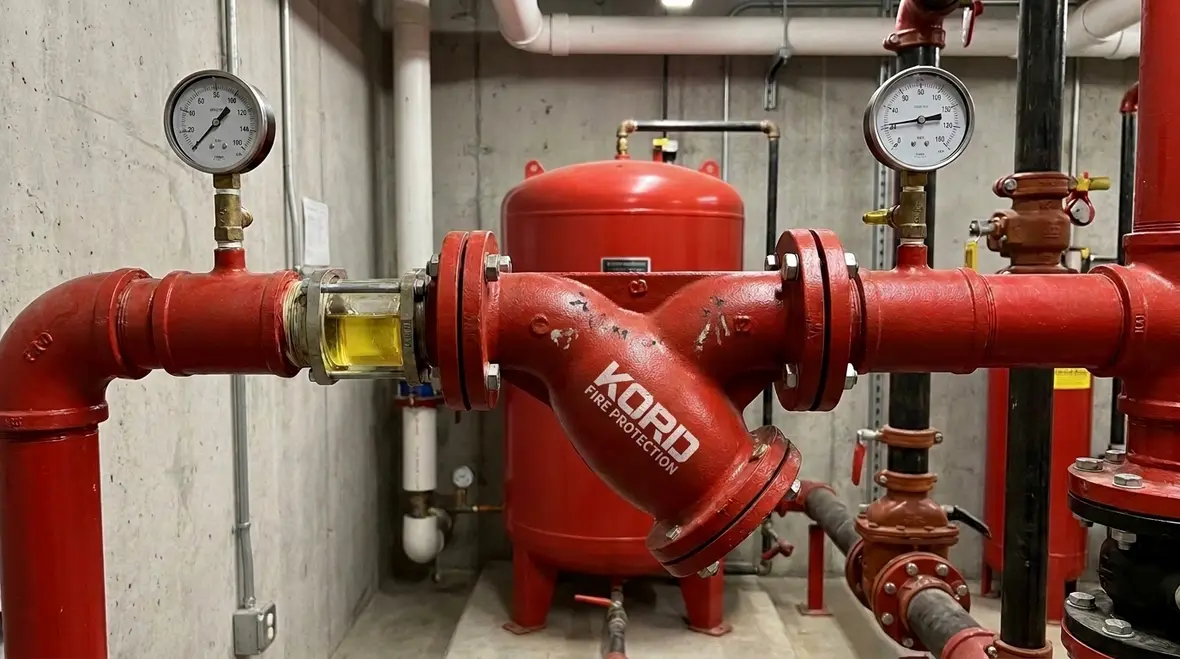
NFPA 16 Section 6.8: Strainers for Foam Concentrate Lines
Quick Answer: NFPA 16 Section 6.8 focuses on protecting foam proportioning equipment by controlling debris and preventing concentration line contamination. Foam concentrate strainer requirements typically include correct sizing, installation location, pressure drop management, and maintenance so foam delivery stays reliable.
Facilities managing broader foam system upkeep can also review foam fire suppression inspection requirements and service to connect strainer maintenance with overall system readiness.
Why foam concentrate strainers matter in real foam systems
Foam systems depend on consistent foam solution and concentrate delivery. In commercial, industrial, and retail facilities, the most common operational risk comes from contamination entering the foam concentrate line. Particulate matter can originate from storage tanks, transfer hoses, thread seal debris, aging elastomers, pipe scale, or work activity during repairs. Once present, debris can cause poor proportioning, unstable discharge, or component wear that may not be obvious during routine visual checks.
NFPA 16 Section 6.8 addresses this risk by requiring strainers for foam concentrate lines. The intent is simple: the system must remove solids before they reach proportioning hardware. Meeting foam concentrate strainer requirements also supports predictable performance during inspections, acceptance testing, and periodic operational checks.
What NFPA 16 Section 6.8 is targeting (and what it prevents)
Section 6.8 addresses strainers that keep debris out of the foam concentrate path used for proportioning. When strainers are missing, incorrectly installed, undersized, or allowed to load with contaminants, several failure patterns emerge:
- Proportioning drift: Solids partially block flow paths, changing concentrate delivery rate and foam ratio.
- Pressure drop problems: A loaded strainer increases upstream pressure differential, which can affect regulator and valve behavior.
- Metering instability: Some proportioning devices become sensitive to flow irregularities, leading to inconsistent foam quality.
- Premature wear: Debris that bypasses filtration can erode moving parts and accelerate maintenance cycles.
Facilities that rely on foam for high value hazards such as flammable liquid control often find that the strainer becomes the first practical line of defense. Compliance also becomes easier to demonstrate when the strainers are correctly specified, accessible, and maintained on schedule.
Where strainers belong and how they must be installed
Strainers must be installed where they will protect the foam concentrate line feeding the foam proportioning equipment. Practical compliance hinges on installation details, not just the presence of a strainer body.
Key installation considerations
- Correct orientation and flow direction: Many strainers are designed for a specific direction of flow. Reversing orientation can reduce capture efficiency.
- Adequate access for inspection and cleaning: If maintenance requires excessive disassembly, the strainer may be skipped or deferred.
- Proper connection integrity: Loose fittings can introduce leakage and allow debris to bypass filtration.
- Enough clearance for removal: Cartridge and basket type strainers should be removable without disturbing piping alignment.
- Downstream protection: The strainer must be located early enough in the foam concentrate path to prevent contaminants from reaching metering components.
Commercial facilities frequently encounter compliance gaps during renovations, where valves and pipe sections are rerouted and access is unintentionally eliminated. A field verification during commissioning or acceptance helps confirm that the strainers match the system layout that the standard assumes.
For a broader compliance framework and related design considerations, facilities can reference NFPA 16 overview guidance.
Choosing the right strainer: mesh, basket design, and capacity
Foam concentrate strainer requirements cannot be met using generic equipment. The filtration approach must match the system’s concentrate chemistry, expected contaminant load, and the operating pressure range.
Common specification elements
- Strainer element type: Basket, Y strainer, or cartridge designs affect cleaning method and how debris loads over time.
- Filtration level: The element must capture debris without causing excessive pressure drop at typical operating flow.
- Flow capacity: Undersized strainers can create high differential pressure, leading to inconsistent foam concentration delivery.
- Compatibility with foam concentrates: Gaskets, cartridges, and seals must resist concentrate exposure and cleaning chemicals.
- Maintenance practicality: A strainer that requires special tools or internal modifications often fails in day to day compliance.
Operators often believe that “finer mesh is always better.” In practice, finer filtration can increase pressure drop and load faster, which then harms proportioning. The correct approach balances debris capture with system hydraulics so the foam system performs consistently between inspections.
Inspection and maintenance: the compliance difference between installed and functional
NFPA 16 expectations focus on more than installation. The strainer must remain functional. Loaded strainers can produce the same symptom profile as a control or proportioning malfunction, which delays troubleshooting and increases downtime risk.
Operational inspection points
- Visual condition: Check for clogging, corrosion, and signs of bypassing or leaks at joints.
- Clean strainer confirmation: Maintenance records should show cleaning or element replacement based on inspection findings.
- Pressure differential awareness: When systems include instrumentation or test procedures, elevated differential pressure can indicate a loaded element.
- Concentrate line verification: After cleaning, verify the line is reassembled correctly and no debris was introduced during maintenance.
Cleaning procedure realities
Proper cleaning typically requires removal of the strainer element or basket, controlled debris disposal, and inspection of seals and seating surfaces. Reusing damaged gaskets or forcing elements into place can cause leaks and reduce filtration efficiency. Commercial facilities that document cleaning method, element condition, and reassembly verification typically demonstrate stronger compliance posture during audits and authority having jurisdiction reviews.
Kord Fire Protection supports recurring compliance by aligning maintenance practices with NFPA 16 system performance goals, including functional verification that the foam concentrate path stays protected over time. This reduces the risk that an otherwise “installed” strainer becomes a hidden failure point.
Common failure points that trigger poor foam performance
In the field, the same root causes repeatedly create noncompliance or performance variability even when equipment appears intact.
Most frequent issues
- Debris loading from transfers: Refilling or concentrate transfer introduces particulates that the strainer must capture.
- Delayed cleaning: Deferred maintenance turns the strainer into a restriction device.
- Wrong element installed: Substituting a different mesh size or cartridge type during service changes the system’s hydraulics.
- Missing strainers after piping work: Modifications may omit or bypass the strainer while maintaining pipe flow.
- Improper reassembly: Misaligned baskets, damaged seats, and incorrect gasket installation allow bypass.
These problems often show up during system tests as ratio instability, foam quality issues, or unusual pump and valve behavior. A maintenance program that treats strainers as high priority life safety components reduces both failure likelihood and troubleshooting time.
Frequently Asked Questions
Call Kord Fire Protection for ongoing compliance support
Foam concentrate strainer requirements become meaningful only when the strainer stays accessible, correctly configured, and verified as part of your system performance. Kord Fire Protection can help your facility validate strainer installation, develop practical maintenance workflows, and support NFPA 16 readiness through testing and documentation. Contact Kord Fire Protection to review your current foam concentrate line filtration and build a compliance plan your operations can sustain.
If you need system-level support beyond this single component, explore fire suppression system services for inspection, testing, repair, and maintenance across foam and other special hazard systems.

Join Our Newsletter!
Get the latest fire safety tips delivered straight to your inbox From our Newsletter.



