
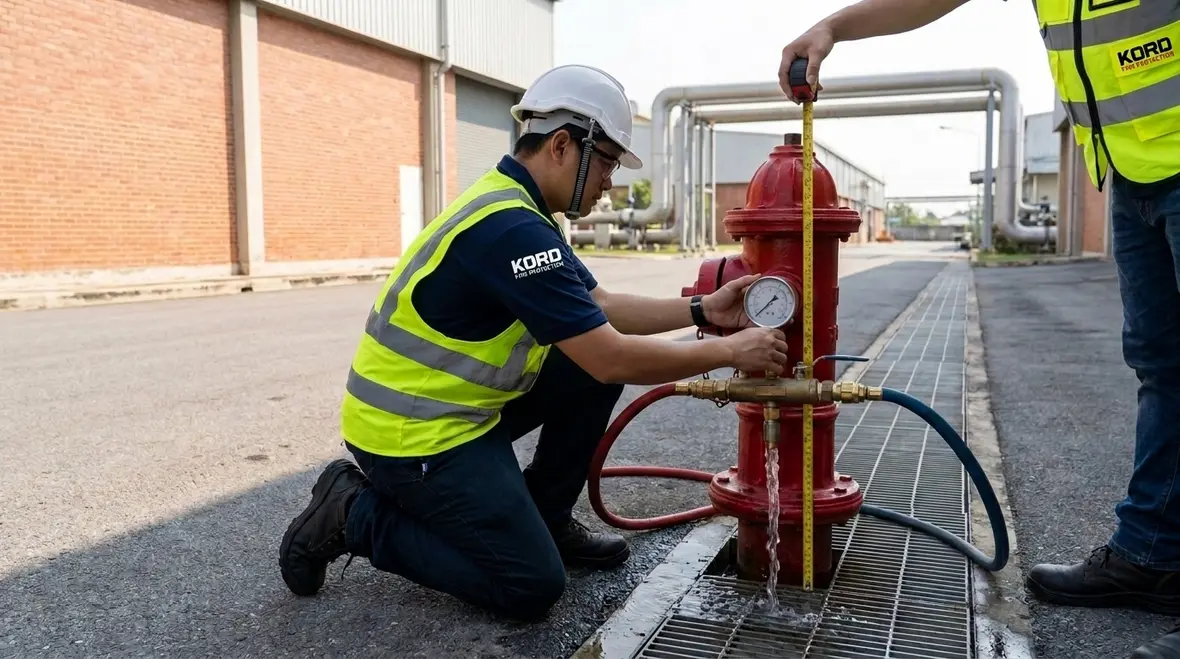
NFPA 15 Section 8.4: Water Supply Information and the 12-Month Waterflow Test Requirement
Quick Answer
NFPA 15 Section 8.4 requires facilities to document water supply details and complete a waterflow test at least every 12 months. The test must be evaluated against the design basis, including gauge elevation and reliable interpretation of system pressure and flow to confirm ongoing performance.
Before diving into the paperwork-and-pressure-reading fun, facilities that want broader inspection, testing, and maintenance support can naturally explore ITM fire protection inspection, testing, and maintenance from Kord Fire Protection.
Why NFPA 15 8.4 water supply documentation drives system reliability
NFPA 15 Section 8.4 focuses on one practical outcome: the fire protection system must receive water supply performance that matches what the design assumed. For commercial, industrial, and retail occupancies, water supply conditions can drift due to municipal changes, site redevelopment, new utility load demands, valve and hydrant usage patterns, or inaccuracies introduced during maintenance and retrofits. When waterflow performance no longer aligns with the hydraulic design, the sprinkler system can fail to deliver expected discharge within the hazard’s design intent.
To manage that risk, the NFPA 15 8.4 water supply information waterflow test 12 months gauge elevation requirements link documentation to periodic verification. The goal is not paperwork. It is defensible evidence that the water supply and system pressure readings were measured and interpreted correctly, including the correct gauge elevation used for calculations and acceptance.
What NFPA 15 8.4 requires for water supply information
Section 8.4 centers on providing accurate, usable information that allows the authority having jurisdiction, designers, and service teams to verify the system hydraulic basis. While project-specific details vary by installation type and jurisdictional approach, common “must-have” elements typically include the source of water supply, site arrangement, and how pressures are measured at a known reference.
Water source and arrangement details
Water supply information generally covers the connection points and the water sources serving the system, such as a municipal main, a dedicated fire service, on site tanks, pumps, or combinations. Service teams should also document the operational configuration, including normally open and normally closed valves, any locked positions, and the methodology used to access test points.
Hydraulic design basis and reference points
For sprinkler and water spray fixed systems, NFPA 15 hydraulic calculations depend on assumptions about available pressure and losses. Section 8.4 documentation must therefore support those assumptions with reliable test results and measurement methodology. This includes ensuring that the gauge used for the waterflow test and the pressure measurement reference are consistent with the design and the calculation method.
Gauge elevation: the detail that can invalidate results
The phrase “gauge elevation” matters because static pressure and residual pressure readings are influenced by elevation differences between the gauge location and the reference point used in the calculations. If the measured gauge elevation does not match the reference used during design or during the test documentation, the residual pressure values can be mis-stated, leading to incorrect acceptance decisions. That is why NFPA 15 8.4 water supply information and the recurring waterflow verification process must treat gauge elevation as a controlled data point, not an afterthought.
What the 12 month waterflow test actually accomplishes
The 12-month waterflow test requirement exists to detect performance changes over time. Even when the fire protection system components remain in good condition, the water supply system may change. Common drivers include hydrant and main use, maintenance outages on municipal infrastructure, changes in pumping schedules, valve positions, temperature effects on water, and underground system work.
In many commercial facilities, waterflow test results also become the practical bridge between engineering and operations. Operations teams need a repeatable field procedure that produces consistent measurements. Engineering teams need the results to be credible for hydraulic verification. Service contractors need a defensible chain of documentation for inspection readiness.
Operational outcomes during the test
A properly conducted waterflow test helps confirm that the water supply can deliver expected residual pressure and flow at the system connection point under flowing conditions. It also verifies that the system’s water supply acceptance criteria remain within the bounds required by the design basis and applicable code requirements.
Common measurement and documentation failure points
- Inconsistent gauge location: technicians place the gauge at a different elevation than the reference used for prior tests or design calculations.
- Incorrect gauge elevation record: the elevation is estimated or transcribed incorrectly, skewing computed pressures.
- Valve position variation: test valves are not returned to the same verified operating position before and after the test.
- Flow meter or gauge setup errors: instrumentation is not calibrated, not correctly zeroed, or not logged with correct identification.
- Uncontrolled discharge conditions: test discharge location and back pressure effects are not accounted for consistently.
Any of these issues can create a “looks good on site” result that fails later when compared to the design basis, or it can produce false failures that trigger unnecessary repairs.
How crews should manage gauge elevation during waterflow testing
Gauge elevation is one of those parameters that affects whether the measured results align with the hydraulic assumptions. A strong compliance program controls how gauge elevation gets measured, recorded, and verified before the test begins.
Before the test: control the measurement reference
- Use a defined datum: the site should establish a consistent reference for elevations, such as a building benchmark or a coordinate reference used by the facility engineering team.
- Photograph and label: capture the gauge location, piping orientation, and the identification tag of the gauge and test kit.
- Confirm elevation method: elevations should be measured using the method used previously for the design basis, or an approved alternate that matches the calculation approach.
During the test: confirm stable readings and correct data capture
- Verify calibration documentation: keep gauge and meter calibration records current and traceable.
- Stabilize flow conditions: record measurements once flow and pressure have stabilized for the intended test duration.
- Record instrument identifiers: technicians should log the instrument serial numbers and measurement units used for residual pressure and flow.
After the test: connect results to acceptance criteria
The test report should clearly show the gauge elevation used in calculations, the residual pressure values, and the flow rate data that support the conclusions. If the water supply is marginal, the report should explain how results were interpreted relative to the design and how differences, if any, were addressed. Where a water supply enhancement is needed, the report should guide the next engineering step rather than simply listing values.
Documentation and compliance workflow for commercial facilities
For facilities like warehouses, strip retail, grocery-anchored centers, and mixed-use developments, inspection readiness depends on consistent reporting and tight coordination among operations, engineering, and the service provider. NFPA 15 8.4 water supply information waterflow test 12 months gauge elevation compliance should be treated as a managed lifecycle activity.
Recommended workflow that reduces last-minute risk
- Schedule the 12-month test window: plan for seasonal and operating constraints, including access to fire service connections and coordination with facility operations.
- Verify the configuration in advance: confirm valves, test connections, and access pathways match the documented configuration.
- Confirm instrumentation readiness: ensure gauges and flow measurement devices are calibrated and ready, and that the gauge elevation measurement approach is verified.
- Complete the test and document immediately: reduce transcription risk by capturing instrument IDs, readings, and gauge elevation data while the team is on site.
- Review results versus design basis: a qualified reviewer should interpret residual pressures and flow in the context of hydraulic calculations.
- Address variances with a corrective action plan: if results fall outside expected performance, document root cause and define repair or enhancement steps.
When fixed systems include pumps, tanks, or water spray components, the water supply verification becomes even more critical. For guidance related to fixed water spray system considerations, see NFPA 15 enhancing fire safety with water spray fixed systems.
For additional background on fire pump systems and related testing concepts, facilities can also reference fire pump flow test pre-test steps.
Kord Fire Protection supports commercial compliance through disciplined testing practices, verification of measurement methodology, and ongoing maintenance planning. Their role is essential when facilities need reliable test data, consistent reporting, and fast corrective action coordination between operations, engineering, and inspection stakeholders.
What happens when results do not match the design basis
A waterflow test that shows inadequate residual pressure or flow can indicate supply limitations or configuration issues. The response should be structured and engineering-led rather than reactionary.
Potential root causes
- Municipal supply changes: demand increases or infrastructure changes can lower available pressure.
- Undocumented valve changes: a partially closed valve, blocked access, or altered configuration can change flow characteristics.
- Hydraulic loss changes on site: added piping, revised routing, or unaccounted fittings can increase losses.
- Measurement method inconsistency: incorrect gauge elevation, incorrect gauge reference, or instrumentation errors can create an apparent deficit.
- Pump or controller issues: where pumps support the system, performance drift can affect residual pressures during test conditions.
Corrective action paths that typically make sense
Facilities typically proceed with one or more of the following: re-verification of measurements including gauge elevation, review of valve configurations, and a hydraulic re-evaluation of the system. If the water supply remains insufficient, design enhancements may include modifications to piping, addition of fire service pumps, storage enhancements, or coordination with the water utility. The most efficient projects treat the test report as the basis for engineering decisions, not as a standalone compliance artifact.
Frequently Asked Questions
Conclusion and Call to Action
NFPA 15 Section 8.4 water supply information and the 12-month waterflow test requirement protect commercial facilities by verifying real water delivery performance over time, with gauge elevation treated as a controlled, calculation-critical input. To avoid false failures, unsafe conditions, and inspection delays, facilities should standardize measurement methods and maintain complete test documentation. Contact Kord Fire Protection to plan your next 12-month waterflow test, validate gauge elevation practices, and keep your fire protection system compliant year after year.
Related links: kordfire.com NFPA 15 water spray fixed systems | firepumps.org | kordelectric.com | kordfire.com.au

Join Our Newsletter!
Get the latest fire safety tips delivered straight to your inbox From our Newsletter.



