
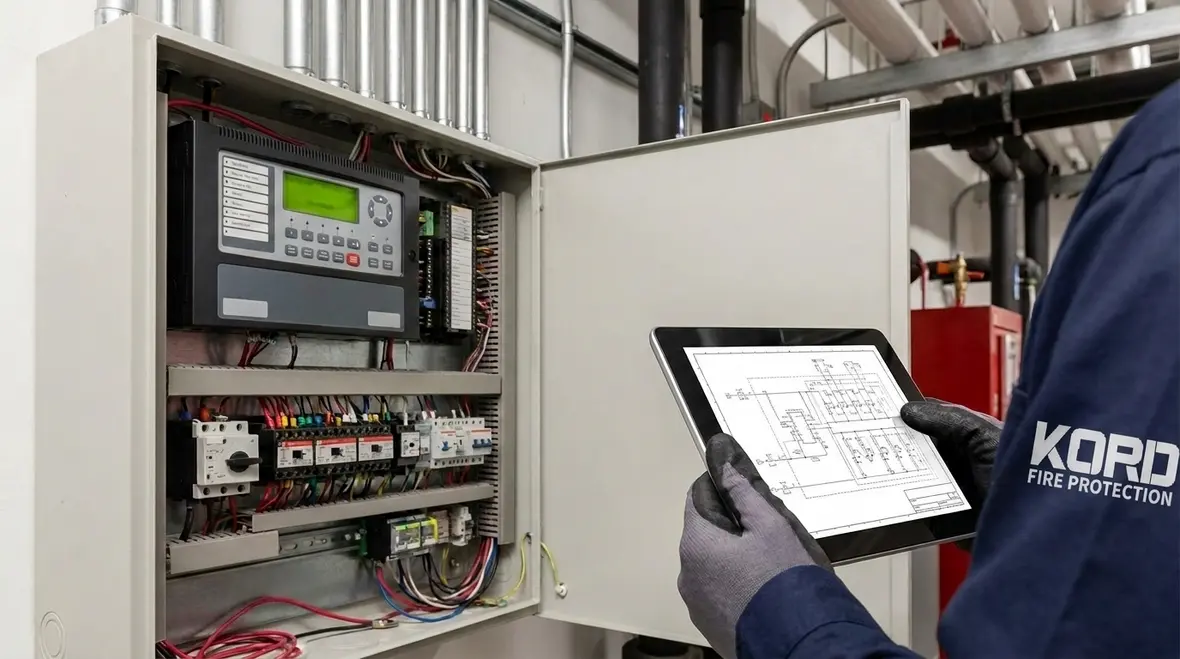
NFPA 15 Section 7.7 Actuation Detection: Delay and Voting Rules
Quick Answer: NFPA 15 Section 7.7 establishes how automatic detection equipment initiates water based fire protection actuation. The rules define permitted actuation delay strategies and how voting across detectors must operate to avoid nuisance activation while maintaining required response reliability under NFPA 72.
For facilities that need the detection logic, field devices, and release pathway to stay aligned in real life instead of just on paper, commercial fire alarm services can help connect FACP programming, testing, and ongoing maintenance with the actual water system actuation sequence.
What Section 7.7 is trying to achieve
NFPA 15 Section 7.7 addresses a recurring commercial fire protection challenge: balancing dependable water system actuation with the need to limit nuisance operation. Automatic detection can be fast and effective, but it can also be triggered by transient conditions, installation issues, or degraded device performance. The Section 7.7 framework works together with NFPA 72 supervision, signaling, and device operational behavior so the facility achieves consistent, auditable control logic for water spray, water mist, and other fixed water systems governed by NFPA 15.
In practice, facility teams must implement NFPA 15 7.7 automatic detection equipment actuation delay voting NFPA 72 rules correctly in the fire alarm control unit and interface control equipment. A correct design reduces unwanted system discharge risk, protects business continuity, and improves inspection outcomes.
How actuation detection, delay, and voting work in real systems
Section 7.7 logic typically shows up in the control pathway between detection circuits and the water system actuation input. The core elements include:
- Automatic detection equipment: Smoke, heat, flame, or other approved initiating devices within the facility hazard area.
- Actuation delay: An intentional timing mechanism that can prevent immediate discharge while conditions are confirmed.
- Voting: Confirmation rules that require one or more detection conditions before actuation occurs.
- Supervision and interface: Proper monitoring of device health, circuit integrity, and control wiring so faults trigger trouble conditions rather than silent failure.
Commercial facilities usually implement this logic through programmable panels or listed interface modules that receive detection inputs from the FACP, then energize the water system control valves, pump start logic, or solenoid actuators as required.
Actuation delay: when timing matters and where it fails
Actuation delay provides a window to ensure the signal represents a credible fire condition rather than a momentary anomaly. The operational problem most commonly observed in the field is not “delay too long,” but “delay implemented inconsistently” across devices, zones, or sensors because of how the programming or relay interface is configured.
Common delay related failure points include:
- Incorrect timer selection in the FACP logic: Using a timing function that conflicts with the intended initiating device action.
- Bypassing in maintenance: Temporary changes made during troubleshooting that remain in place after work is complete.
- Loss of reference to detector state: Logic that does not properly reset if detectors clear, creating unintended actuation later.
- Power and reset behavior not aligned with NFPA 72: Loss and return of power can produce unexpected states if the control sequence is not designed for normal and abnormal conditions.
For safety, the facility needs documented timing logic, tested interfaces, and a repeatable procedure for restoring correct behavior after any inspection, service call, or software update.
Voting: reducing nuisance while preserving fire detection reliability
Voting rules require multiple detector inputs or specific detector group states to reach a confirmed condition before actuation. Voting can use one of several practical approaches, depending on how the system is designed and permitted. Facility teams typically configure voting at the FACP logic level or via a listed voting interface. The key compliance requirement is that the implemented logic must match the approved design and the applicable NFPA provisions governing automatic detection and control.
In day to day operations, voting failures tend to originate from:
- Detector replacement mismatch: Replacing with a different device type or sensitivity class and not updating listing assumptions or test results.
- Alarm verification conflicts: Alarm verification modes that change the timing or state transitions feeding the water system interface.
- Unintended cross zoning: Wiring or software mapping that makes the voting group behave differently than the fire protection design intent.
- Stuck inputs or dirty detectors: A detector that never clears can “force” a voting condition, increasing discharge likelihood during minor events.
Commercial, industrial, and retail locations often run high device counts, frequent tenant turnover, and variable maintenance access. This increases the probability of wiring changes, device swap errors, and logic drift after renovations.
How NFPA 72 supervision and operating states connect to NFPA 15 Section 7.7
NFPA 15 Section 7.7 does not operate in isolation. The actuation detection strategy depends on NFPA 72’s system supervision, trouble and supervisory signal behavior, and how the FACP manages detector states and circuit faults. An effective compliance approach ensures that:
- Supervisory conditions and trouble conditions do not allow unmonitored failure states that could prevent actuation when needed.
- Faults trigger appropriate indications and do not inadvertently “simulate” a fire alarm input.
- Reset behavior after a fire alarm, test, or fault return produces the expected detector and output states.
- Any delay and voting sequence still satisfies the required performance expectation of the fixed water system interface.
From a maintenance standpoint, the facility must verify that control circuits remain supervised, that detector circuits display correct device status, and that the interface control equipment returns to normal condition after testing. Where a system uses multiple control relays, solenoids, or valve actuators, the inspection must confirm correct de energization and correct re energization thresholds based on the approved logic.
Implementation checklist for commercial facilities
Facilities that pass inspections reliably usually follow a disciplined process that ties design intent to on site behavior. The checklist below supports field verification of NFPA 15 7.7 automatic detection equipment actuation delay voting NFPA 72 logic.
1) Confirm the approved design sequence
- Review drawings and control schematics showing detection groups, voting method, and actuation delay strategy.
- Verify that the FACP programming sequence matches the approved interface behavior for the water system.
- Confirm that any alarm verification or special modes do not alter the intended actuation criteria.
2) Validate timing, resets, and state transitions
- Conduct functional tests that prove actuation occurs within the expected timing window when voting is satisfied.
- Prove that the system returns to normal state correctly when detector conditions clear before the actuation threshold.
- Verify behavior after trouble clearance and after power disturbances, consistent with NFPA 72 expectations.
3) Confirm voting integrity across devices and zones
- Test the configured voting group so the output only activates when voting requirements are met.
- Confirm that each detector in the voting group produces the expected input state at the FACP.
- After any tenant improvement or wiring change, confirm that mapping and group assignment remain unchanged.
4) Confirm valve and pump control interface behavior
- Verify correct interface energization of the actuators, solenoids, or valve control circuits.
- Check that any electrically operated devices fail to a safe state and do not remain energized due to stuck relays.
- Confirm notification signaling and water system initiation are coordinated as intended.
Maintenance and inspection realities that affect compliance
Many compliance issues do not stem from fundamental misunderstanding of Section 7.7. Instead, they arise from process gaps during maintenance, device replacements, and software updates. A practical maintenance program should treat detection actuation logic as a controlled system with version control and repeatable testing.
Common commercial scenarios that create drift
- Software updates: After firmware upgrades, custom logic can reset or behave differently, especially with alarm verification settings.
- Device substitutions: Swapping devices during maintenance without verifying compatibility can change response behavior even if the wiring stays the same.
- Renovations and tenant changes: Reassigning spaces, removing ceiling tiles, adding partitions, or relocating detectors can change smoke transport and create false or delayed inputs.
- Cleaning and environmental impacts: Dust and airflow changes can affect detector sensitivity and voting outcomes.
For facilities seeking a robust compliance pathway, Kord Fire Protection supports ongoing testing, verification, and documentation so delay and voting logic remains aligned with the approved configuration over time. Water based systems require coordinated attention to both detection and actuation interfaces, and that coordination is where most “paper compliance” fails.
For additional context on fixed water system considerations, see NFPA 15 enhancing fire safety with water spray fixed systems.
FAQ: Delay and voting for NFPA 15 Section 7.7
Get your delay and voting logic tested and documented
Commercial facilities should treat NFPA 15 Section 7.7 delay and voting as a controlled, testable control sequence, not a “set it and forget it” feature. Engage Kord Fire Protection to validate FACP programming, confirm detector group voting integrity, test actuation timing, and document results for inspections. For planning resources and industry references, review firepumps.org, then contact Kord Fire Protection for an on site compliance review.

Join Our Newsletter!
Get the latest fire safety tips delivered straight to your inbox From our Newsletter.



