
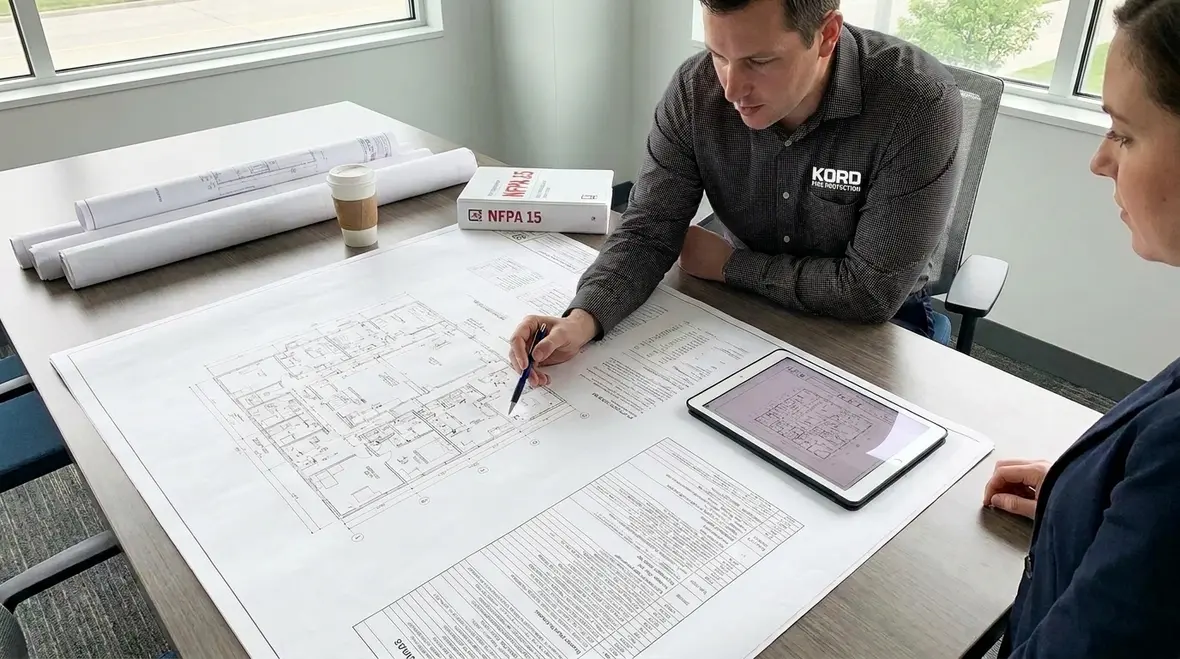
NFPA 15 Section 8.2: What Your NFPA 15 Working Plans Must Include Before AHJ Approval
Quick Answer: Before AHJ approval, NFPA 15 Section 8.2 working plans must demonstrate the design, installation, and water based system performance in a clear, verifiable format. The submittal typically needs system layout, hydraulics, component specifications, protection criteria, and commissioning level details for review and approval.
If you are tightening up plan review readiness, it also helps to coordinate broader fire and electrical system support for compliance early, especially when interfaces, controls, and commissioning details need to behave like one coherent package instead of a last minute group project.
Why NFPA 15 8.2 working plans get delayed at the AHJ stage
Commercial and industrial facilities often treat NFPA 15 working plans as a one time engineering delivery. In practice, AHJs and plan reviewers look for evidence that the installed water based fixed system will meet the applicable hazard design intent, operate as intended, and be maintainable across the facility lifecycle. When the plans do not “tell the full story,” reviewers issue requests for additional information, which pushes approvals and installation schedules downstream.
For many teams, the deciding factor is how completely the submittal addresses the “NFPA 15 8.2 working plans submittal scale details AHJ” checklist items, including the scale of drawings, design basis documentation, equipment selections, and details needed for field verification and testing.
What Section 8.2 expects you to show before approval
NFPA 15 working plans under Section 8.2 focus on one outcome: the AHJ must be able to determine that the system is designed to protect the hazards and that components and installation methods align with NFPA 15 requirements. A compliant submittal should enable reviewers to confirm the system’s water supply adequacy, distribution arrangement, operating sequence, and installation details that impact performance.
From a practical standpoint, the working plans should be drafted like a field verification tool. Each drawing and specification item should map to what technicians will inspect during rough installation, commissioning, and periodic maintenance.
Drawing set essentials: layout, scaling, and location verification
AHJs commonly scrutinize whether the plan set supports accurate field correlation. Your drawing package should include clear floor and area layouts for the protected spaces, with enough graphic clarity to locate components, offsets, and boundaries. If the drawings cannot be used to correctly place spray nozzles, piping, valves, and inspection points, the reviewer cannot confidently approve the design.
Plan scale details that matter to AHJ review
Scale expectations vary by jurisdiction, but the core need remains constant: the AHJ must be able to verify spacing, obstruction conditions, and component locations. The review process often fails when drawings are either too generalized or too crowded without adequate legibility. The “NFPA 15 8.2 working plans submittal scale details AHJ” consideration typically becomes the difference between an approval and a resubmittal when layouts do not clearly show nozzle location coordinates relative to structural and process hazards.
- Use legible plan scales that support spacing verification for discharge devices.
- Clearly show piping routes, elevations, and identification of risers and mains.
- Include obstruction indications and ceiling conditions that affect spray distribution.
- Label all control and isolation valves with consistent tag numbering.
- Show access locations for inspections, drains, and testing provisions.
System design documentation: hydraulics, hazard basis, and water supply
Working plans must include enough engineering detail to demonstrate that the system will perform for the design hazard. This includes the hazard classification assumptions, density or discharge criteria where applicable, and the hydraulic calculations that justify the selected pipe sizes, valves, fittings, and discharge devices.
AHJs look for consistency. For example, if the drawings show a particular hazard area but the calculations use a different design basis, plan review stalls until the discrepancy is resolved. Consistency must extend to the node selections used for calculations and the assumptions used for pressure losses.
Hydraulic calculation package that survives review
A robust submittal typically includes the hydraulic design method, the most demanding area calculation path, and a transparent list of loss coefficients and assumptions. Field teams then use these calculations to confirm that the as built condition will match what the design expects.
- Identify design areas, remote areas, and the controlling nozzle layout path.
- Provide pipe schedule details used in the calculations.
- List expected water supply pressures at the system connection.
- Include pump curve or water supply performance documentation where relevant.
- Document any remote connections or pressure reducing devices and their role.
Common failure points AHJs flag during water spray and water distribution review
- Mismatched pipe sizes between drawings and calculation takeoffs.
- Unclear assumptions for friction loss, elevation changes, and fittings.
- Missing documentation for water supply performance and reliability.
- Discharge device selections without full specification detail.
- Inadequate depiction of drains, test connections, and system release controls.
For facilities seeking deeper design and performance guidance for fixed water spray systems, Kord Fire Protection often supports teams with practical, compliance oriented design review and maintenance planning. Reference: NFPA 15 enhancing fire safety with water spray fixed systems.
Component submittal detail: what equipment specifications must show
AHJs need confidence that the installed system components will operate correctly and remain serviceable. Your working plans should identify the materials, listed components, and installation requirements that affect reliability. This includes all key control components, discharge devices, piping material, supports, and any pressure or flow control equipment.
Critical components reviewers expect to see clearly identified
- Discharge devices including type, rating, and coverage assumptions.
- Piping material and joining methods consistent with NFPA 15.
- Valves and their operational purpose, including isolation and control valves.
- Strainers, check valves, and backflow protection elements where applicable.
- Alarm and supervisory connections tied to system operation requirements.
- Drain and test arrangements that support acceptance and maintenance.
Why “specs-only” drawings fail in the field
Even if equipment is correctly selected, plan approval often depends on how well the specifications integrate with the layout. For example, discharge device placement must account for obstructions and ceiling effects. Similarly, the valve arrangement must align with test and inspection access so the facility can maintain compliance after installation.
Commercial facilities also require ongoing operational readiness. Kord Fire Protection supports the practical side of compliance through commissioning support, inspection preparation, and maintenance scheduling so the system remains consistent with the approved working plan assumptions.
Commissioning and maintenance readiness: build review proof into the working plans
AHJs increasingly expect working plans to reflect maintainability and confirmability. While NFPA 15 focuses on design and installation documentation, the working plans should anticipate what will be tested and inspected after construction. This includes provisions for verifying flow, checking alarm operation, verifying distribution performance, and supporting routine maintenance activities.
Test and inspection provisions that reviewers look for
- Test connections sized and located for safe and effective verification.
- Drain arrangements that permit complete drainage without compromising piping integrity.
- Clear valve location and tag numbering for field operation and inspection.
- Access for inspection and servicing of strainers, valves, and controls.
- Documentation of system supervisory features tied to control sequences.
When water supply systems include pumps or complex duty and standby arrangements, plan reviewers want assurance that performance will be verified during acceptance testing. For additional background on fire pump testing practices and related industry expectations, see this NFPA 25 fire pump testing requirements guide.
Frequently Asked Questions
Conclusion and next step
AHJ approval under NFPA 15 Section 8.2 depends on clarity, consistency, and verifiability. Ensure the working plans clearly show scaled layouts, hazard basis, hydraulic design support, and component details that match what technicians will inspect and test in the field. If you want a faster, fewer cycle approval path, engage Kord Fire Protection early to validate plan package completeness and align design assumptions with installation and maintenance realities.

Join Our Newsletter!
Get the latest fire safety tips delivered straight to your inbox From our Newsletter.



