
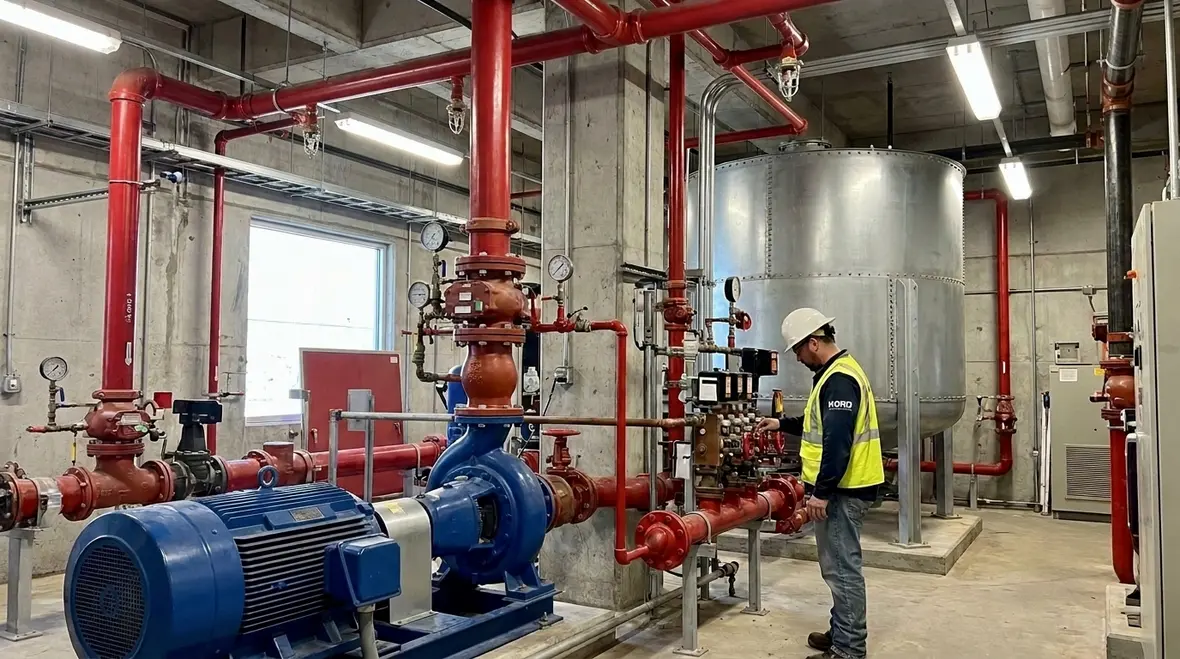
NFPA 15 Section 1.5 Equivalency: Substituting Superior Systems and Methods in Fire Protection
Quick Answer
NFPA 15 Section 1.5 allows an Authority Having Jurisdiction to accept alternative fire protection systems or methods when they can demonstrate superior performance. To qualify, the proposal must address hazard conditions, water delivery performance, reliability, and ongoing maintenance to achieve strength and effectiveness comparable to, or better than, the standard approach.
Why NFPA 15 1.5 equivalency matters for commercial facilities
Commercial, industrial, and retail facilities often face constraints that make strict “as written” compliance challenging, such as legacy piping layouts, limited ceiling space, phased renovations, process modifications, and occupant workflow requirements. In those situations, NFPA 15 1.5 equivalency can support a compliant path forward when a design team can show the proposed approach provides NFPA 15 1.5 equivalency superior quality strength effectiveness, with measurable reliability and defensible inspection and maintenance practices.
This article explains how equivalency is evaluated, what information is typically required, where projects fail during approval, and how ongoing service and testing reduce the risk of noncompliance. If you are also reviewing broader commercial fire suppression services, it helps to connect equivalency planning with long term inspection, testing, and maintenance support early in the process. ([kordfire.com](https://kordfire.com/fire-suppression/?utm_source=openai))
What Section 1.5 equivalency demands from the proposal
NFPA 15 Section 1.5 provides a mechanism to substitute systems and methods when they achieve a performance level at least equivalent to the standard requirements. The key word is equivalency, and the burden of proof generally rests with the applicant. The Authority Having Jurisdiction evaluates whether the alternative method maintains or improves fire control outcomes under the specific hazard profile.
Equivalency is not a “paper exercise”
Approvals commonly fail when a submittal focuses only on engineering narrative or brand preference. The AHJ expects evidence that the alternative system will perform as intended during a real fire event, including water supply behavior, spray distribution, and actuation reliability. The proposal should clearly connect performance claims to the hazard and to NFPA 15 design intent.
Performance areas that usually need justification
-
Suppression effectiveness: Demonstrate how the alternative delivers water to the target area, including spray pattern, coverage, and potential water losses.
-
Reliability of actuation: Address detection and control logic, valve operation time, and fail-safe behavior under credible conditions.
-
System hydraulic performance: Provide hydraulic calculations that reflect real elevations, pipe roughness assumptions, strainers, valves, and obstructions.
-
Water supply capability: Confirm pump performance, tank sizing behavior (where applicable), and pressure and flow stability under demand.
-
Inspection and maintenance feasibility: Show the facility can maintain the system to preserve performance over time.
Where equivalency requests most often arise in water spray systems
Equivalency is commonly requested for practical field realities. The most defensible submittals tie the alternative method to measurable performance results and to a maintenance plan that keeps the system within design tolerances.
1) Modifying spray layout and protection boundaries
In renovations, ceilings may become open or partially blocked, and obstructions can change spray coverage. An equivalency request may propose alternative placement, different spray nozzle types, or revised piping routes. The project team should verify that coverage remains consistent with hazard requirements and that obstructions do not create untreated pockets.
2) Substituting nozzle types or distribution methods
Different nozzle configurations can influence spray angle, droplet characteristics, and drainage behavior. Equivalency should address whether the nozzle substitution maintains effective water application and mitigates new failure points, such as clogging susceptibility or drainage pattern changes that reduce wetting of target surfaces.
3) Alternative detection, zoning, or actuation strategies
Some facilities require minimal disruption during commissioning, or operations demand selective operation. While zoning and control changes can be workable, the AHJ typically expects evidence of timely operation and correct water demand coordination. Any change to actuation must be paired with demonstrated valve performance and verified timing under credible system conditions.
4) Water supply or pump arrangement constraints
Older buildings may have limited floor loads, insufficient pump room space, or pump configurations that complicate “straight” compliance. In these cases, an equivalency proposal should document pump curve suitability, system static and residual pressure behavior, and the ability to sustain demand flow. This is also where maintenance readiness matters most.
How equivalency holds up during inspection, testing, and maintenance
Even when design intent looks sound, field performance often depends on what maintenance teams can reliably execute. AHJs commonly look for inspection and test methods that validate the alternative system’s ongoing ability to deliver the required performance. A strong equivalency strategy includes service procedures, documented test intervals, and clear responsibilities.
Operational mechanisms the AHJ will expect to be verifiable
-
Valves and actuation components: Check for correct alignment, mechanical integrity, and proper operation under flow and supervisory conditions.
-
Nozzle cleanliness and flow stability: Identify strainer maintenance, flushing practices, and the susceptibility to debris in the plant environment.
-
Hydraulic stability: Confirm that actual field conditions match the model assumptions, including elevation changes and pressure drops through assemblies.
-
Control logic correctness: Verify that the system resets and coordinates with alarms and supervisory signals as intended.
Common failure points that undermine “superior quality strength effectiveness” claims
-
Overlooked obstructions: HVAC modifications or rack expansions create areas where spray cannot reach required surfaces.
-
Unverified strainer loading and flow losses: Performance degrades when filtration is not maintained to the required standard.
-
Hydraulic assumptions that do not match the as built condition: Differences in pipe routing, fittings, or valve types can change pressure and flow at nozzles.
-
Maintenance gaps: If the alternative relies on specialized components that are not regularly inspected or stocked, equivalency becomes difficult to sustain.
Practical equivalency support also includes documenting test history and ensuring that service providers can verify flow, inspect nozzles, and confirm pump and control performance. Kord Fire Protection supports commercial compliance through ongoing testing, inspection readiness, and water spray fixed system maintenance planning. For related water spray system concepts, see NFPA 15 enhancing fire safety with water spray fixed systems.
What to include in an equivalency submittal (so it gets approved)
A well prepared NFPA 15 1.5 equivalency package reduces review cycles and avoids last minute redesign. The goal is to provide enough evidence for the AHJ to conclude the alternative offers superior quality strength effectiveness for the specific hazard.
Recommended documentation elements
-
Clear hazard description: Include commodities, storage configuration, fire load characteristics, ventilation conditions, and credible ignition scenarios.
-
Design comparison: Explain what differs from the standard approach and why the alternative improves or maintains performance.
-
Hydraulic analysis: Provide pressure and flow calculations reflecting as built elevations, friction factors, fittings, valves, and demand conditions.
-
Water delivery evidence: Present coverage logic, spray distribution rationale, and drainage or wetting considerations based on the alternative nozzle or layout.
-
Reliability and actuation basis: Describe valve operation, control sequencing, supervisory monitoring, and reset behavior.
-
Inspection and maintenance plan: Define test procedures, inspection frequency, nozzle and strainer cleaning processes, and recordkeeping.
-
Commissioning and acceptance criteria: Identify measurable acceptance outcomes, not only narrative requirements.
Use independent standards and references where helpful
When addressing water supply performance and pump considerations, referencing reputable industry resources can strengthen credibility. For broader background on fire pump system fundamentals, consider Fire Pumps information at firepumps.org. ([kordfire.com](https://kordfire.com/nfpa-15-section-8-4-water-supply-information-for-spray-systems/?utm_source=openai))
How service partners reduce compliance risk after approval
Equivalency does not end at plan review. The facility must sustain the design performance through routine maintenance, inspection testing, and timely corrective action. Commercial and industrial environments add complexity through vibration, dust load, humidity cycles, and workflow restrictions, which can accelerate wear or clogging.
Kord Fire Protection supports ongoing NFPA 15 readiness by aligning field practices with the performance basis used for approval. That includes maintaining water spray fixed system components, verifying operational readiness, supporting maintenance documentation, and helping facility teams prevent the most common failure points that reduce actual discharge effectiveness over time. Related reading like NFPA 15 Section 5.1 general system components requirements and NFPA 15 Section 8.4 water supply information for spray systems fits naturally here if you are comparing design intent with field maintainability. ([kordfire.com](https://kordfire.com/nfpa-15-section-5-1-general-system-components-requirements/?utm_source=openai))
Working with experienced commercial technicians also helps ensure that the alternative method remains maintainable. That maintainability supports the “superior quality strength effectiveness” claim not only during commissioning but throughout the life of the system. Kord Fire describes its broader service model around inspections, installations, repairs, and preventive maintenance for commercial and industrial properties on its main service pages. ([kordfire.com](https://kordfire.com/fire-suppression/?utm_source=openai))
Frequently Asked Questions
Next step: validate your NFPA 15 1.5 equivalency path early
If your project needs an alternative approach, confirm the performance basis and maintenance strategy before installation so the AHJ can evaluate it confidently. Kord Fire Protection helps commercial facilities build defensible submittals and sustain system effectiveness through inspection, testing, and ongoing water spray fixed system service. Contact Kord Fire Protection to review your proposal and identify the highest risk gaps early in the process. ([kordfire.com](https://kordfire.com/fire-suppression/?utm_source=openai))

Join Our Newsletter!
Get the latest fire safety tips delivered straight to your inbox From our Newsletter.



