
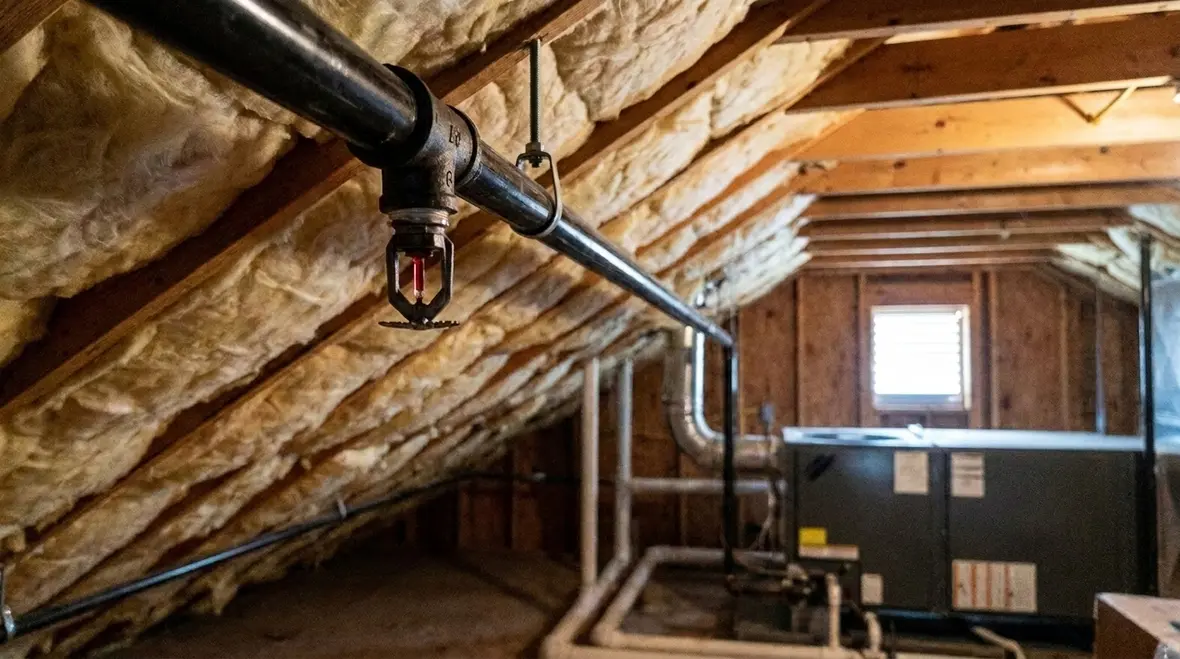
NFPA 13R Section 7.4: Do You Need Sprinklers in Your Attic? Attic Protection Requirements
Quick Answer
NFPA 13R Section 7.4 can require sprinklers in attics depending on attic construction, protection features, and hazards present. When the attic contains or supports specific fire loads or fuel fired equipment, compliance often drives attic sprinkler installation, layout, and inspection readiness.
Why NFPA 13R 7.4 attic rules matter to real buildings
Commercial facilities and multi family occupancies frequently treat attics as “non hazard storage” spaces. NFPA 13R 7.4 challenges that assumption by setting conditions for when the sprinkler system must extend into attics. In practice, the decision impacts ceiling clearance requirements, sprinkler head selection, branch line routing, and ongoing inspections.
For teams managing life safety compliance, the attic question usually becomes urgent when a building has concealed spaces, partial finishes, HVAC routing, or fuel-fired equipment located in or serving the attic. In those cases, meeting NFPA 13R 7.4 attic sprinkler requirements fuel-fired equipment expectations prevents delayed corrections during inspection, insurance review, or occupancy change.
If you’re reviewing how attic sprinkler design fits into broader system service and upkeep, Kord Fire Protection’s fire sprinkler service page gives useful context on keeping systems reliable, compliant, and ready when it matters.
What Section 7.4 is trying to prevent
Attics create fast fire growth potential because heat and smoke move quickly through concealed spaces. Even when the main living areas are protected, a fire that ignites in the roof cavity or attic duct spaces may feed oxygen through ventilation paths, then spread vertically or horizontally before occupants can detect and control the incident.
Section 7.4 focuses on the ability of sprinklers to reach and control fire in these concealed spaces. When conditions indicate that the attic is not sufficiently isolated, sprinkler protection in the attic becomes the practical means to limit spread and reduce heat release rates, improving survivability and firefighter effectiveness.
So when does an attic need sprinklers under NFPA 13R 7.4?
NFPA 13R 7.4 is not a blanket “all attics require sprinklers” rule. It relies on attic configuration and the presence of fire hazards that justify detection and suppression where the fire can develop. Facility teams typically evaluate the following elements during code review and sprinkler layout:
- Attic use and occupancy: Storage, maintenance staging, or equipment spaces can raise the required level of protection.
- Concealment and airflow paths: Duct runs, ventilated cavities, soffit openings, and large unbroken voids can allow rapid spread.
- Fire load characteristics: Construction materials, typical storage items, and how the attic is maintained.
- Fuel fired equipment and its location: When fuel fired equipment is in or directly connected to the attic, sprinkler protection becomes a compliance driver for fuel fired equipment exposure.
- Compartmentation and separation effectiveness: Incomplete barriers, penetrations, or missing fire stopping undermines the concept of isolation.
From a plan review perspective, the “when” question often becomes a documentation and detailing exercise. The most common outcomes include either attic sprinklers are required due to hazard and accessibility limitations, or alternative construction features are shown to reduce the need for suppression in that void.
Fuel fired equipment in the attic: where projects get tripped up
Fuel fired equipment adds both ignition potential and heat release uncertainty. Even when combustion products and venting are correctly installed, failure modes can include flame rollout, blocked venting, cracked heat exchangers, duct leakage, or surrounding combustible contamination. When this equipment sits in or serves the attic, inspectors typically expect suppression capability where ignition and spread could occur.
Common compliance challenges during attic sprinkler design
- Sprinkler placement conflicts with slopes and obstructions: Roof framing, insulation baffles, and ductwork reduce available coverage. Designers must maintain proper distances, spray pattern intent, and spacing controls.
- Freeze protection and temperature exposure: Attics may be unconditioned or partially conditioned. That drives insulation allowances, heat tracing considerations, and selection of sprinkler temperature ratings where applicable.
- Insulation installation practices: Insulation can block sprinkler discharge characteristics and reduce effective coverage if not installed per requirements. Maintenance teams must prevent “retrofit insulation drift.”
- Hidden piping runs and access limitations: If pipe routing is not planned for future testing access, the building can face long inspection delays or costly retrofits.
- Penetrations and fire stopping: Sprinkler piping and electrical conduits create penetrations that require proper sealing. Poor fire stopping can negate compartmentation arguments.
Commercial facilities that run maintenance and changeouts over time often see the hazard evolve. For example, a “light equipment” space can become a storage area after HVAC service cycles. That operational drift increases the probability that the inspector will evaluate attic protection as necessary to satisfy NFPA 13R 7.4 attic sprinkler requirements fuel-fired equipment expectations.
How systems get installed, inspected, and kept compliant in attics
Attic sprinkler systems succeed when the installation supports not just code at acceptance, but operational reliability over the building life. This means rigorous attention to routing, clearances, commissioning, and ongoing inspection readiness.
Installation mechanisms that impact performance
- Branch line layout and coverage intent: Attic geometry can cause dead zones if heads are clustered without respect to spray pattern and obstruction rules.
- Pipe support and restraint: Concealed spaces often tempt under supported piping. Vibration from rooftop equipment and building movement can stress fittings.
- Valve placement for accessibility: Inspectors and technicians require workable access. If valves, drains, or test connections are buried, inspection timelines expand.
- Identification and as built documentation: Attics hide components. Labels, correct orientation, and accurate floor plan drawings reduce service errors and speed future testing.
Inspection and testing: the operational reality
Sprinkler performance depends on the system remaining unobstructed and properly maintained. Common failure points include partial blockage by stored materials, accumulated dust, insulation displacement over time, or failed repairs during renovations.
Professional inspection programs typically include:
- Visual checks for physical obstructions at the sprinkler level.
- Verification of water supply capacity where any attic sprinkler addition changes flow demand.
- Maintaining clear access to drains, inspector test connections, and any dedicated check valves.
- Review of changes in attic usage or equipment placement, especially around fuel-fired equipment.
For a practical system baseline and installation context, facility teams can reference this overview: NFPA 13 overview for automatic fire sprinkler system installation. While NFPA 13R has its own scope, the fundamentals of layout intent, installation quality, and commissioning practices translate directly into attic protection execution.
How to plan attic sprinkler compliance for commercial, industrial, and retail operations
Attic protection decisions often come late in the project when drawings are finalized or equipment is already purchased. A better approach begins with a structured hazard and access review, paired with a maintenance ready design.
Recommended compliance workflow
- Attic hazard audit: Identify storage practices, HVAC routing, penetrations, and the presence or service pathway of fuel-fired equipment.
- Construction review: Confirm insulation approach, compartment boundaries, and how the roof cavity will function during a fire scenario.
- Sprinkler layout pre check: Evaluate head spacing, obstruction tolerances, and pipe access so inspection testing remains practical.
- Water supply and demand confirmation: Verify that any attic extension stays within the system design limits and does not create unexpected flow issues.
- Maintenance plan: Document “do not block” conditions, coordinate access panels, and set expectations for future insulation or renovation work.
Kord Fire Protection supports these steps with commercial focused service planning. For facilities that need ongoing compliance, testing, and maintenance coordination, a continuous service partner reduces the risk of losing protection due to renovation work, equipment relocations, or insulation changes. That type of prevention is especially important when NFPA 13R 7.4 attic sprinkler requirements fuel-fired equipment considerations are in play.
Additional guidance and cross checks
Sprinkler system pump and water supply considerations often connect to attic protection because any added heads and piping increases demand and affects inspection testing. For additional water supply context, teams may consult: BS EN 12845 water supply for fire pumps guide.
When combined with a focused attic hazard audit, these cross checks help ensure the system remains reliable under both initial acceptance and routine recurring inspections.
Frequently Asked Questions
Next step: confirm attic requirements before the inspector arrives
Attic sprinkler compliance is easiest when teams verify attic hazards, fuel fired equipment interfaces, and access requirements early. Kord Fire Protection can support plan review guidance, installation coordination, and ongoing inspection readiness so your system meets NFPA 13R 7.4 attic sprinkler requirements fuel-fired equipment expectations. Contact Kord Fire Protection to schedule a compliance focused attic and system review, then lock in a maintenance plan that prevents concealed space issues from returning during future renovations.

Join Our Newsletter!
Get the latest fire safety tips delivered straight to your inbox From our Newsletter.



